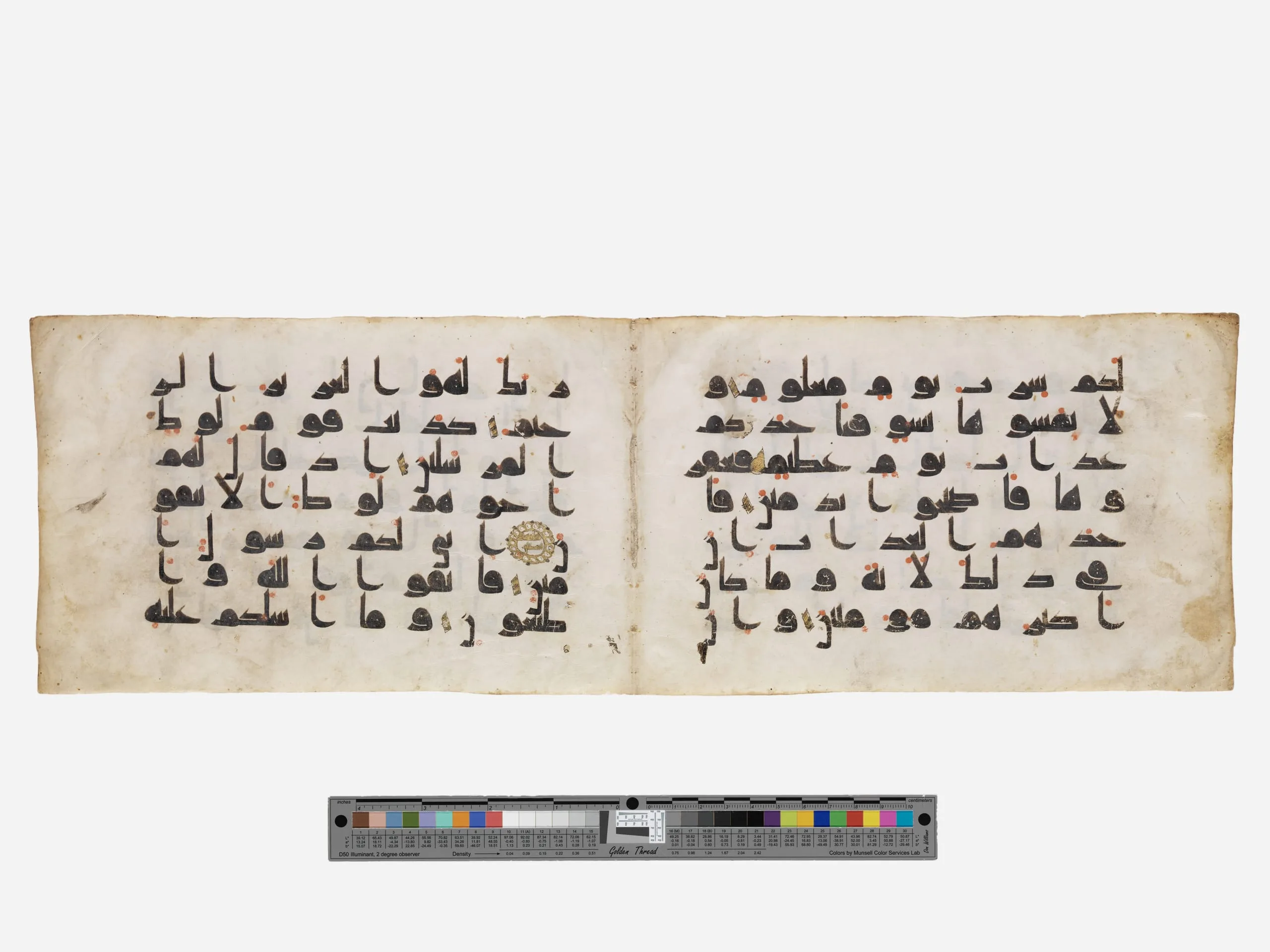
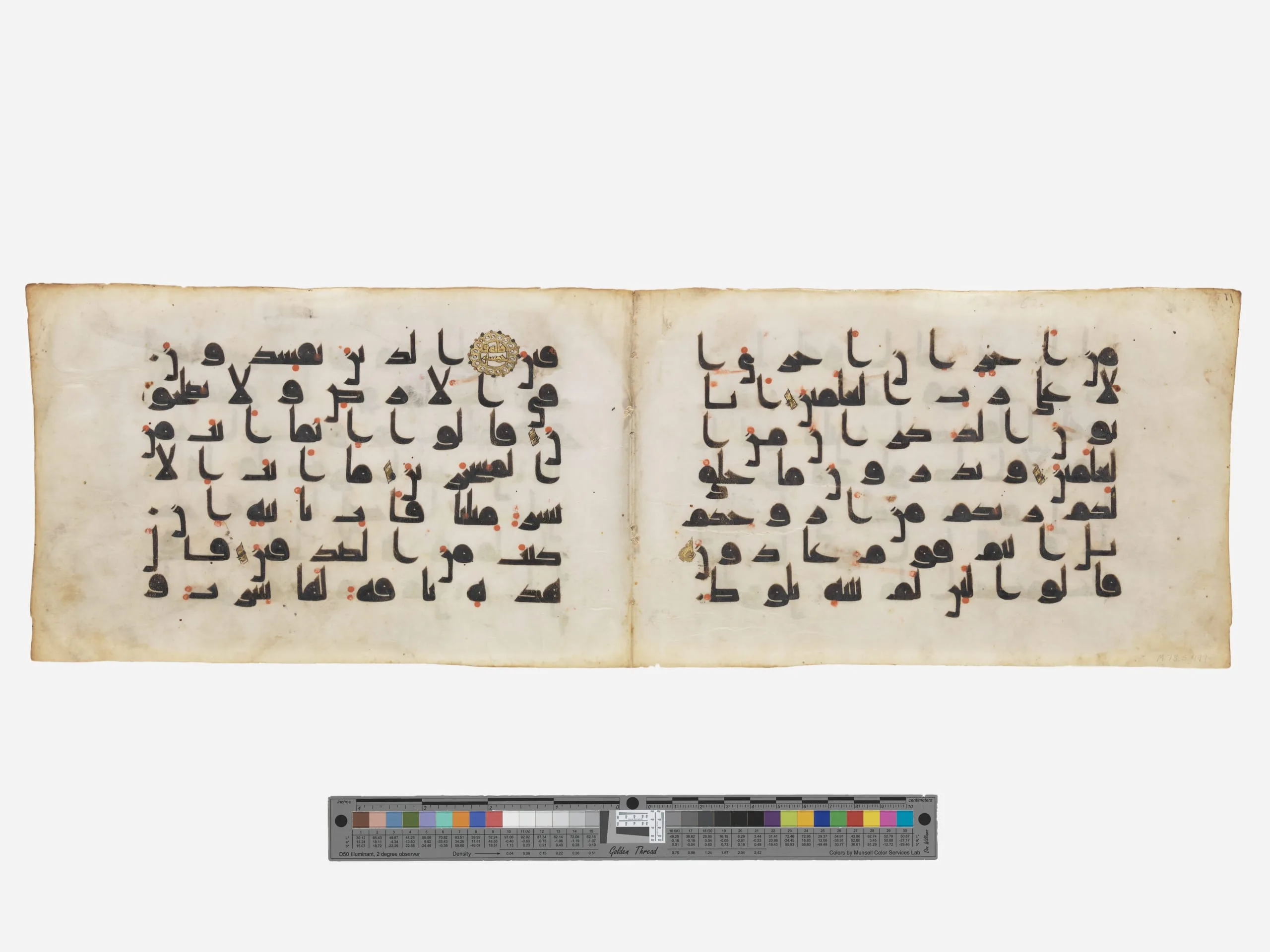
- Title
- Two Pages from a Manuscript of the Qur'an (26:151-55; 26:155-59; 26:159-64; 26:164-67)
- Date Made
- 9th-10th century
- Medium
- Ink and gold on parchment
- Dimensions
- unspecified (unspecified): 5 3/4 × 18 1/4 in. (14.61 × 46.36 cm)
- Accession Number
- M.73.5.499
- Curatorial Notes
In Muslim cultures, words are used not only to communicate but to decorate. Because it is through writing that the Qur’an is transmitted, scripts in the Arabic alphabet were devised and perfected to be worthy of divine revelation. By the late eighth century, manuscripts of the Qur’an had achieved a standard format rendered in parchment, made from cured and scraped animal skin, generally sheep, and configured and bound as a codex or book. These two facing pages are from an illuminated Qur’an dating to the ‘Abbasid period. Copied in rectilinear kufic script, each folio has seven lines of text written in dark brown ink, with the short vowels indicated by red dots. Such early Qur’anic manuscripts are today challenging to read for those unfamiliar with text lacking the dots or letter-pointing that, from the eleventh century onward, were used to distinguish one consonant from another.
- Selected Bibliography
- Pal, Pratapaditya, ed. Islamic Art: The Nasli M. Heeramaneck Collection. Los Angeles: Museum Associates, 1973.
- Komaroff, Linda. Islamic Art at the Los Angeles County Museum of Art. Los Angeles: Museum Associates, 2005.
- Komaroff, Linda. Beauty and Identity: Islamic Art from the Los Angeles County Museum of Art. Los Angeles: Los Angeles County Museum of Art, 2016.