- Title
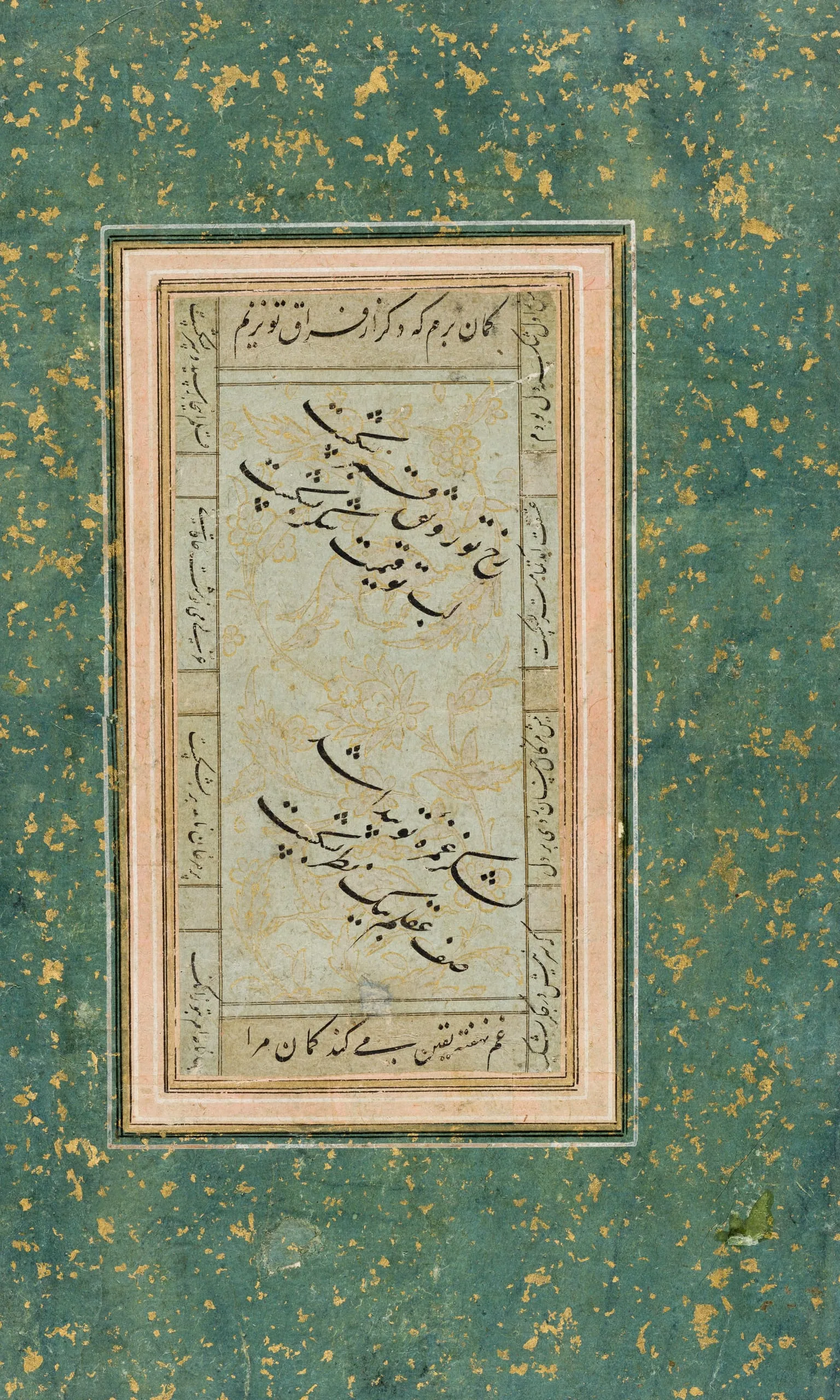
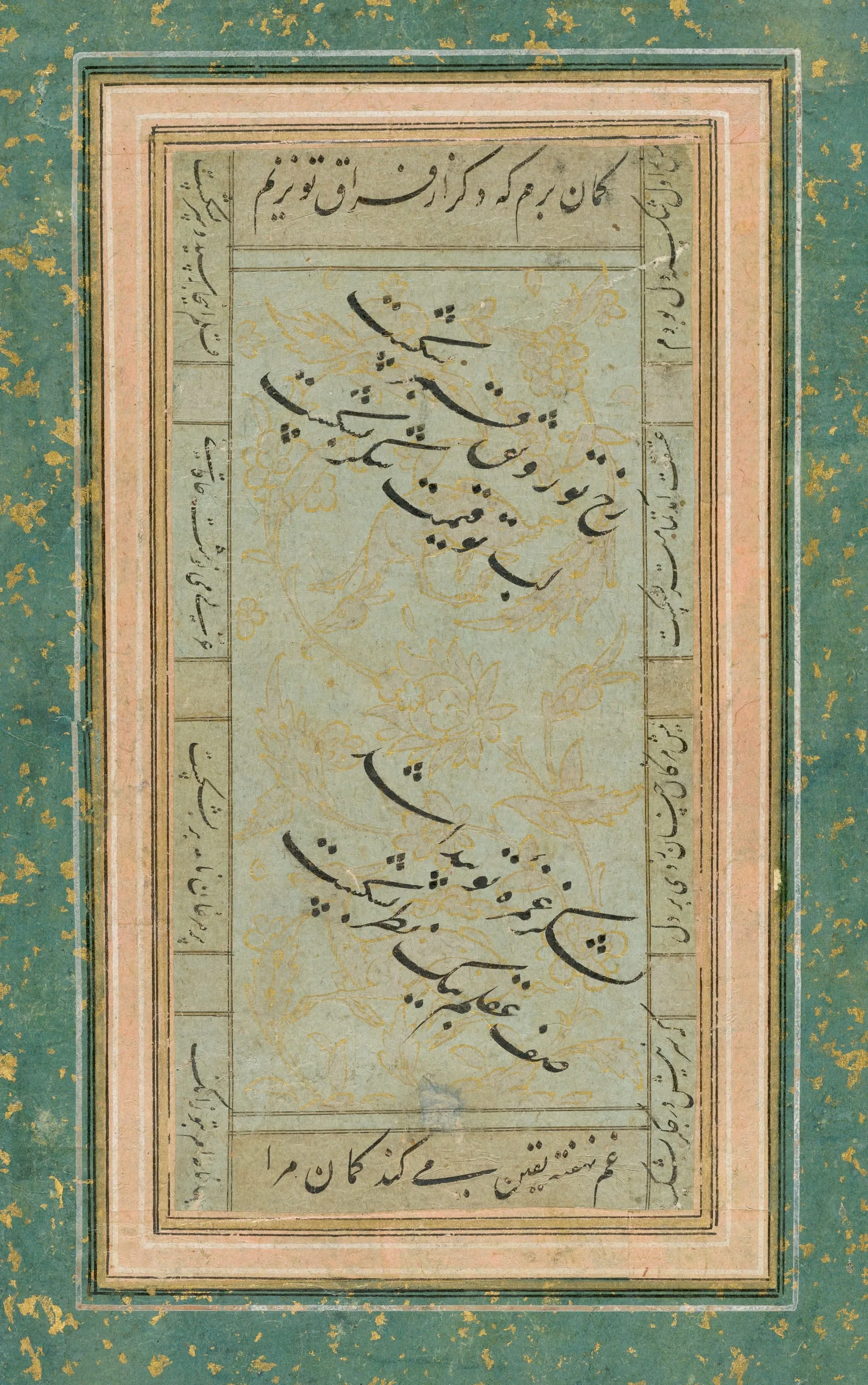
- Page of Calligraphy from an Album
- Date Made
- 16th century
- Medium
- Ink, opaque watercolor, and gold on paper
- Dimensions
- 11 1/4 × 7 1/8 in. (28.58 × 18.1 cm)
- Accession Number
- M.73.5.784
- Curatorial Notes
This album page showcases verses of Persian love poetry written in nasta‘liq, a distinctive type of hanging script developed in late fourteenth-century Iran, with verses by Khaqani (d. 1190) and Amir Khusraw Dihlavi (d. 1325). The text is embellished with stylized floral and leaf designs and remounted into gold-flecked margins—a common practice for albums collected by the court and wealthy elite. The versatility of nasta‘liq allowed for various compositional formats, including the chalipa style seen here, which features four diagonal lines of poetry in the center surrounded by a border of additional verses.
Nasta‘liq was used primarily for copying Persian poetry not only on paper but also in inscriptions on a variety of objects (see M.73.5.340). It became the principal calligraphic script in Persian-literate regions, including Iran, Central Asia, Anatolia, and India (where it sometimes was used to render Turkic and Indic languages). Renowned for its elegance, it was an integral part of Persian artistic expression, not just as a writing system but as a visual art form that encapsulates the beauty of the Persian language and the depth of its literary traditions, as demonstrated by this specimen.
2024