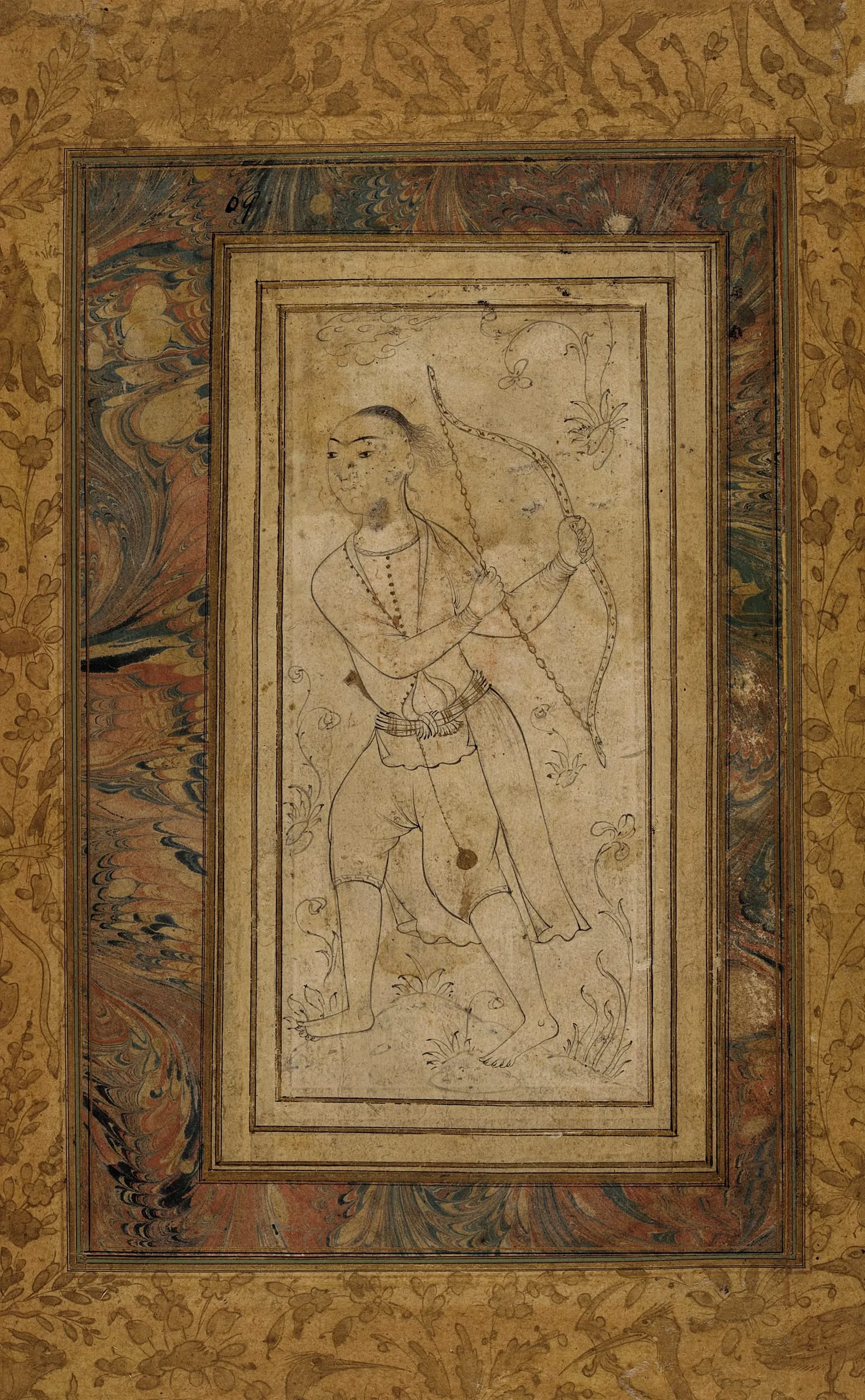
In the late sixteenth century, a new type of painting emerged in Iran that favored individual subjects painted on a single folio, with no relation to a narrative text, as had been the prior tradition. Such single-page compositions reached their peak in popularity during the seventeenth century at Isfahan, the capital of the Safavid dynasty, which blossomed into a commercial and cultural hub. No longer confined by court patronage, artists found a willing market among the cultivated social elite, producing popular themes such as depictions of youths like this one. These paintings were often enjoyed individually or gathered in an album known as a muraqq‘a.
Although this figure holds a bow, he is not an archer but a dancer accompanying himself on an instrument. The “string” of the bow is a chain, which could be used to produce sound. In some cases, bells were hung along the chain or the bow’s bent wood frame, adding to its musical possibilities. Here, a bell instead hangs from the dancer’s waist sash, which would have made sound as the youth moved. In addition to his instrument, the figure’s appearance also indicates he is a performer. Such beardless young men are frequently shown in paintings with partially shaved heads and long hair on top, and typically wearing short trousers and a belted robe so that the front of the waist is exposed, likely to aid and emphasize their body movements.
2025