LACMA

ShopMembershipMyLACMATickets
LACMA
Los Angeles County Museum of Art
5905 Wilshire Blvd.
Los Angeles, CA 90036
info@lacma.org
(323) 857-6000
Sign up to receive emails
Subscribe
© Museum Associates 2026
  • About LACMA
  • Jobs
  • Building LACMA
  • Host An Event
  • Unframed
  • Press
  • FAQs
  • Log in to MyLACMA
  • Privacy Policy
© Museum Associates 2026
Collections

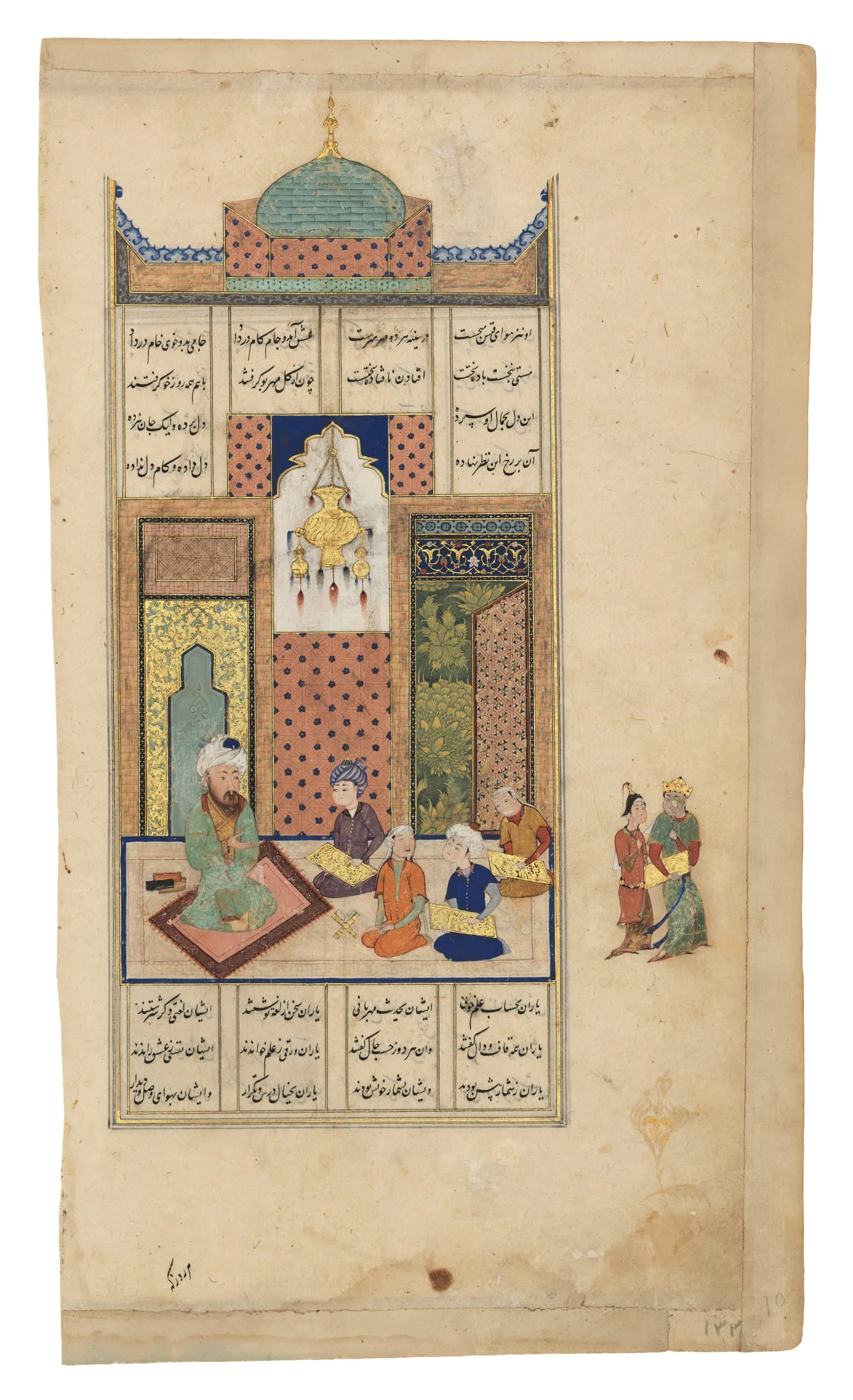
Layla and Majnun at School, Page from a Manuscript of the Khamsa (Quintet) of Nizami1517/ AH 924

Not on view
Persian illustrated manuscript page with miniature painting of four robed, turbaned figures seated inside an ornate domed interior, surrounded by columns of Persian script

Unknown, Layla and Majnun at School, Page from a Manuscript of the Khamsa (Quintet) of Nizami, 1517/ AH 924, Los Angeles County Museum of Art, The Nasli M. Heeramaneck Collection, gift of Joan Palevsky, photo © Museum Associates/LACMA

Title
Layla and Majnun at School, Page from a Manuscript of the Khamsa (Quintet) of Nizami
Place Made
Iran, Shiraz
Date Made
1517/ AH 924
Medium
Ink, opaque watercolor, and gold on paper
Dimensions
9 1/2 x 5 1/2 in. (24.13 x 13.97 cm)
Credit Line
The Nasli M. Heeramaneck Collection, gift of Joan Palevsky
Accession Number
M.73.5.417
Classification
Manuscripts
Collecting Area
Art of the Middle East: Islamic
Curatorial Notes

While literacy rates are difficult to measure in the medieval and premodern periods, it is clear that the culture of the Islamic world was highly engaged with literature, with stories passed textually and orally, and certain characters, such as the young lovers Layla and Majnun, figuring prominently in popular culture. This folio, which once belonged to a bound manuscript of the Khamsa (Quintet) of Persian poet Nizami Ganjavi (d. 1209), depicts a scene from the story of Layla and Majnun, when the two first meet at school. Although the tale takes place on the Arabian Peninsula, the artists drew inspiration for the architecture and costumes from their own environment in sixteenth-century Shiraz, Iran, and may have also incorporated contemporaneous learning practices. Basic education, both formal and informal, was widespread in Islamic lands, with children offered lessons at home, in village schools, or at local mosques. Here, the students are learning to read from tablets under the direction of a teacher seated at left.

The manuscript to which this folio belongs was disassembled, most likely when it was brought to the art market, and its pages dispersed. LACMA holds seven of these folios (see also M.73.5.418, .421, .423, .424, and .606), including the colophon, which dates the manuscript to AH 924 (1517 CE) and lists the scribe as Muhammad Zarin-Qalam (see M.73.5.604).
Selected Bibliography
  • Pal, Pratapaditya, ed. Islamic Art: The Nasli M. Heeramaneck Collection. Los Angeles: Museum Associates, 1973.