LACMA

ShopMembershipMyLACMATickets
LACMA
Los Angeles County Museum of Art
5905 Wilshire Blvd.
Los Angeles, CA 90036
info@lacma.org
(323) 857-6000
Sign up to receive emails
Subscribe
© Museum Associates 2026
  • About LACMA
  • Jobs
  • Building LACMA
  • Host An Event
  • Unframed
  • Press
  • FAQs
  • Log in to MyLACMA
  • Privacy Policy
© Museum Associates 2026
Collections

Unknown
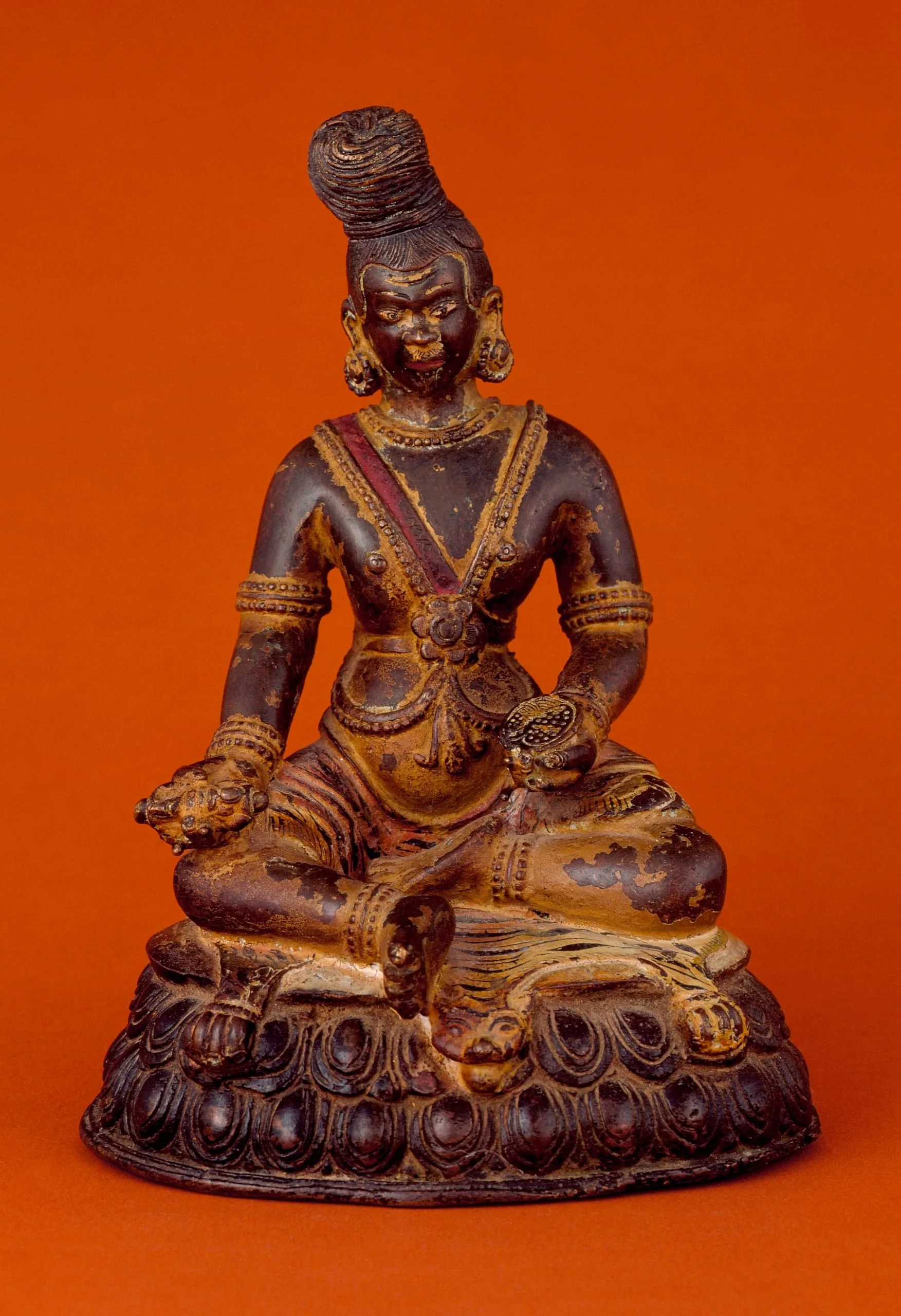
The Mahasiddha (Great Adept) Tsangnyön Heruka (1452-1507)15th century

Not on view
Small bronze sculpture, heavily patinated, of a seated cross-legged figure with a tall coiled topknot, elaborate gilded jewelry, and a wide grin, set on a double-lotus pedestal

Unknown, Tsangnyön Heruka (1452-1507), late 15th -16th century, Los Angeles County Museum of Art, From the Nasli and Alice Heeramaneck Collection, Museum Associates Purchase, photo © Museum Associates/LACMA

Artist or Maker
Unknown
Title
The Mahasiddha (Great Adept) Tsangnyön Heruka (1452-1507)
Place Made
Eastern Tibet
Date Made
15th century
Medium
Brass with paint
Dimensions
7 x 5 x 4 in. (17.78 x 12.7 x 10.16 cm)
Credit Line
From the Nasli and Alice Heeramaneck Collection, Museum Associates Purchase
Accession Number
M.73.4.14
Classification
Sculpture
Collecting Area
South and Southeast Asian Art
Curatorial Notes

The Mahasiddha (Great Adept) Tsangnyön Heruka (The Crazy Heruka of Tsang, 1452-1507) was an eccentric tantric master of the Kagyu school of Tibetan Buddhism who left the monastery to become an itinerant yogi. He also composed biographies of early Kagyu teachers, including literary works on the life and songs of the renowned Tibetan Buddhist master and yogi, Milarepa (1040-1123; see M.72.108.1, M.81.90.2, and M.82.165.2).

Tsangnyön Heruka is represented as a scowling tantric yogi with his long hair (jata) tied up in an ascetic’s tall bun. Profusely adorned with bone ornaments, he also wears a jeweled cross-chest belt (channavira) symbolic of his spiritual power and a yogic band (yogapatta) over his right shoulder. He wears a tiger skin wrapped around his waist and underneath him as a rug. He holds a thunderbolt (vajra) in his right hand, and a skullcup (kapala) in his left hand. He sits in the relaxed posture (lalita asana) on a double lotus base.

See Himalayan Art Resources, no. 85763, https://www.himalayanart.org/items/85763
Selected Bibliography
  • Pal, Pratapaditya. Art of Tibet. Los Angeles; Berkeley, CA: Los Angeles County Museum of Art; University of California Press, 1983.
  • Beguin, Gilles. Dieux et Demons de l'Himalaya: Art du Bouddhisme Lamaique. Paris: Grand Palais, 1977.
  • Reedy, Chandra L. Himalayan Bronzes: Technology, Style and Choices. Newark: University of Delaware Press, 1997.
  • Fisher, Robert E. Mystics and Mandalas: Bronzes and Paintings of Tibet and Nepal. Redlands, CA: University of Redlands, 1974.
  • Pal, Pratapaditya. Art of Tibet. Expanded edition. Los Angeles: Los Angeles County Museum of Art, 1990.
  • Pal, Pratapaditya. The Art of Tibet. New York: The Asia Society, Inc., 1969.