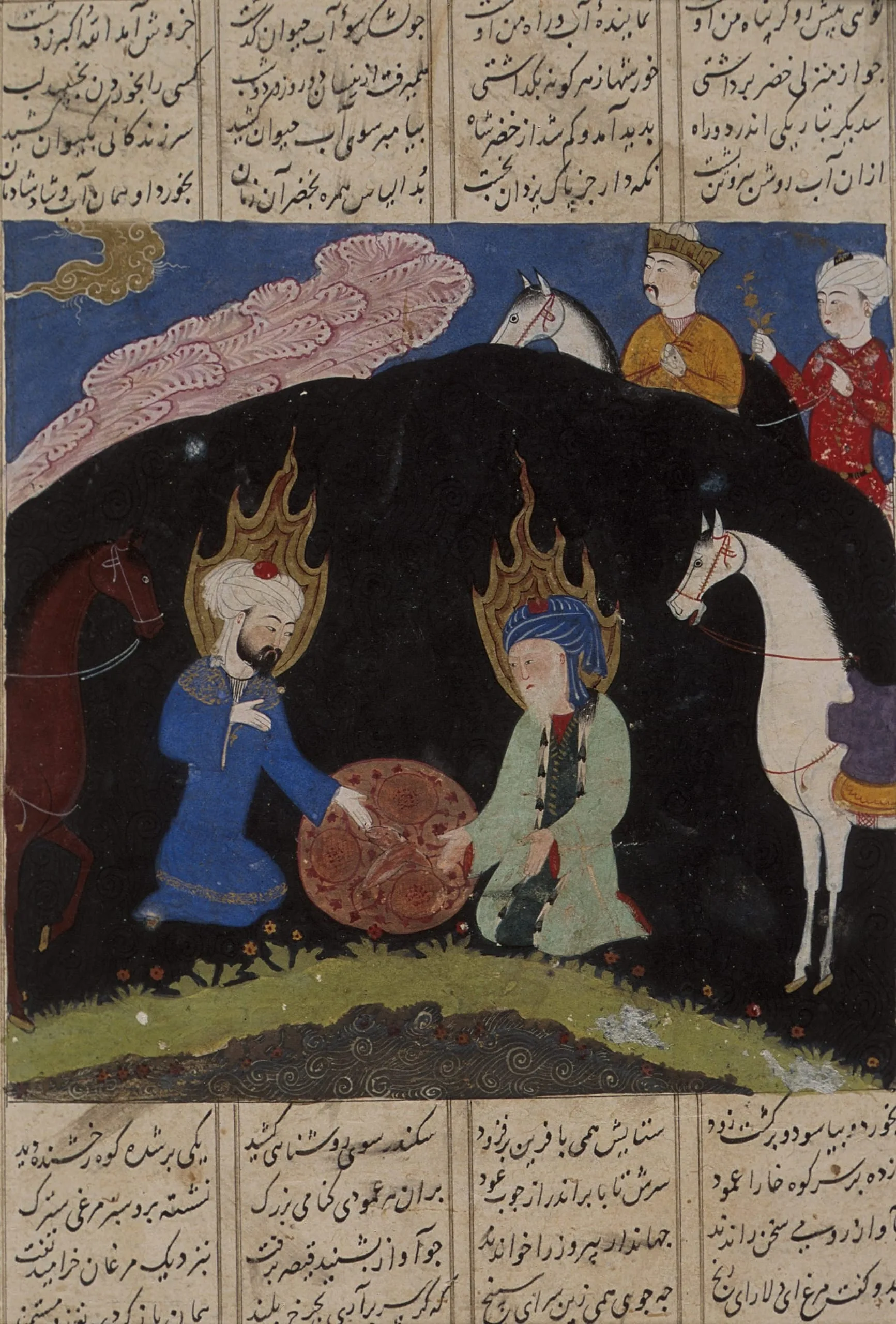
The Shahnama (Book of Kings), the Iranian national epic, was composed by Firdawsi and completed around 1010. It chronicles in verse the legendary and historical kings and heroes of the Persian Empire up to the Arab Muslim conquest in the seventh century. Illustrated manuscripts of the text, usually made under courtly patronage, only survive from the early fourteenth century onward; many of these were broken up in modern times for the sake of their paintings. Typically, the architectural settings and costumes of the depicted characters reflect the era in which the manuscript was made, drawing a connection between ancient kings and heroes and the then present-day court. On that account, the commissioning of such anachronistically illustrated manuscripts appealed to great kings and provincial rulers alike.
This painting references key moments from Alexander the Great’s pursuit of the Fountain of Life, a tale prominently featured in Persian literature, including the Shahnama, in which Alexander, known as Iskandar, is transformed into a Persian prince. The narrative unfolds across time: Iskandar and his men venture into the Land of Darkness with the prophet Khizr as their guide, although they eventually part company. As depicted in the foreground, framed against a black mountain perhaps signifying the Land of Darkness, Khizr finds and drinks from the magical spring of immortality, joined by the prophet Elias; their flaming halos emphasize their sanctity. In the background, behind the mountain and seemingly oblivious to Khizr’s discovery, Iskandar continues his futile quest along with a companion. This folio is one of seven illustrations from the same Shahnama in LACMA’s collection (see M.73.5.23, .410, .411, .413, .462, and .463).
2024