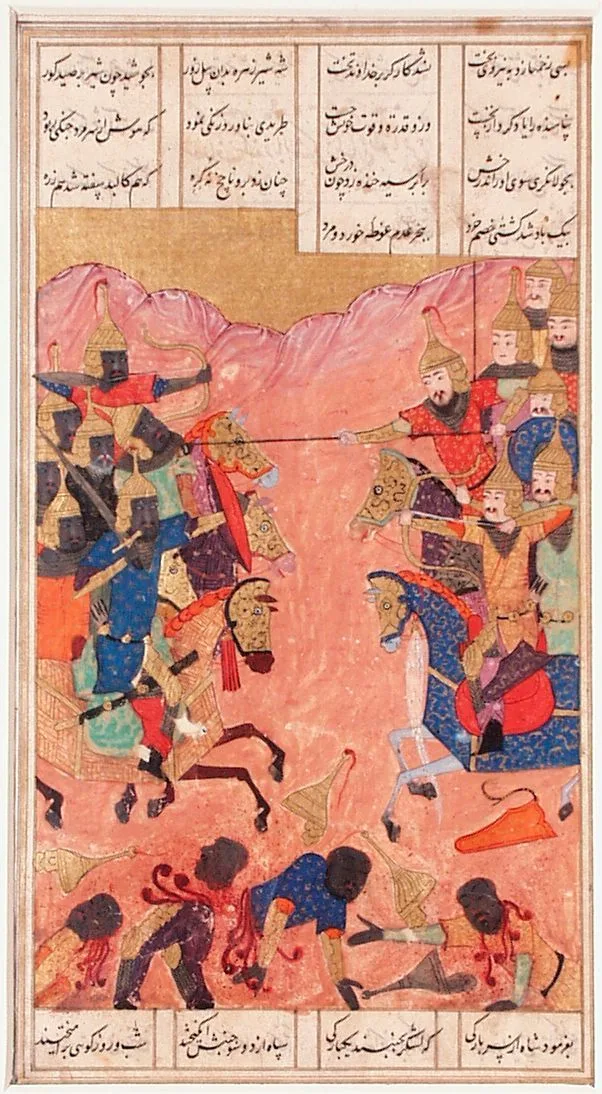
The legacy of Alexander the Great in Iranian culture was largely shaped through medieval Persian literature, most notably the Shahnama (Book of Kings) of Firdawsi, completed circa 1010, and the Iskandarnama, fifth book of the Khamsa (Quintet), composed by Nizami and completed around 1202. These literary transformations reimagine Alexander as Iskandar, a legendary monarch embedded within the long tradition of Persian kingship, while also integrating him into Islamic narratives despite his pre-Islamic origins. In Nizami’s narrative poem, Iskandar’s far-flung adventures are chronicled as the acts of a just and enlightened ruler.
This folio captures a mythological battle in which Iskandar, in defending Egypt, leads his forces against the warriors of the East African coast, known in Persian as the Zangi. The two armies clash, their champions falling one by one, until the chief of the Zangis, Palangar, faces Iskandar. As the text recounts, Iskandar, using an extra-long spear, fatally pierces Palangar’s coat of mail. The scene is rendered in the distinctive style associated with Shiraz, in which proportionally large figures fill the mountainous landscape with its high horizon and golden sky. The page layout seamlessly integrates text and image, following the Shiraz tradition, with four columns of text in nasta‘liq arranged in a stepped composition. A passage of text, placed directly above Iskandar, narrates the moment of Palangar’s death: “With a breath of wind, the bark of the enemy became wrecked; he plunged into the ocean of nothingness and perished.”
The manuscript to which this folio belonged was disassembled, most likely when it was brought to the art market, and its pages dispersed. LACMA has seven of these folios (see also M.73.5.418, .421, .423, .560, and .606), including the colophon page, which dates the manuscript to AH 924/1517 CE and is signed by the scribe Muhammad Zarin-Qalam, or “Golden Pen,” an honorific title (see M.73.5.604).
2025