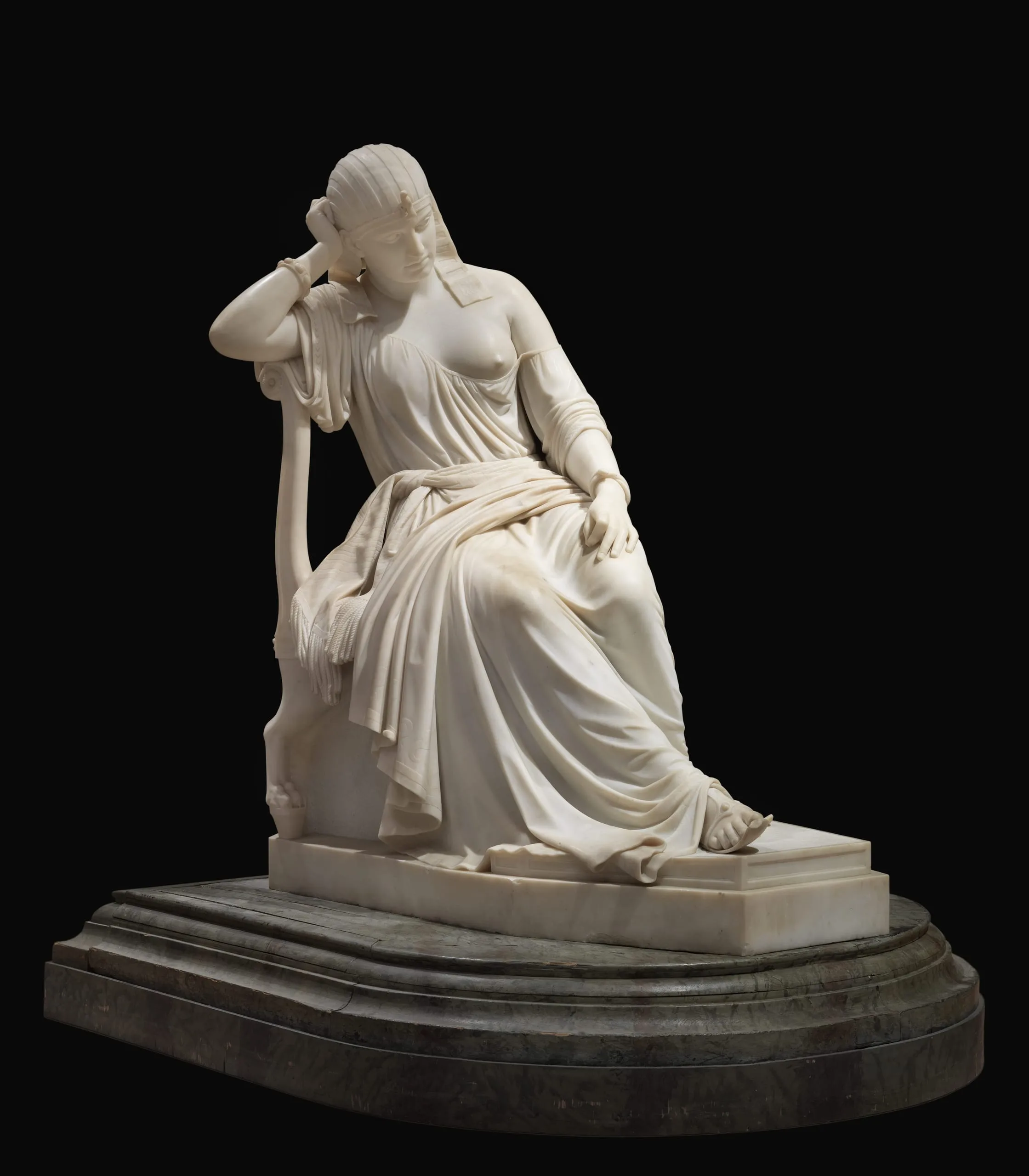
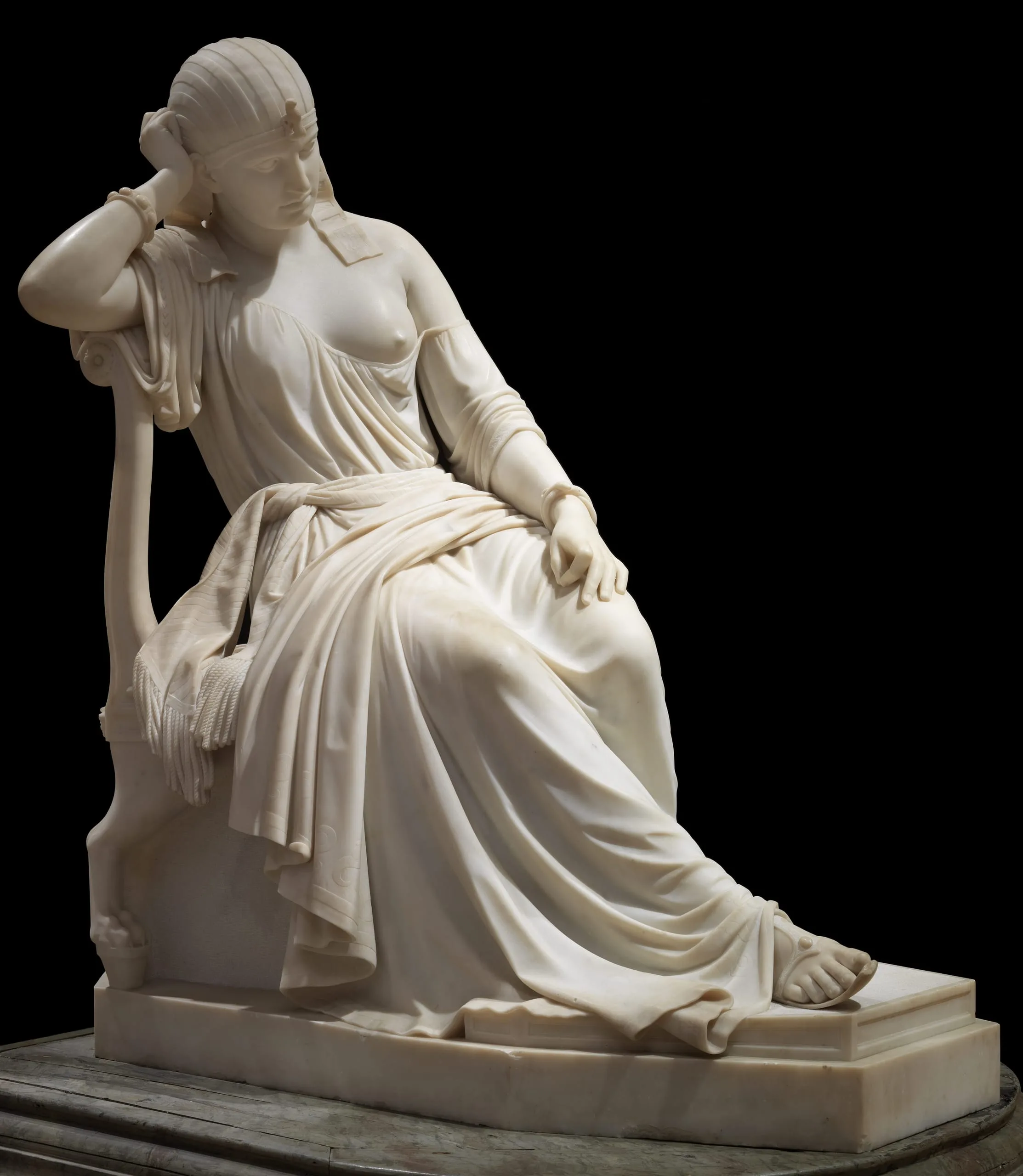
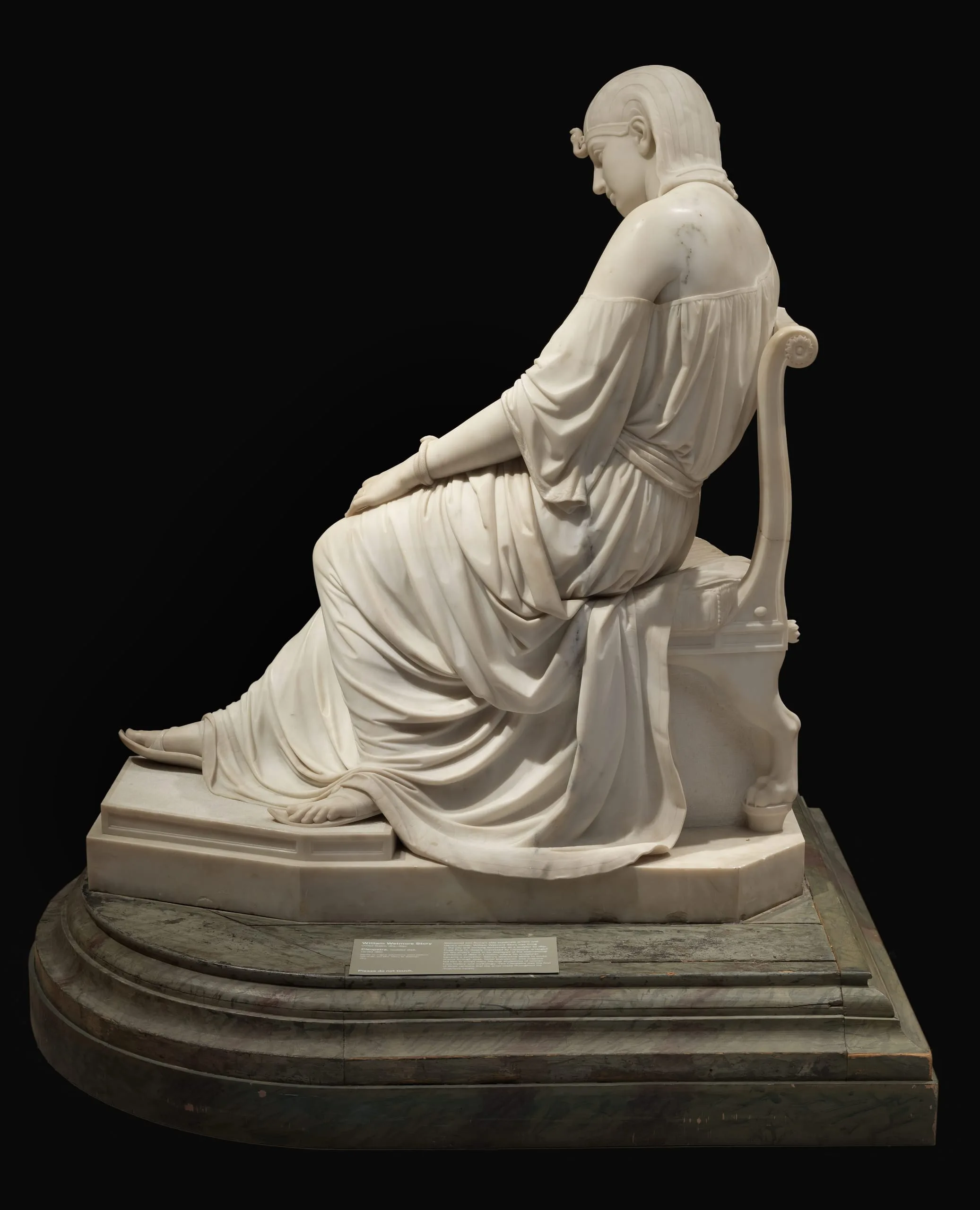
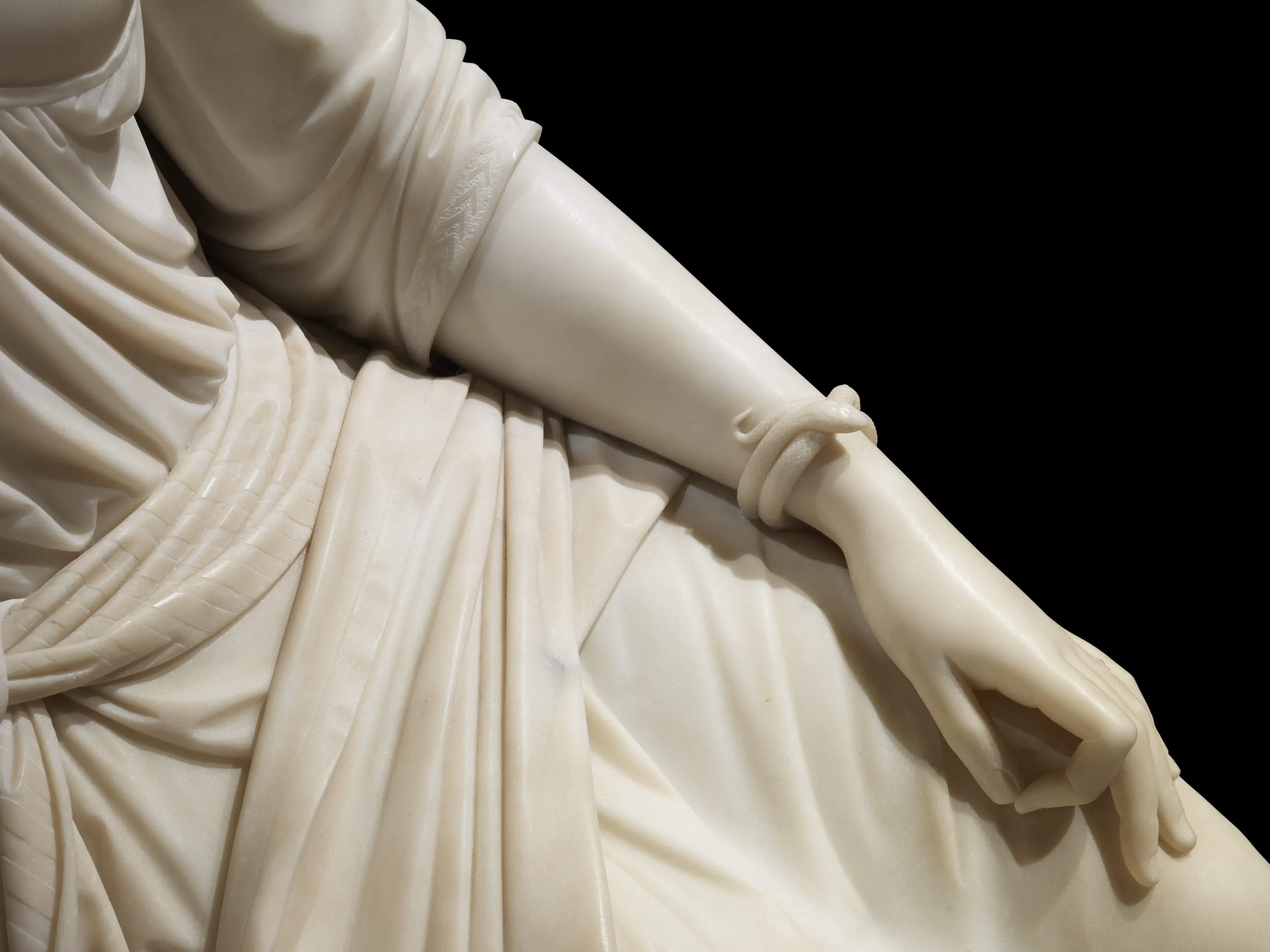
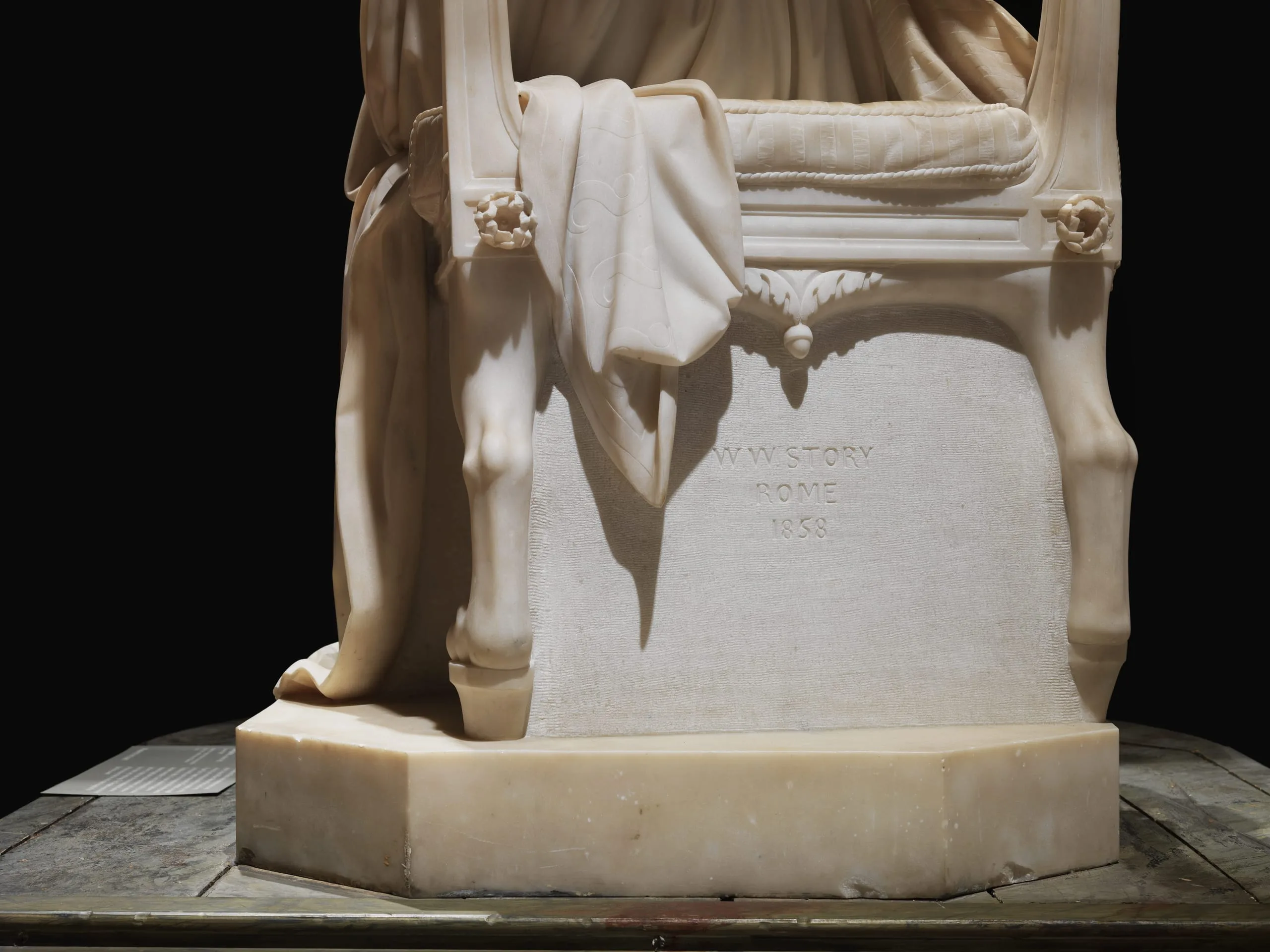
This white marble sculpture depicts a classical subject, the ancient Egyptian ruler Cleopatra. Prefiguring her death by suicide following her affair with the Roman general Mark Antony, she sits frozen in a moment of contemplation, gazing down while resting her head against her arm and baring a breast. Story’s translation of Egyptian motifs on her bracelet, clothing, head covering, and chair offer additional context about her identity. A snake, whether intended as an actual reptile or a lifelike bracelet, coils around one wrist, adding narrative detail based on the legend that Cleopatra died by the bite of a poisonous asp.
Cleopatra is charged with meaning derived not only from ancient Egypt but from the period in which Story created the sculpture while working in Rome just before the American Civil War. At the time, many viewers would have understood Cleopatra to depict a woman of Black African descent, which deviated from more common Neoclassical representations of white, European subjects. Based on this perception of Cleopatra’s race, some have interpreted abolitionist messages in the work. Scholarship further reveals how discourse about the sculpture has often referenced negative racial stereotypes and fantasies of exoticism to convey the complexity of Cleopatra’s pose, expression, and significance.
Indeed, Story’s Cleopatra drew a lot of attention and generated many opinions in its time. In his novel The Marble Faun (1860), American author Nathaniel Hawthorne wrote a fictionalized account of Story’s creation of Cleopatra that added to the sculpture’s celebrity. A few years later, Pope Pius IX sent the work, at his expense, to the 1862 International Exhibition in London along with Story’s The Libyan Sibyl (1860; The Metropolitan Museum of Art)—the latter described by the artist as his “anti-slavery sermon in stone.” LACMA’s Cleopatra is the original sculpture that traveled to London, though Story later created several slightly different versions that have further contributed to the work’s renown.
Selected Bibliography
Buick, Kirsten Pai. Child of the Fire: Mary Edmonia Lewis and the Problem of Art History’s Black and Indian Subject. Duke University Press, 2010. https://doi.org/10.2307/j.ctv11hpqbf.
Hamer, Mary. “Black and White? Viewing Cleopatra in 1862.” In The Victorians and Race, ed. Shearer West, 53−67. Scolar Press, 1996.
Nelson, Charmaine A. The Color of Stone: Sculpting the Black Female Subject in Nineteenth-Century America. New ed. University of Minnesota Press, 2007. https://www.jstor.org/stable/10.5749/j.ctttv20h.
Trafton, Scott. Egypt Land: Race and Nineteenth-Century American Egyptomania. Duke University Press, 2004. https://doi.org/10.2307/j.ctv125jndz.
Selected Exhibition History
International Exhibition, Fine Art Department, Foreign Division, Roman School, London, 1862, no. 2691, as Cleopatra Seated.