- Title
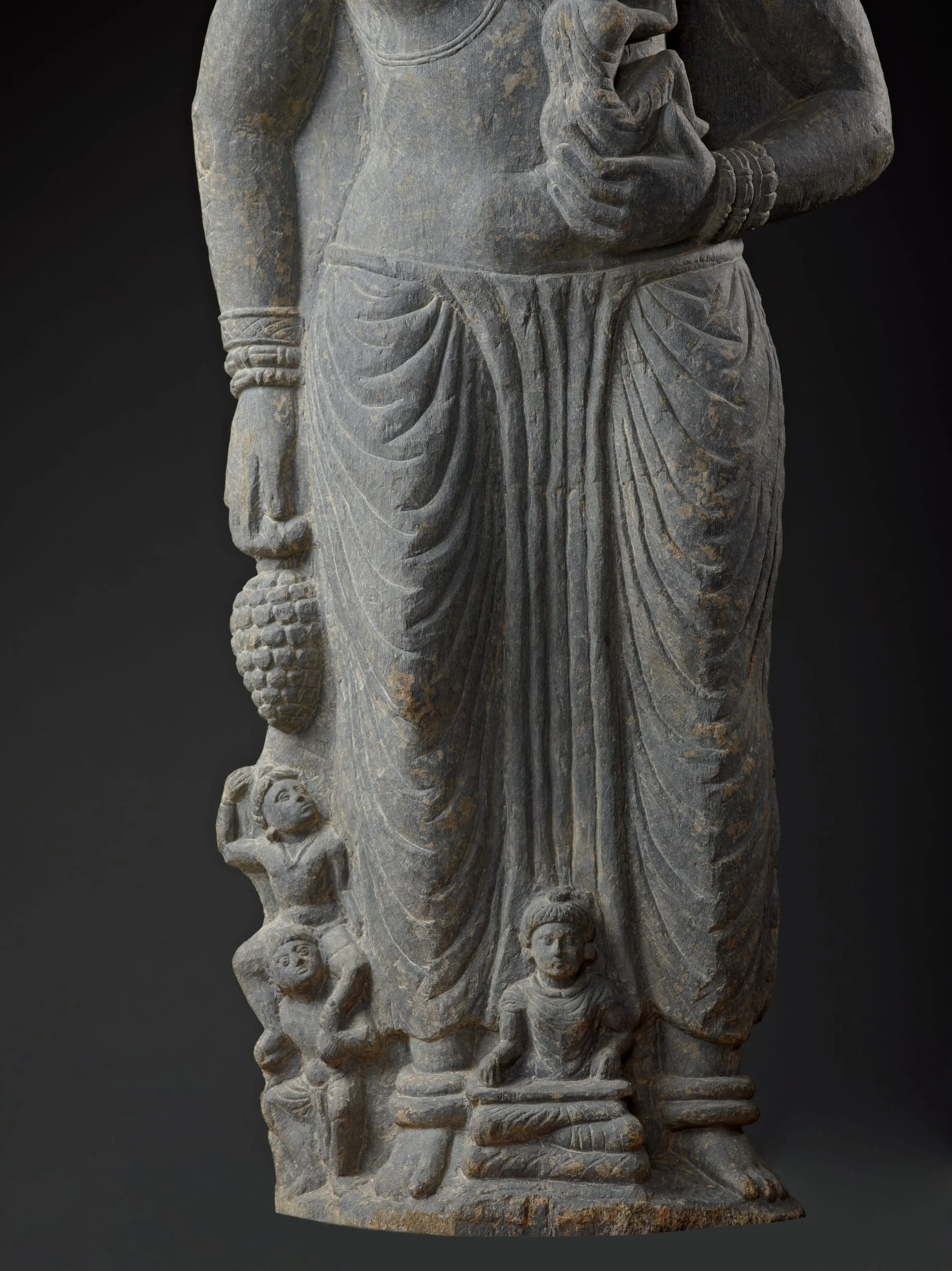
- The Buddhist Goddess Hariti with Her Children
- Date Made
- circa 1st century BCE
- Medium
- Foliated gray phyllite
- Dimensions
- 43 1/2 x 14 x 6 in. (110.49 x 35.56 x 15.24 cm)
- Accession Number
- M.78.105
- Curatorial Notes
Hariti was an ogress and queen of the demigods (yakshas) who lived in Rajagriha (modern Rajgir), Bihar when the Buddha also resided there (see also M.73.4.6 and M.83.66). Although she was a loving mother with hundreds of children herself, she abducted and devoured many of the local children. Their parents tried to propitiate her with offerings to no avail, so they appealed to the Buddha to save their children. To teach her the lesson of the pain she was causing the children’s parents, the Buddha hid her youngest son Pingala (or in some myths, her youngest daughter Priyankara) under his begging bowl. After frantically searching everywhere for her missing child, the Buddha asked her to imagine the suffering of the mothers of single children whom she had kidnapped. Hariti then converted to Buddhism, her child was returned, and thenceforth she became the revered protectress of children and women in childbirth. Hariti’s conversion reflects the absorption of fertility and spirit cults into mainstream Buddhism.
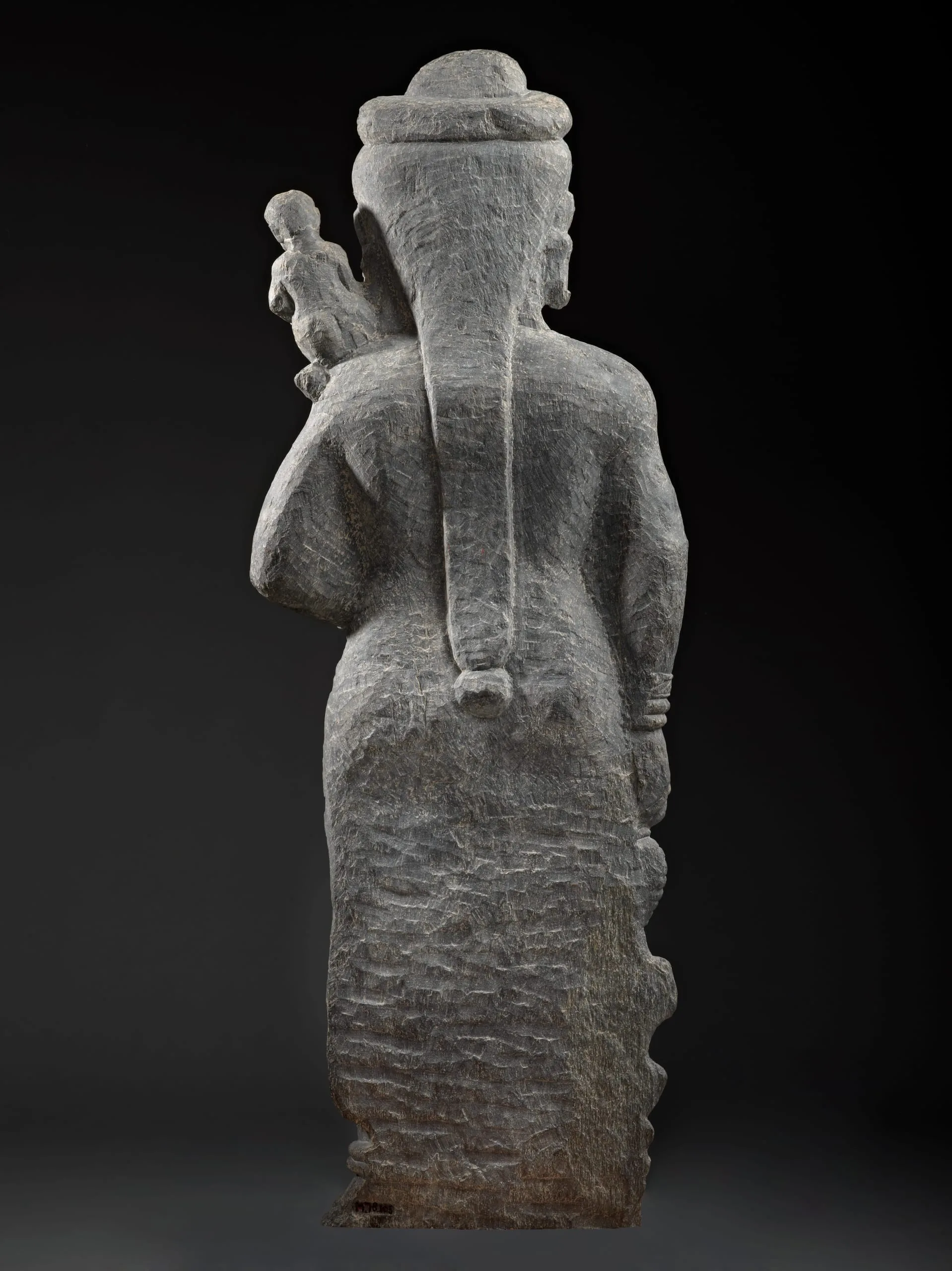
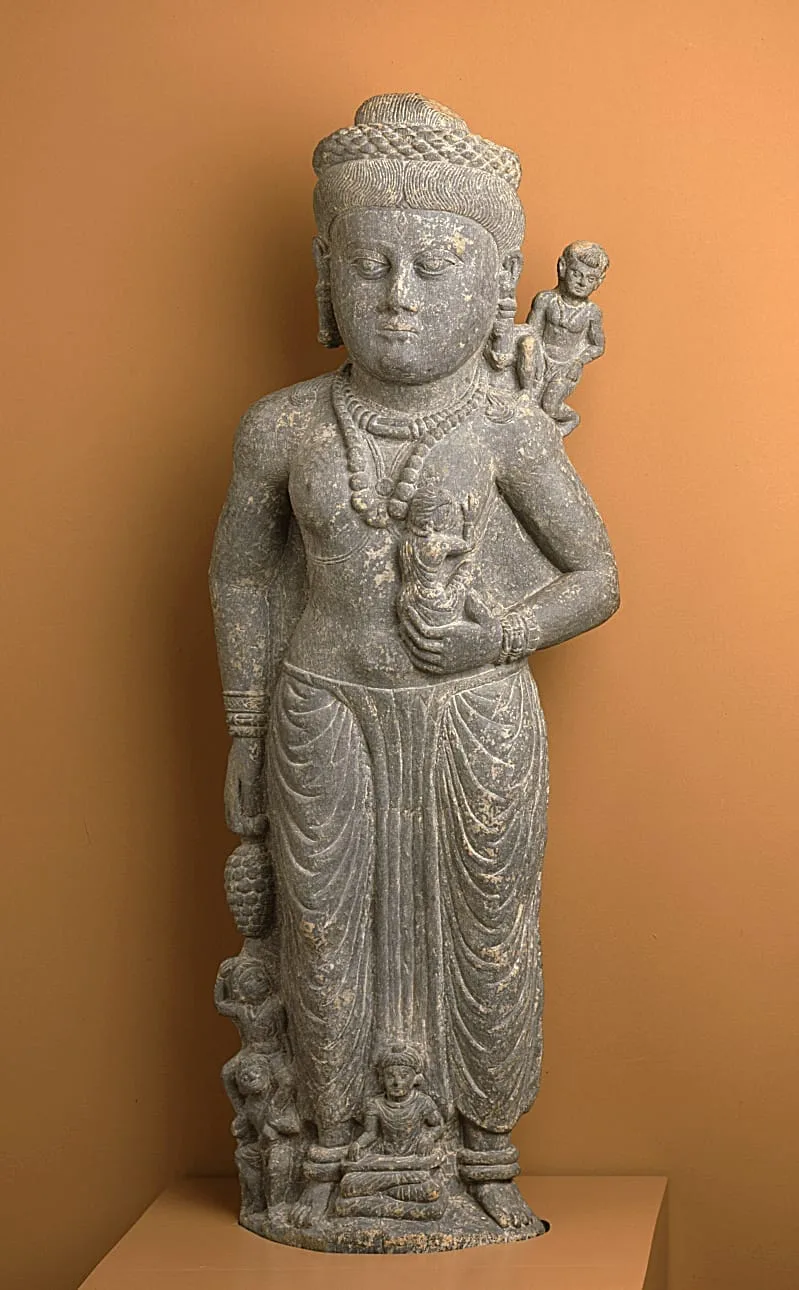
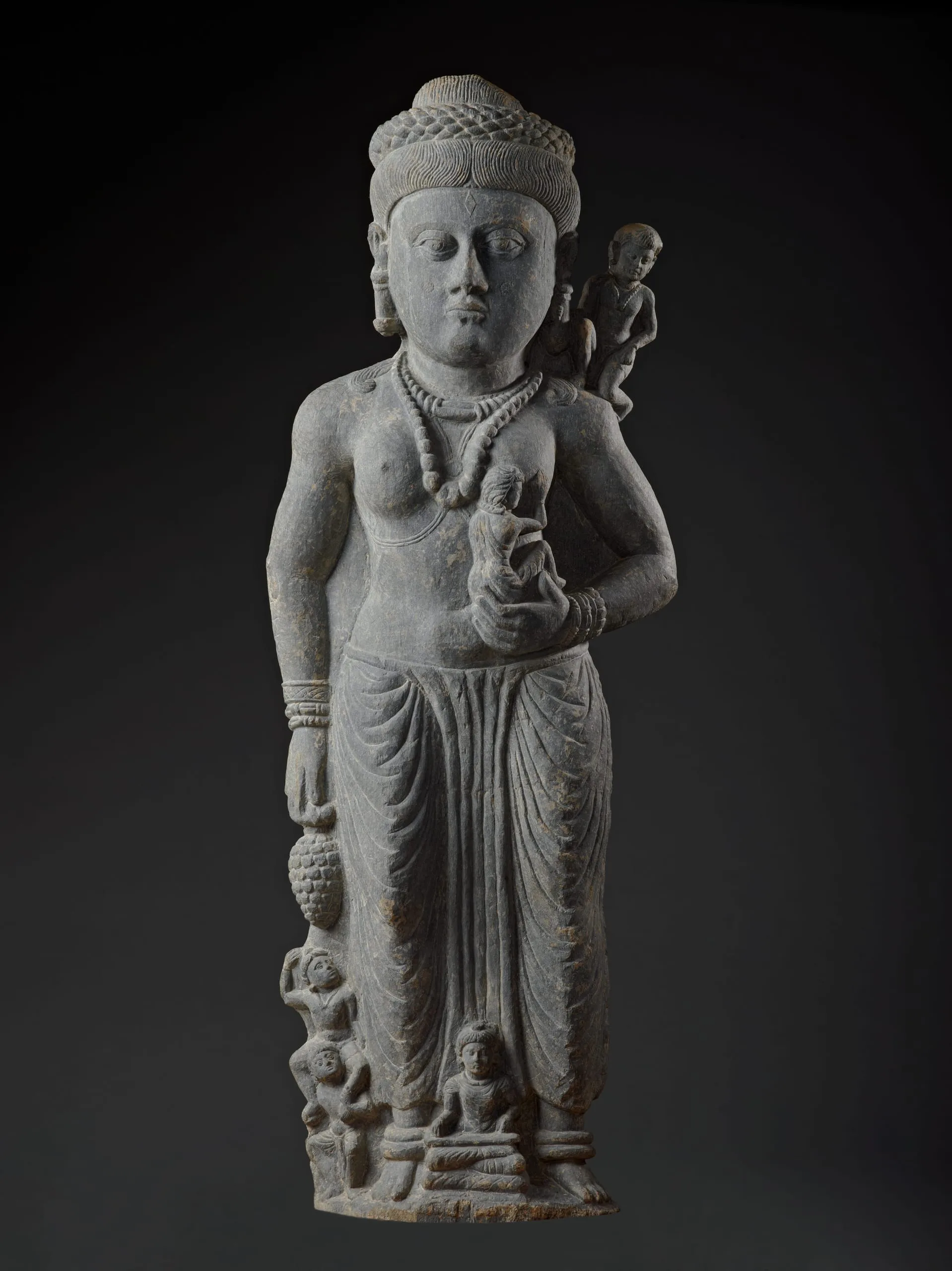
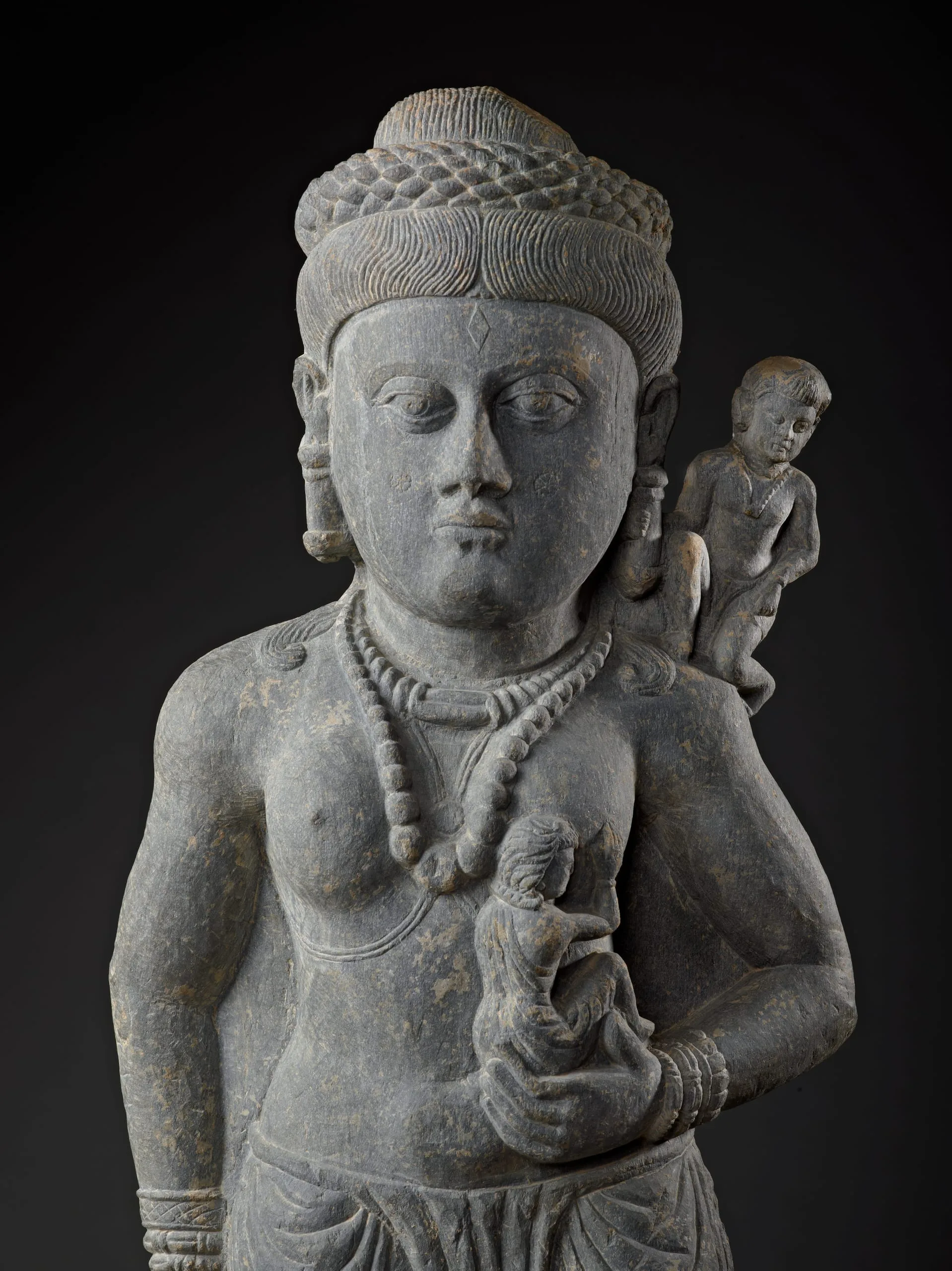
Hariti stands stiffly erect along with four of her children. She wears her hair in a bun tied with a garland. Her long locks fall to her shoulders and a long ponytail hangs down her roughly finished back. One of her children suckles at her bare breast, a boy perches on her left shoulder, and two more boys are by her right foot attempting to reach the grape bunch she dangles in her right hand. A seated figure between her feet likely represents the Buddha.
- Selected Bibliography
- Pal, Pratapaditya. Indian Sculpture, vol.1. Los Angeles: Los Angeles County Museum of Art; University of California Press, 1986.
Pal, Pratapaditya. The Divine Presence: Asian Sculptures from the Collection of Mr. and Mrs. Harry Lenart. Los Angeles: Los Angeles County Museum of Art, 1978.
- Newman, Richard. The Stone Sculpture of India: a Study of the Materials Used by Indian Sculptors from ca. 2nd Century B.C. to the 16th Century. Cambridge, MA: Center for Conservation and Technical Studies, Harvard University Art Museums, 1984.
El Universo de la India: Obras Maestras del Museo de Arte del Condado de Los Angeles. Santiago: Centro Cultural Palacio La Moneda, 2012.
- Little, Stephen, Tushara Bindu Gude, Karina Romero Blanco, Silvia Seligson, Marco Antonio Karam. Las Huellas de Buda. Ciudad de México : Instituto Nacional de Antropología e Historia, 2018.
- Little, Stephen, and Tushara Bindu Gude. Realms of the Dharma: Buddhist Art across Asia. Los Angeles: Los Angeles County Museum of Art, 2025.