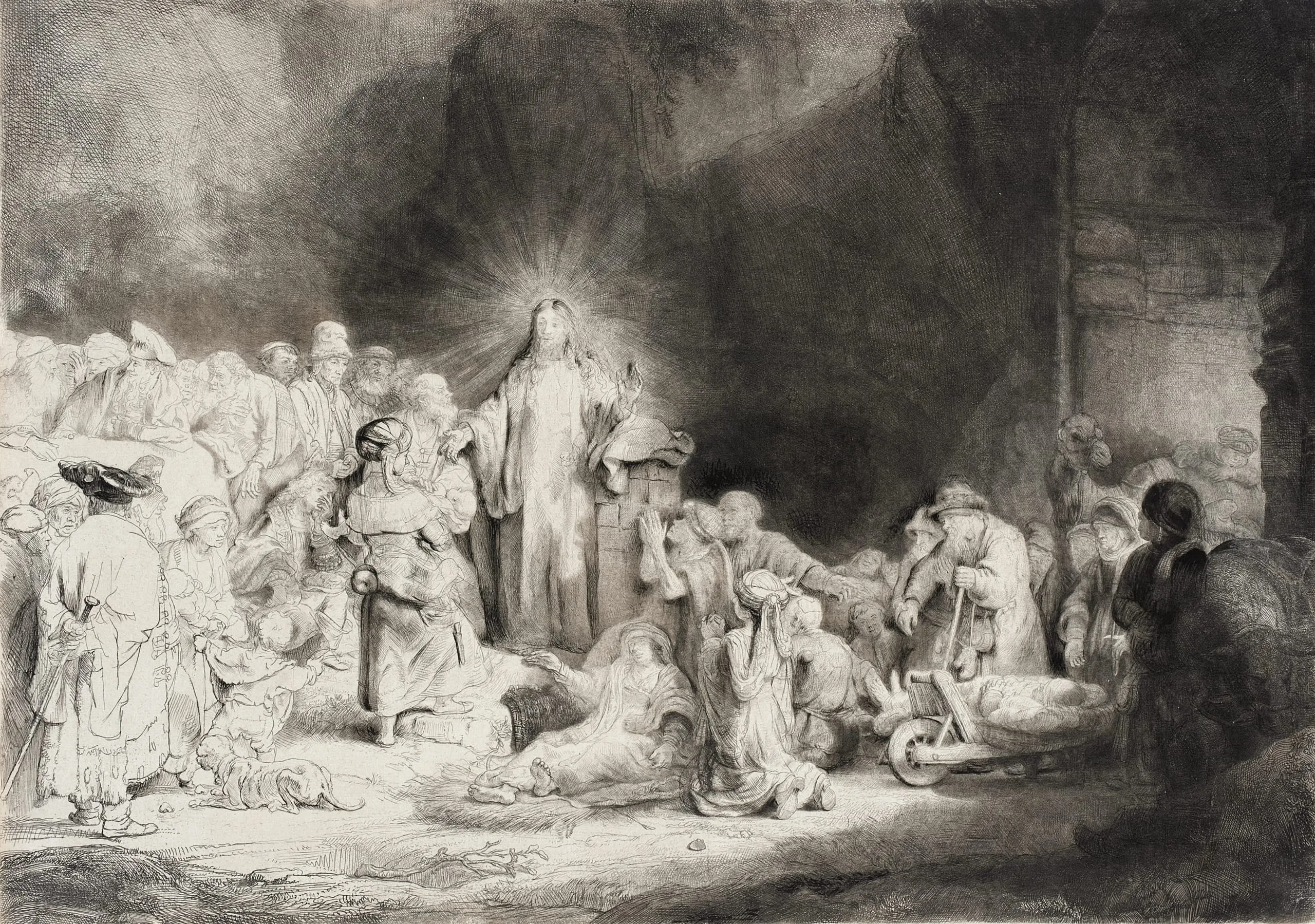
Rembrandt’s most famous print—called “The Hundred Guilder Print” for the substantial price it commanded as early as the 1650s—is also one of his most ambitious. The artist may have worked on it in stages over several years (perhaps as long as a decade), resulting in a variety of unique impressions produced through experimentation with inking and paper types. Two states of the print are known. The first is quite rare; LACMA’s second-state impression dates to before the plate left Rembrandt’s possession, as it shows no evidence of later reworkings.
The work is a tour de force of printmaking: the artist used diverse techniques to vary tone and meaning, with light lines deployed for the lively children and alert disciples at left, while rich shadow created by drypoint lends gravity to the sick and aged figures at right. At center, Christ stands illuminated in a dark alcove, his arms spread as if to welcome the crowd of onlookers to whom he preaches; at his right, his disciples look on, while at his left are gathered multiple ill people seeking blessings. With his right hand, Christ gestures toward an infant held up by a woman who approaches him, while his open left palm seems to affirm that those before him and on his left will receive God’s grace.
The scene combines references to at least four stories from chapter 19 of the Book of Matthew, revealing a close reading of the text. These include the stories of Christ healing the sick, debating with scholars, calling the children to him, and advising the rich young man. However, the actions and expressions of various figures may also refer to seventeenth-century Dutch interpretations of individual passages from the Gospel, including advisings about faithfulness, child baptism, and arrogance.
Claire Spadafora Baes
2025