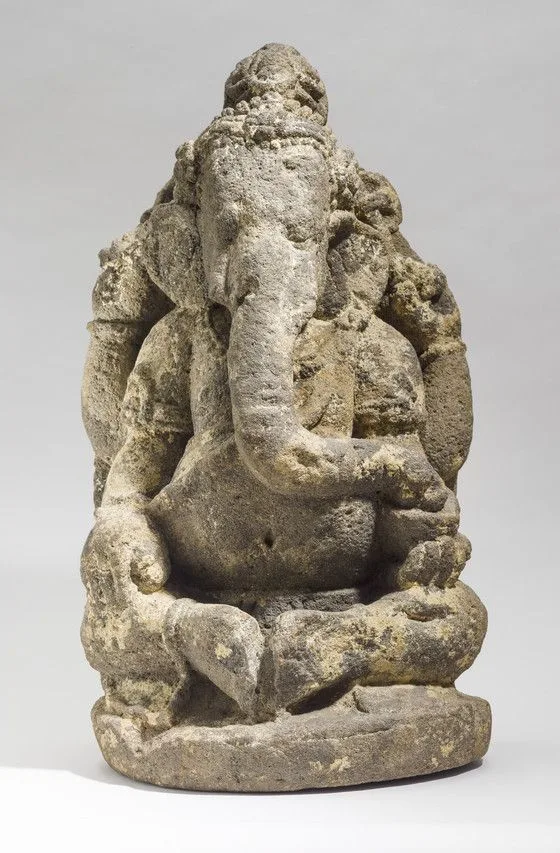
As the lord of obstacles, Ganesha is worshiped at the beginning of every new undertaking, ritual, or journey, especially perilous travels. His elephant head attests to the absorption of an elephant cult into mainstream Hinduism and reflects his mythological origin. According to religious lore, his mother Parvati, without Shiva's knowledge, created Ganesha created him from the sweat of her brow to guard her while Shiva was away. When Shiva returned and demanded access to Parvati's chamber, Ganesha, not recognizing his father, blocked his path. Angry, and unaware that the boy was his son, Shiva shot flames from his third eye, cutting off Ganesha's head and sending it spinning into the heavens. Parvati was inconsolable. Shiva vowed to replace Ganesha's head, and he searched the entire universe to no avail. Out of desperation, he took the head of a baby elephant that had sinned by lying with its head pointed to the north (considered an inauspicious direction) and returned home with it to restore Ganesha to life.
This four-armed representation of Ganesha mainly follows earlier Indian iconographic conventions. In his upper right hand, he holds a rosary (akshamala) symbolic of asceticism (now partially damaged). In his upper left hand, he holds a battle axe (parashu) for removing obstacles. His lower left hand holds a bowl of sweetmeats (laddu) that he is eating with his trunk. His lower right hand touches his calf and may have once held his broken tusk (danta), which according to various myths was lost in battle, used as a stylus, or as a projectile that he hurled at the moon when it ridiculed him for falling off his rat mount and bursting open his belly overstuffed with sweetmeats. The LACMA Ganesha deviates from the standard Indian iconography in his distinctive seated posture in which his feet are placed sole-to-sole resembling the butterfly pose (baddha konasana) of modern yoga. This iconographic innovation is primarily found in Indonesian art, although Malaysian and earlier Indian instances are known. See Robert L. Brown, "Ganesa in Southeast Asian Art: Indian Connections and Indigenous Developments," in Ganesh: Studies of an Asian God, ed. Robert L. Brown (Albany: State University of New York Press, 1991), pp. 185-186. See also M.83.221.3.