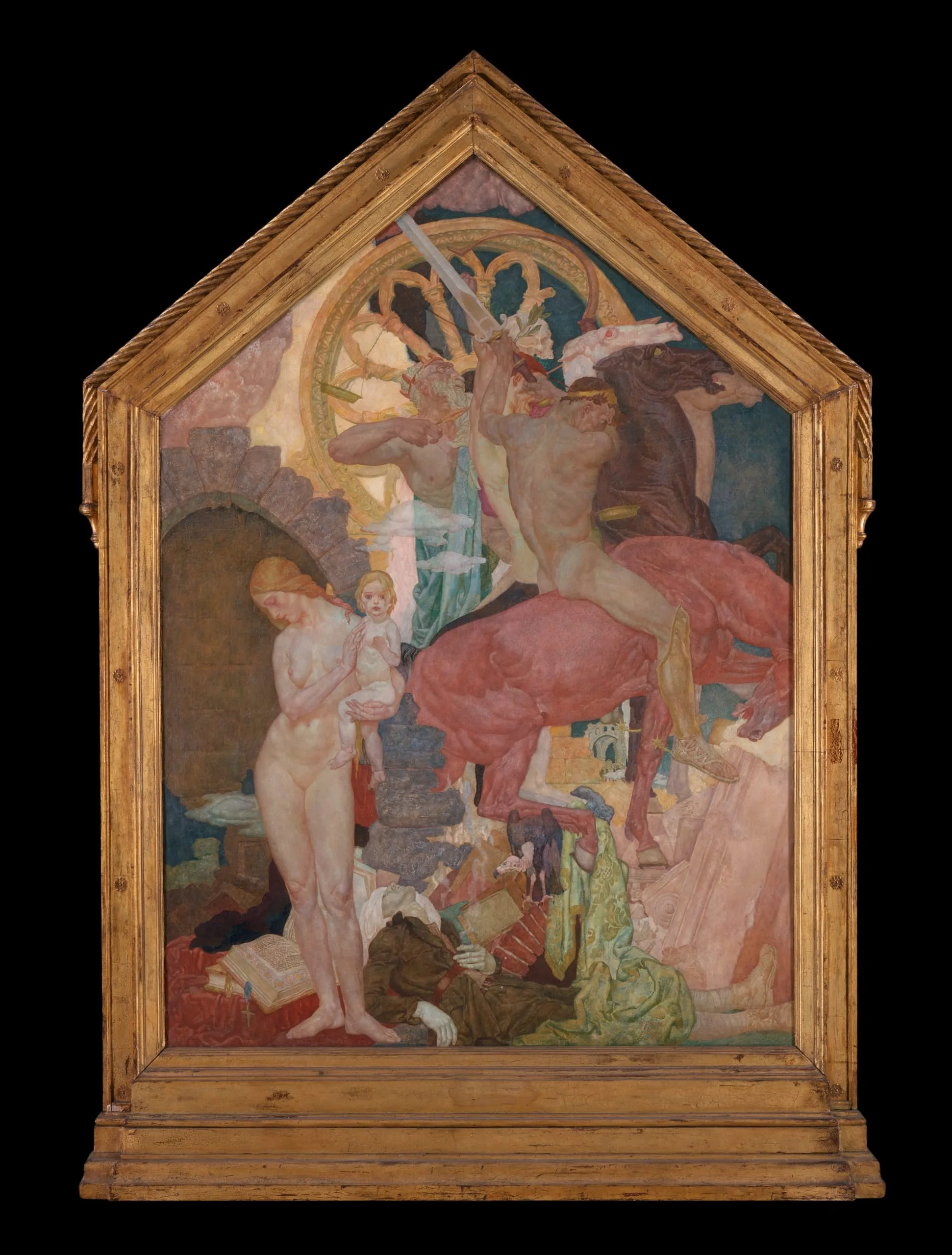
Recessional was Savage’s most critically acclaimed easel painting from the 1920s. He painted two almost identical versions, both dated 1923. He exhibited these canvases simultaneously throughout the country at annual art exhibitions from 1923 to 1925. The other version (Mattatuck Museum, Waterbury, Connecticut) was awarded prizes when it was exhibited at the National Academy of Design in New York and the Art Institute of Chicago, while the museum’s painting was awarded the John Schaffer Prize at the First Pan-American Exhibition of Oil Paintings at the museum in 1925-26.
Although the smaller of the two, the museum’s painting is probably not a study in view of its large scale and complete finish. It may have been the first version, since in it basic changes to the composition are discernible: areas of a more opaque overpainting cover alterations, most notably a change in direction of the scales. The Italianate architectural frame is original and typical of Savage’s presentation of his early easel paintings as early Renaissance altarpieces. The frame and painting technique reflect Savage’s attempt to echo the early Renaissance masters he had studied in Italy.
Desiring his painting to appear as an old master fresco, Savage prepared the canvas surface with a thick layer of gesso, roughened the overall surface, and then sculpted many of the details before beginning to paint. The oil paint was applied in thin, transparent layers, which were wiped and set with a fixative, further creating the illusion of a frescoed surface.
Although the size and format suggest that Savage intended the painting to resemble an altarpiece, the subject is a modern allegory inspired by World War I. The artist employed the religious imagery of the Four Horsemen of the Apocalypse as the central motif to symbolize the war’s destruction. A bulletin that was issued at the time the Los Angeles Art Association purchased the painting provides a detailed analysis of the imagery: the Four Horsemen trampling the world into ruins signify not only the tragedy of war in general but the recurring cycle of war, conquest, plague, and death. The older figure of the crowned archer is Greed, who releases his shaft of envy and hate toward the far horizon, while War, bearing a sword, is joined by Pestilence with his scales and Death with his scythe. A wounded man in uniform lies dying in the foreground. Remnants of the civilization that was destroyed by the war are scattered throughout. The large rose window of a cathedral forms a center backdrop and refers to the church, the support of humanity through the ages. For Savage the church imagery refers to the literary source of the painting’s theme and title: Rudyard Kipling’s famous poem "Recessional" (1897). Kipling believed that throughout the course of history God alone was immutable. On the left, sheltered by a stone arch, an idealized female nude symbolizing Bereavement and Truth holds an infant who symbolizes the hope of Regeneration. At her feet are scattered a number of books, the largest of which is a Bible open to the Beatitudes.
The two versions of Recessional differ only in minor details: in the museum’s version the infant has hair falling over her left eye (perhaps symbolically obstructing her view of the future), fewer books are piled up in the lower left, and the stonework of the wall in the background is different.
The painting was acquired through public subscription; over two hundred subscribers, including socially prominent figures and artists organizations, contributed through the Los Angles Art Association. Among them were the critic Arthur Millier and painters Carl Oscar Borg, Paul Sample, and HANSON PUTHUFF. Such diverse support reveals both Savage’s stature during the thirties and the continued appetite for war memorials following the first World War.