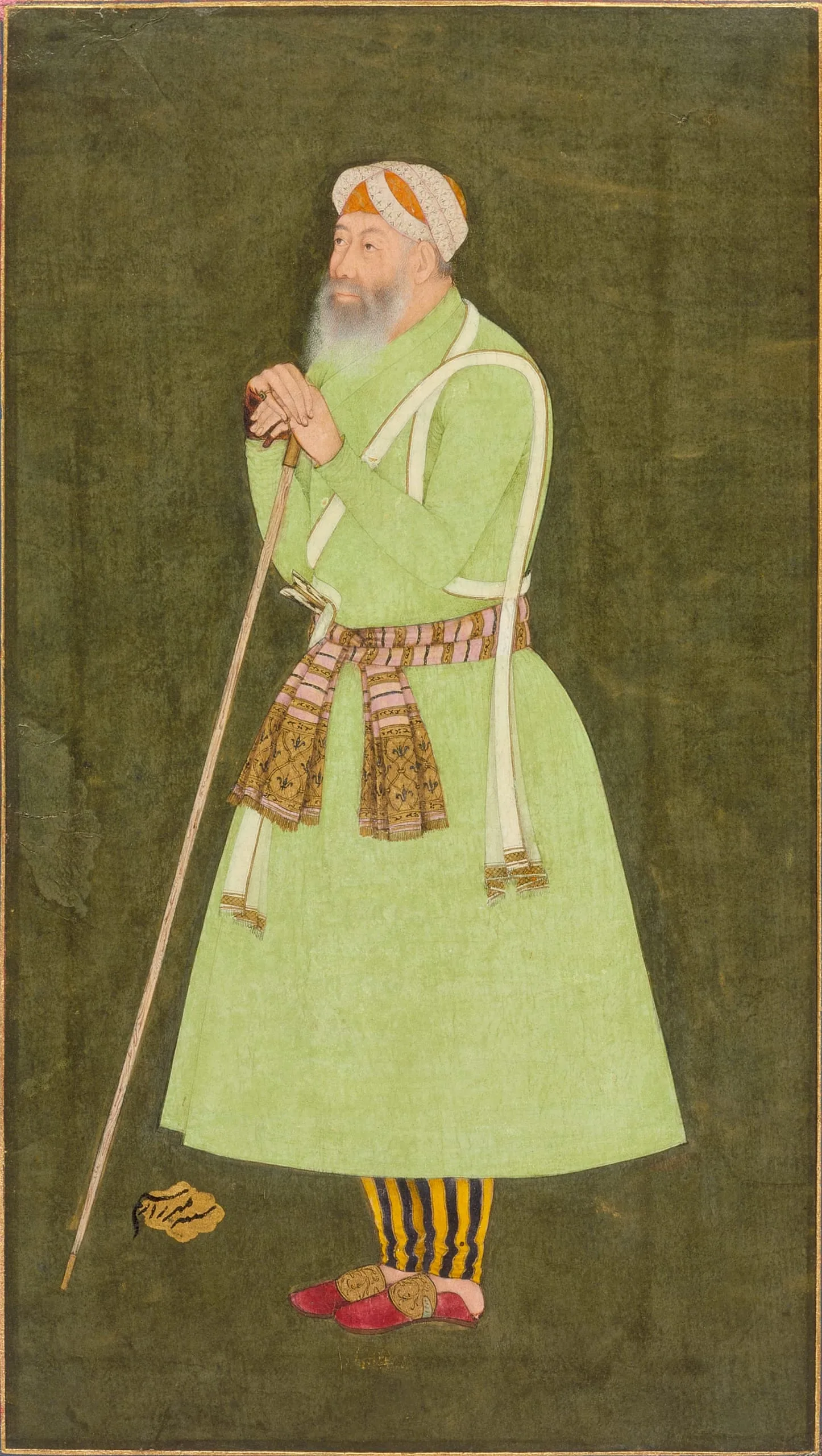
Mughal portraiture flourished under the emperors Jahangir (r. 1605−27) and Shah Jahan (r. 1628−58), building upon traditions established by their predecessor Akbar (r. 1556−1605). These portraits were created in imperial workshops primarily for private viewing within the court. Following Akbar’s initiative, they were often compiled into muraqq‘a (albums) that documented both living and deceased nobles. While these portraits were idealized, they maintained distinct individual characteristics, typically depicting subjects in three-quarter or profile views set against a mostly monochromatic green background. Today, these album pages are dispersed among collections worldwide.
One such example is the present folio. The inscription in the golden cartouche identifies the subject as Mirza Rustam Safavi (1569−1641), one of the Safavid nobles who sought refuge in the Mughal court due to internal conflicts in Iran. Attracted by the hospitable court of Akbar, he arrived in India in 1592 and served as a loyal administrator under three Mughal emperors until his retirement under Shah Jahan. He also was related to the Mughal imperial family through matrimonial alliances—his niece was Shah Jahan’s first wife. His portrait is ascribed to Hashim, a distinguished court artist known for his depictions of prominent political figures.
Standing in profile against a green background, Mirza Rustam cuts an elegant figure in a green jama with brocaded sash, striped pajamas, red shoes embroidered with gold medallions, a red-and-white turban arranged in an unusual manner, and a neatly folded shawl draped across his torso. His finely rendered facial hair covers a somewhat weary expression. The slender walking stick, a convention in portraits of older men, reinforces his dignified presence.
2025