- Artist or Maker
- Madhava
India, active 1575-1610 - Artist or Maker
- Tulsi
India, active 1575-1596 - Title
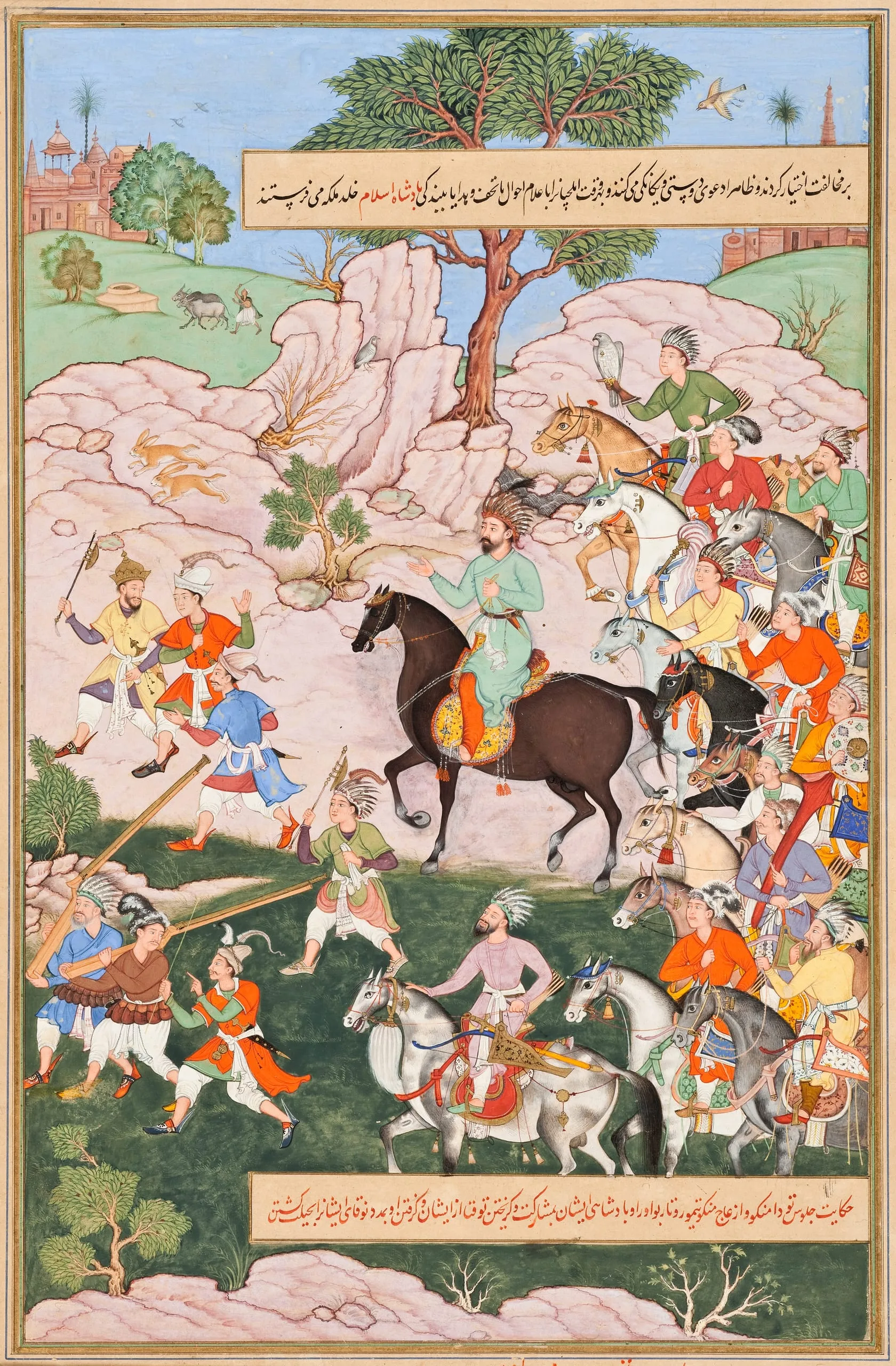
- Toda Mongke and His Mongol Horde, Folio from a Chingiznama (History of Genghis Khan)
- Date Made
- 1596
- Medium
- Opaque watercolor, gold, and ink on paper
- Dimensions
- Sheet: 15 x 10 in. (38.1 x 25.4 cm); Image: 12 3/8 x 8 in. (31.4 x 20.3 cm)
- Accession Number
- M.78.9.8
- Curatorial Notes
The Chingiznama (History of Genghis Khan) is a section of the Jami al-Tawarikh (History of the World) written by the eminent Persian historian Rashid al-Din (1247-1318). Its first section, called the Tarikh-i Ghazani, describes the history of the Mongol and Turkish tribes, concentrating on the Mongol Emperor Genghis (or Chingiz) Khan (r. 1206-1227) and his successors until the death of Ghazan Khan (r. 1295-1304). This manuscript of the Chingiznama was completed in 1596. It is now held mainly in the Gulistan Palace Library, Tehran.
This folio depicts Toda Mongke, the Khan of the Mongol Golden Horde (r. 1280-1287), and his army. He is the central figure on horseback wearing a distinctive feathered headdress also worn by some of his soldiers. The setting is a hilly landscape with palatial structures appearing in the distance. It has been suggested that this painting may show him on the way to his accession ceremony. Contemporary accounts record that he converted to Islam and lived an austere life, surrounding himself with theologians. His religious studies came at the expense of the affairs of state, and when he was reminded by his ministers of his duties as the Khan, he abdicated in favor of his nephew Tulabugha and dedicated himself to God. According to the marginal inscriptions, the illustration was designed and painted by Tulsi (active 1575-1596) and the portraits were done by Madhava (active 1575-circa 1610), who is also known as Madhu or Madhava Kalan (Madhava the Elder).
- Selected Bibliography
- Pal, Pratapaditya. Indian Painting, vol.1. Los Angeles: Los Angeles County Museum of Art, 1993.
- Heeramaneck, Alice N. Masterpieces of Indian Painting : From the Former Collections of Nasli M. Heeramaneck. New York: A.N. Heeramaneck, 1984.
- Rosenfield, John. The Arts of India and Nepal: The Nasli and Alice Heeramaneck Collection. Boston: Museum of Fine Arts, Boston, 1966.
- Keene, Bryan C., editor. Toward a Global Middle Ages: Encountering the World Through Illuminated Manuscripts. Los Angeles: The J. Paul Getty Museum, 2019.