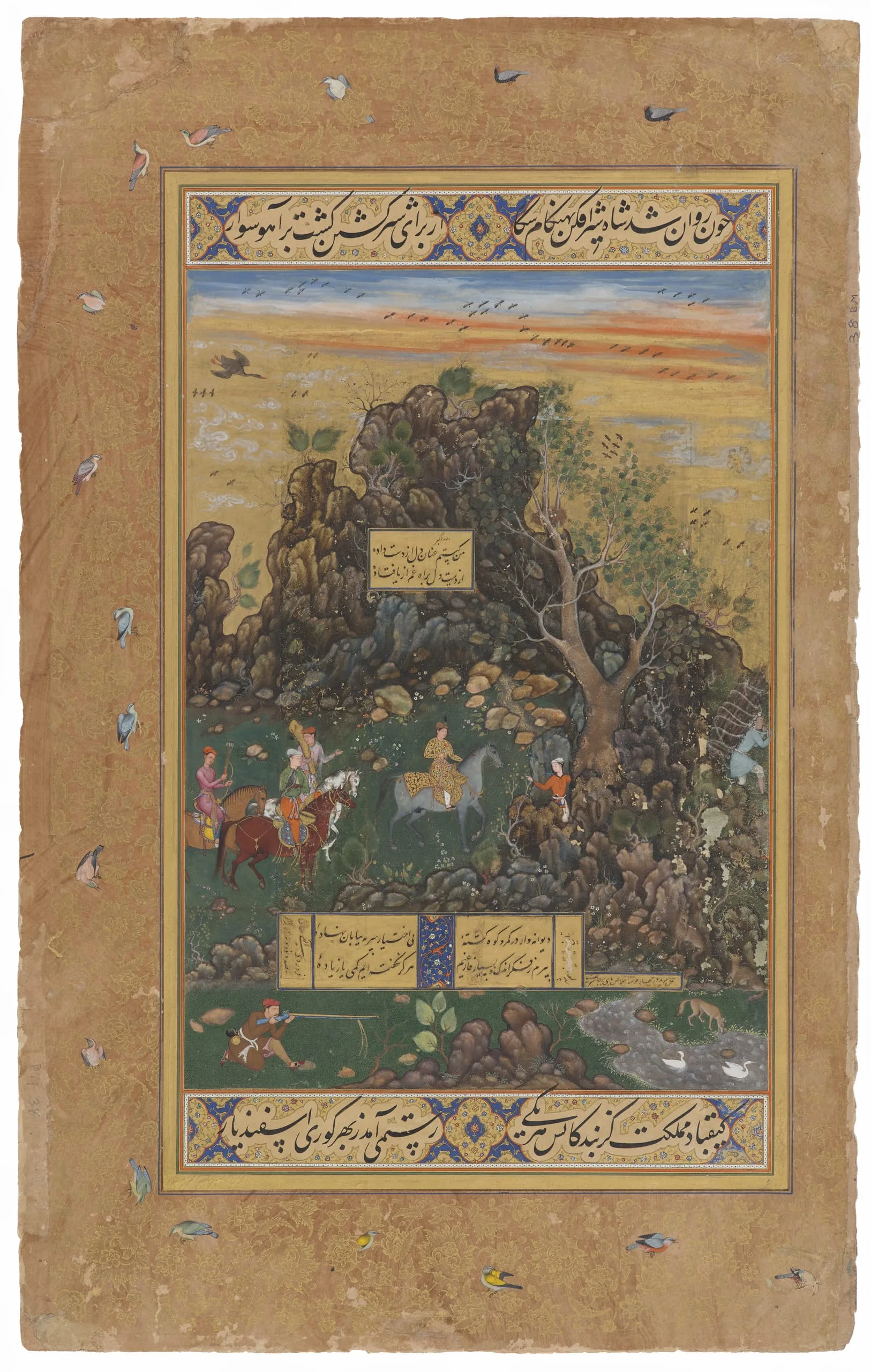
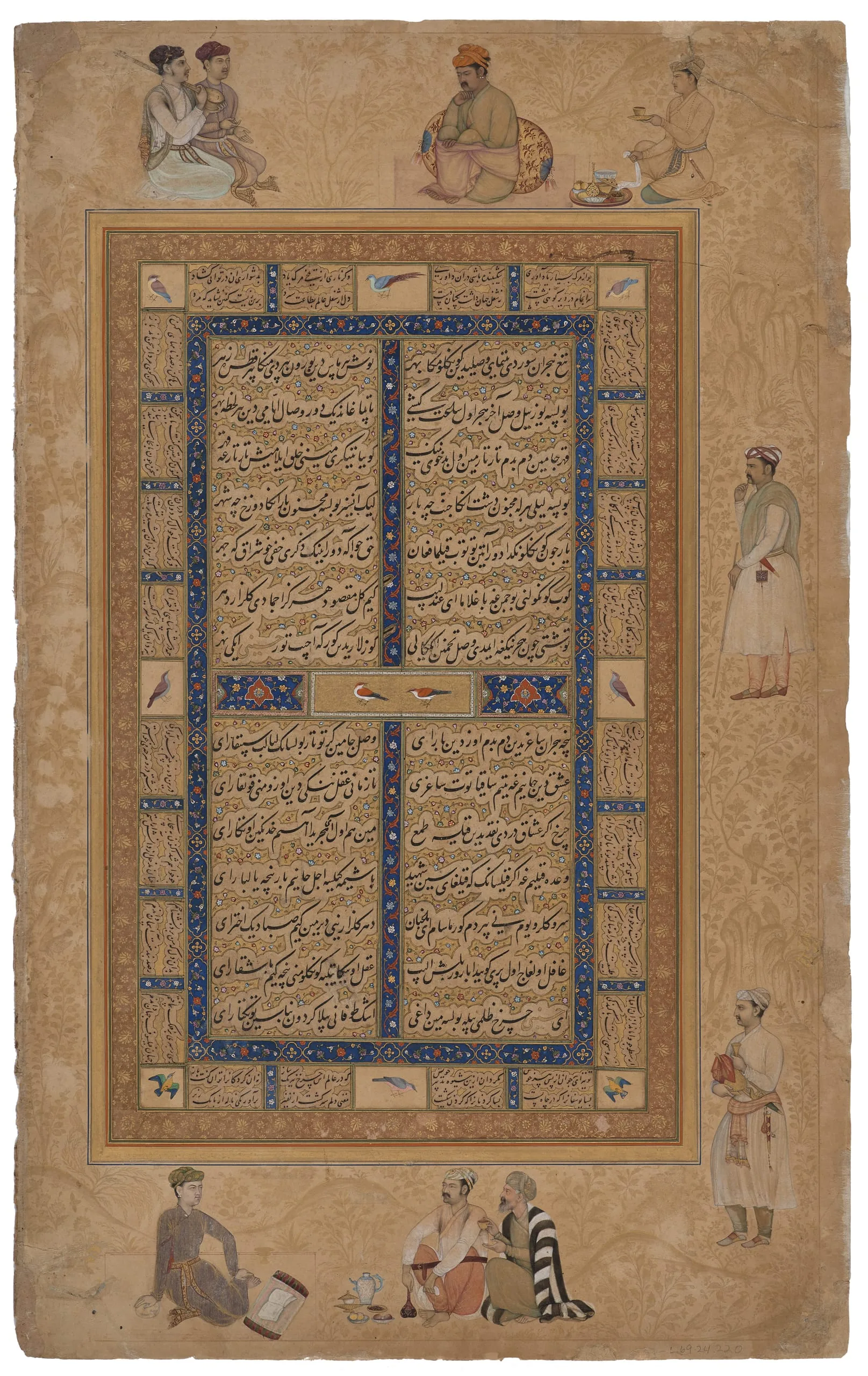
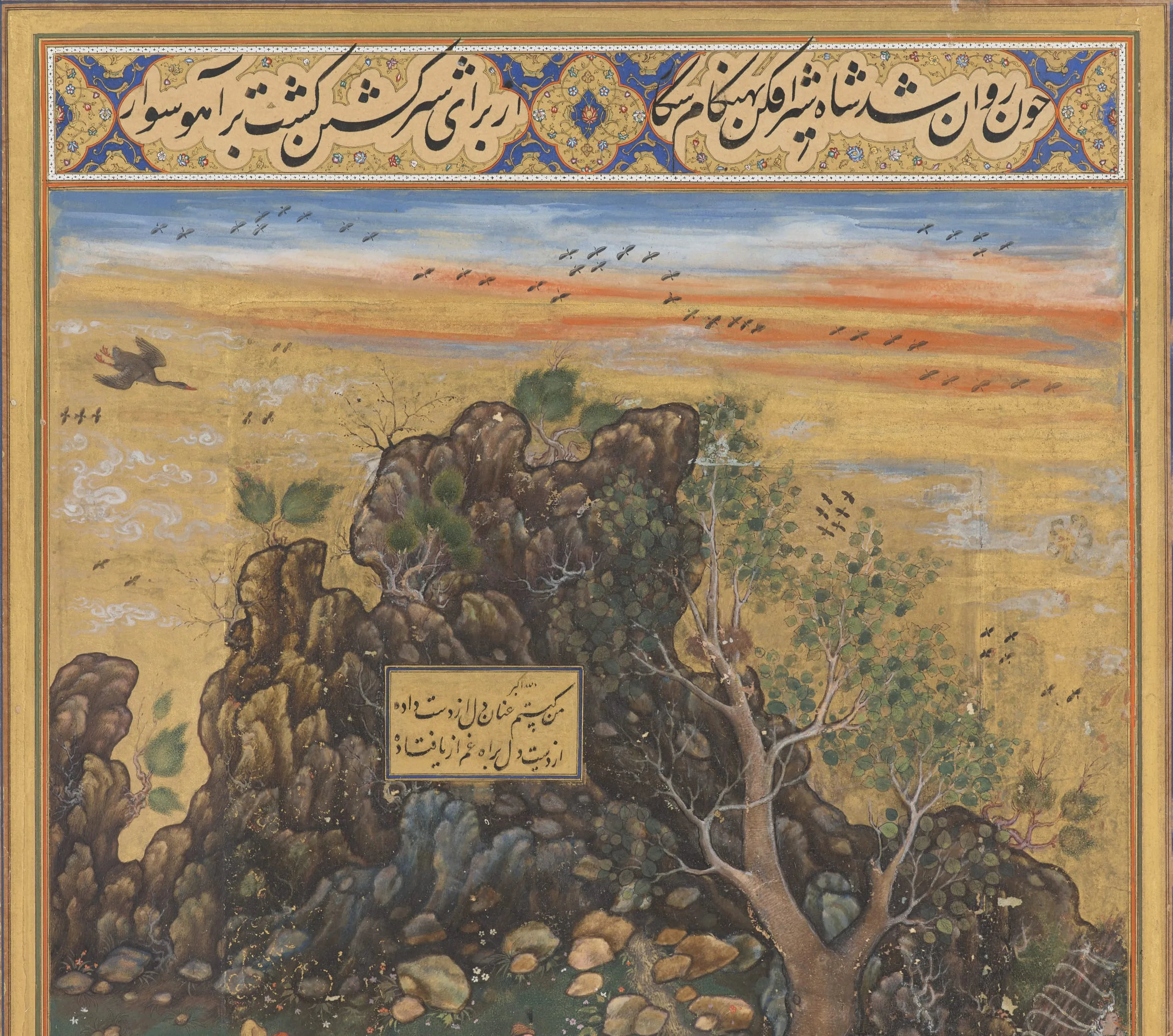
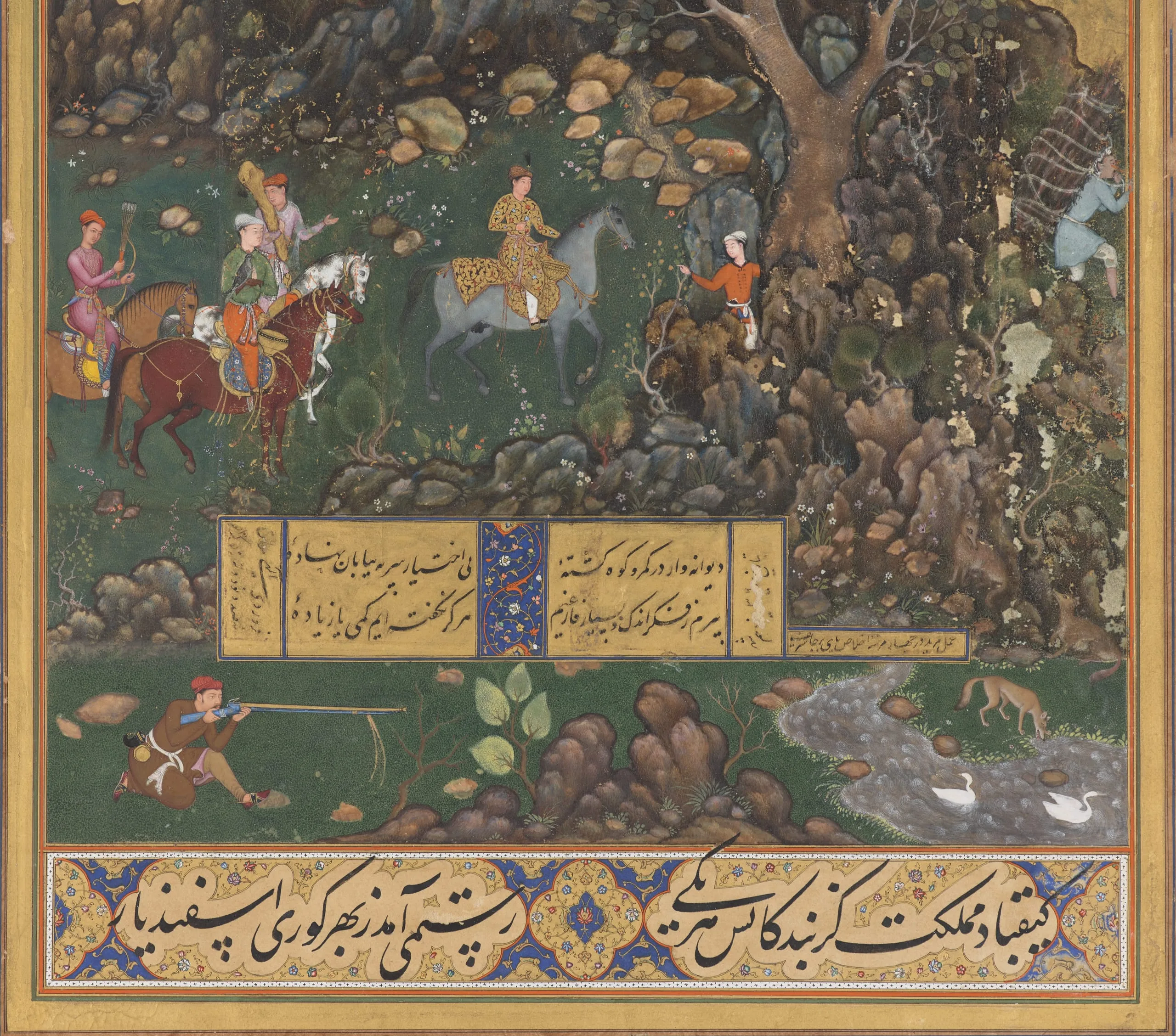
The Persian album, or muraqq‘a, which flourished from the fifteenth to the seventeenth century in Iranian lands, was adopted in Mughal India by the early seventeenth century. A muraqq‘a is generally a compendium of calligraphy and paintings bound in a booklike format, with facing pages of each medium arranged in alternate fashion. A form of collecting, it is an idiosyncratic gathering of diverse materials organized by the compiler to reflect multilayered meanings that would have resonated with the elite, erudite audience for which it was intended. Like many illustrated manuscripts, albums were frequently dispersed. Such is the case with this folio, which has its own complex history.
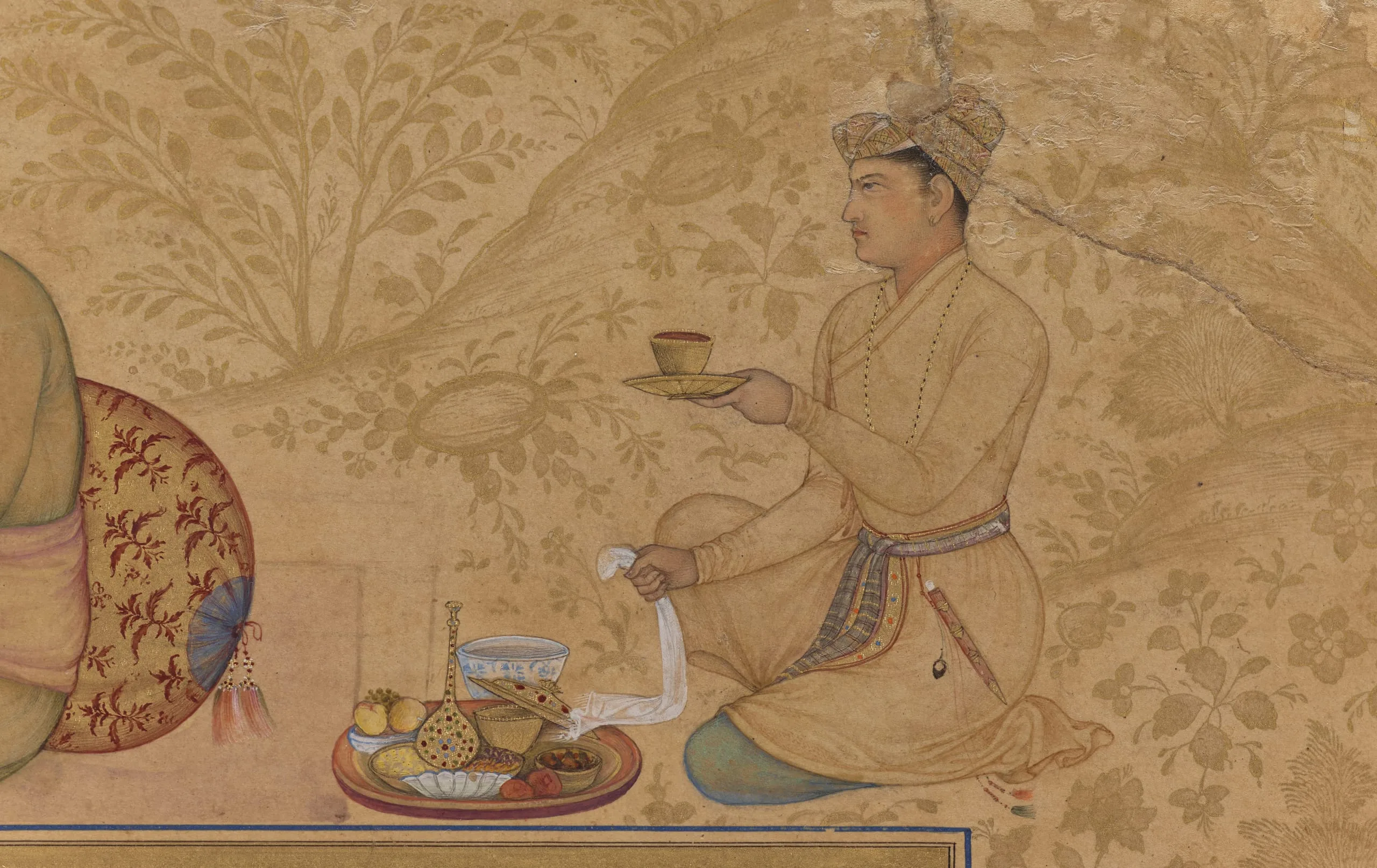
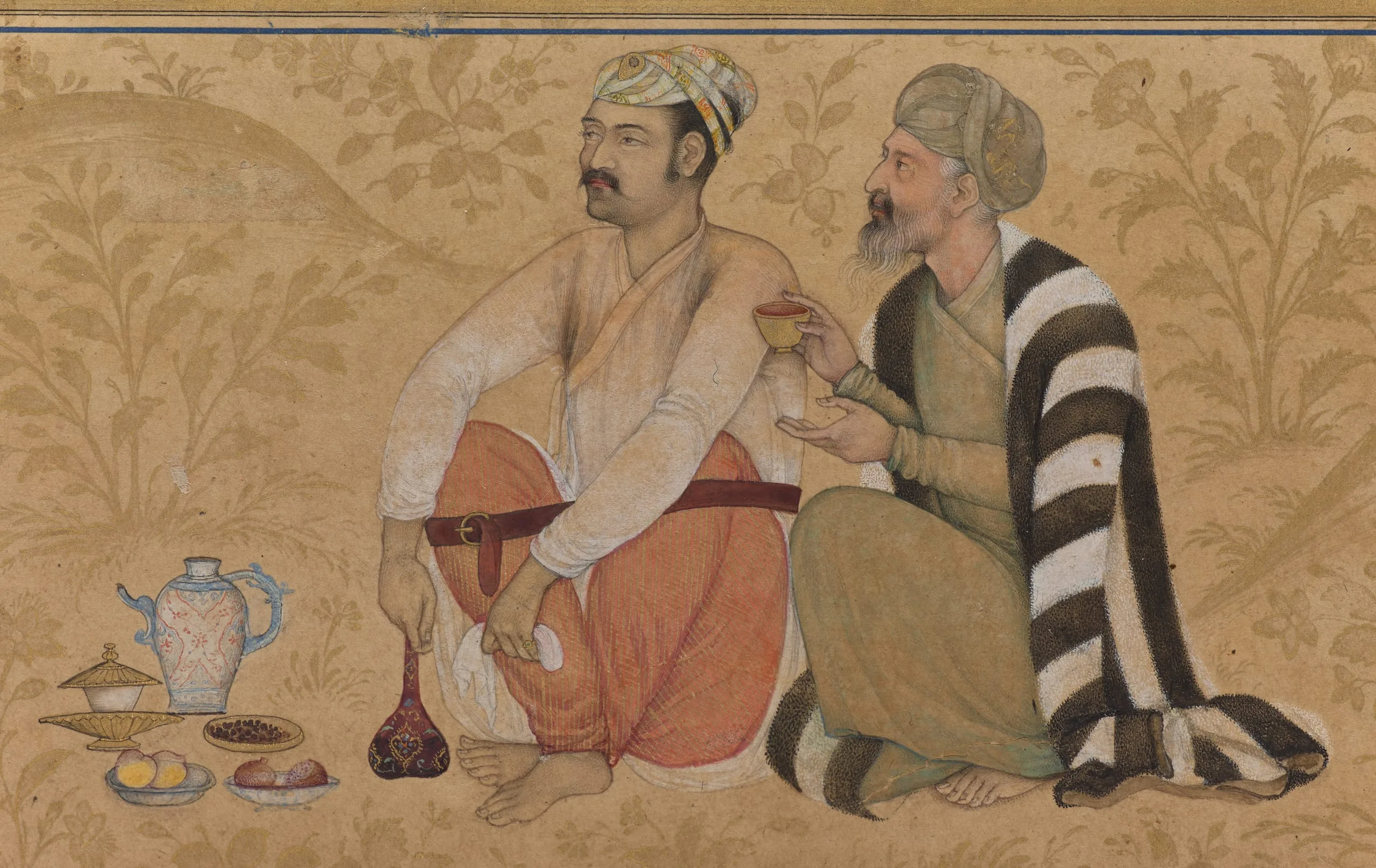
The page comes from the Gulshan Album, which began to be compiled around 1599−1604 for Prince Salim, later Mughal emperor Jahangir (r. 1605−27). The bulk of the album is preserved in the Gulistan Library, Tehran; it consists of paintings and calligraphy from diverse sources and of varying dates, which were contemporaneously mounted with elaborate borders featuring figures and flora and fauna, as is the case here. Though distinctively Mughal, the folio underscores the Persianate roots of the dynasty and its cultural aspirations.
Stylistic and technical analysis suggests that the painting, which depicts a hunting party in a mountainous landscape, is a pastiche assembled from several distinct parts, with other interventions and overpainting. The earliest sections may be the work of the Iranian artist ‘Abd al-Samad around 1550−56, after he entered the service of the Mughal emperor Humayun (r. 1530−40 and 1555−56). Some of the subsequent painting is by Muhammad Sharif, son of ‘Abd al-Samad, whose signature is at the bottom right center, with the date 1591 at left. To better fit the dimensions of the Gulshan Album, the composition may have been later expanded along with the addition of Persian verses characterizing the hunt as a spiritual quest, at the top and bottom of the page. The Chaghatay calligraphy on the verso is from the collected poetry of Sultan-Husayn Bayqara (r. 1469−1506), the last great ruler of the Timurid dynasty from which the Mughals descended (see M.73.5.599a-b). The figural compositions of the borders are attributed to the painter Govardhan.
Linda Komaroff
2025