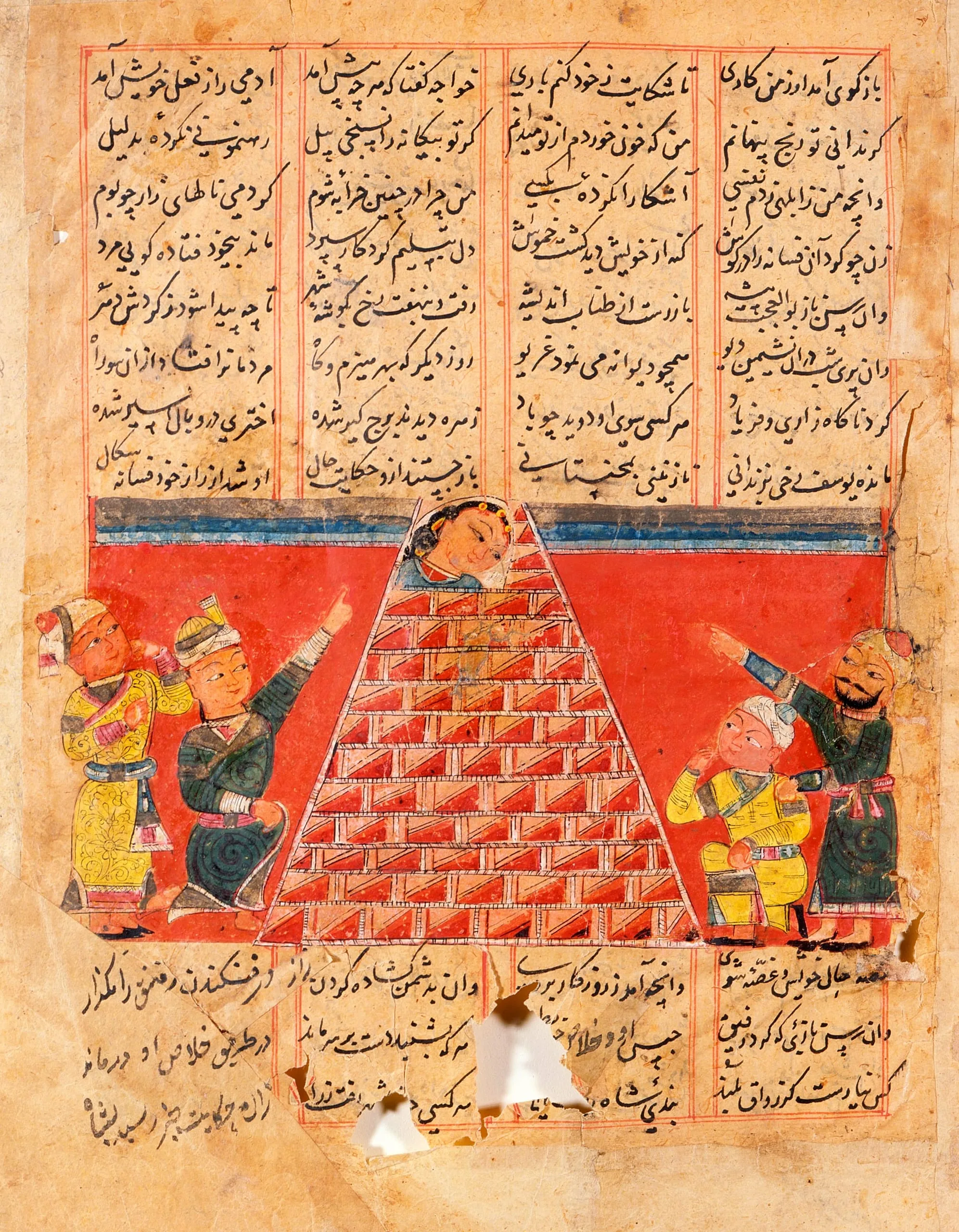
The Khamsa (Quintet) of Amir Khusraw of Delhi (1253–1325) consists of five poems written in rhyming couplets (masnavi) in 1301-1302. It emulates the Khamsa of Nizami Ganjavi of Iran (circa 1141–1209). The five poems are Matla ul-Anwar (Dawn of Lights), ethical and Sufi topics; the romance of Khusraw-Shirin; the romance of Layla-Majnun; Aina-e-Sikandari, the history of Alexander the Great (r. 336-323 BCE); and Hasht-Bihisht (Eight Paradises), the story of the Sasanian king Bahram V (or Bahram Gur, r. 420-438). This folio is from a widely dispersed Khamsa of Amir Khusraw of Delhi (Dihlavi) that was stylistically influenced by 14th-century paintings of Mamluk Egypt or of the Inju school of Iran. Additional folios are in the Arthur M. Sackler Gallery and Freer Gallery of Art, Washington; Cleveland Museum of Art; Metropolitan Museum of Art, New York; Museum of Fine Arts, Boston; Nelson-Atkins Museum of Art, Kansas City; San Diego Museum of Art; Seattle Art Museum; Victoria and Albert Museum, London; Worcester Art Museum; and various private collections.
The Hasht-Bihisht consists of seven stories, each told to Bahram V on a particular day of the week by a different princess in a color-coded pavilion. This painting depicts an episode recounted on Sunday in the Saffron Pavilion. The wife of the goldsmith Hasan is shown stranded at the top of a prison tower after helping her husband escape from it. She is being taunted from below by onlookers.