- Title
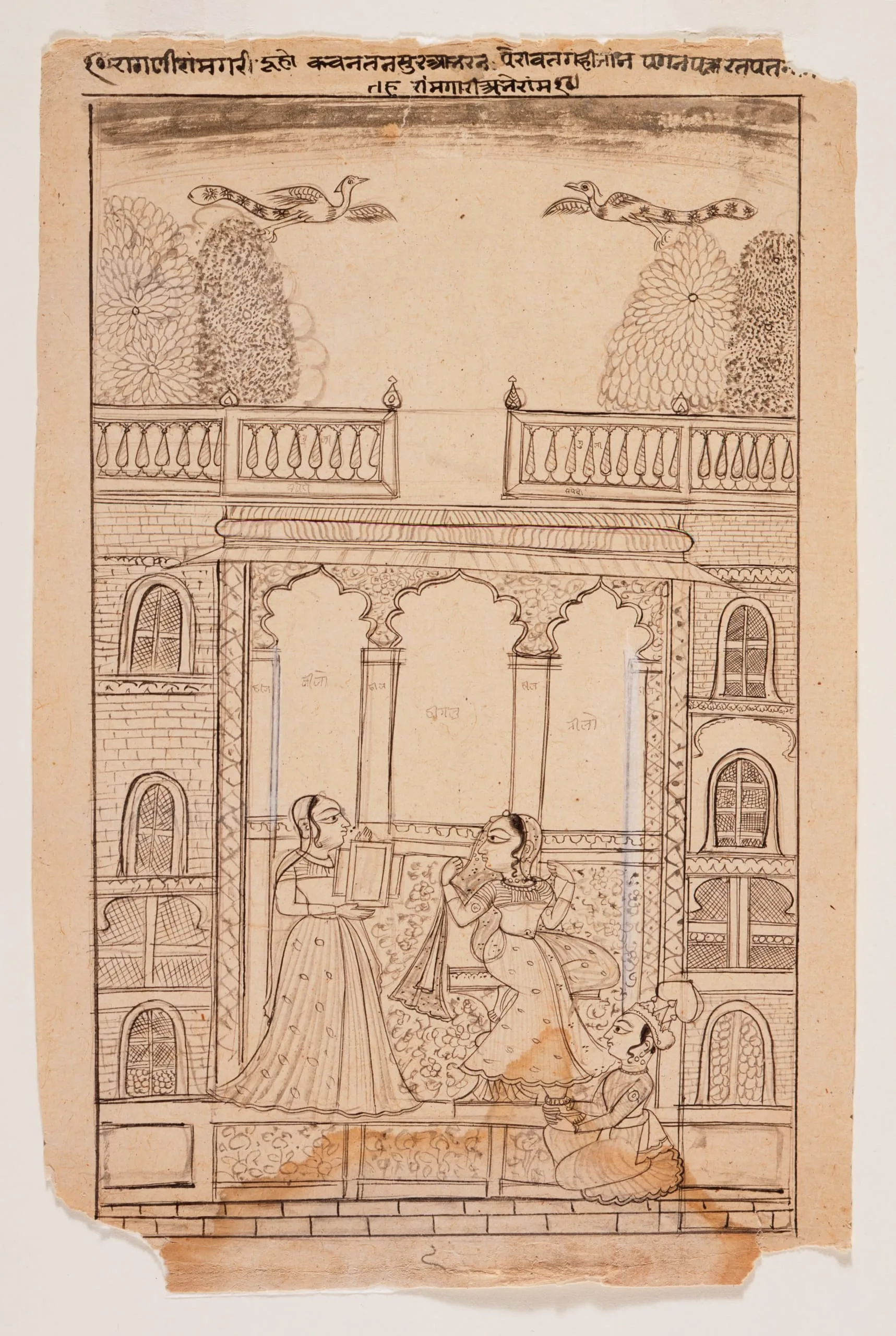
- Ramagadi Ragini, Fourth Wife of Malkos Raga, Folio from a Ragamala (Garland of Melodies)
- Date Made
- circa 1775
- Medium
- Ink on paper
- Dimensions
- Image: 11 7/8 x 7 3/8 in. (30.16 x 18.73 cm); Sheet: 13 1/8 x 8 1/2 in. (33.33 x 21.59 cm)
- Accession Number
- M.77.154.25
- Curatorial Notes
Ramagadi (or Ramakali) Ragini is the fourth wife of Malkos Raga in the predominant ragamala (garland of melodies) classification system generally known as the Rajasthani system. The Hindi inscription in the header identifies the melody by the variant spelling of “Rammagari Ragani.” It is an early morning melody that is typically personified as a kneeling hero or Krishna massaging the feet of his anxious lover, who turns her face away to reject him and often gazes into a mirror held by her maidservant. For example, see an iconographically comparable Ramakali Ragini attributed to Mewar, Rajasthan, circa 1680, in the Metropolitan Museum of Art, New York (54.174).
Here, the pleading hero is Krishna, who is identifiable by his distinctive peacock feather crown. The light-colored sky indicates it is a daytime melody. The two peacocks prominently portrayed in the sky suggest it is the break of day when peacocks often call loudly. That this is a preparatory drawing is evident from the brief color key notations for the subsequent colorist. The primary artist was responsible for the composition and figural outlines.
- Selected Bibliography
- Pal, Pratapaditya and Catherine Glynn. The Sensuous Line: Indian Drawings from the Paul F. Walter Collection. Los Angeles: Los Angeles County Museum of Art, 1976.