- Title
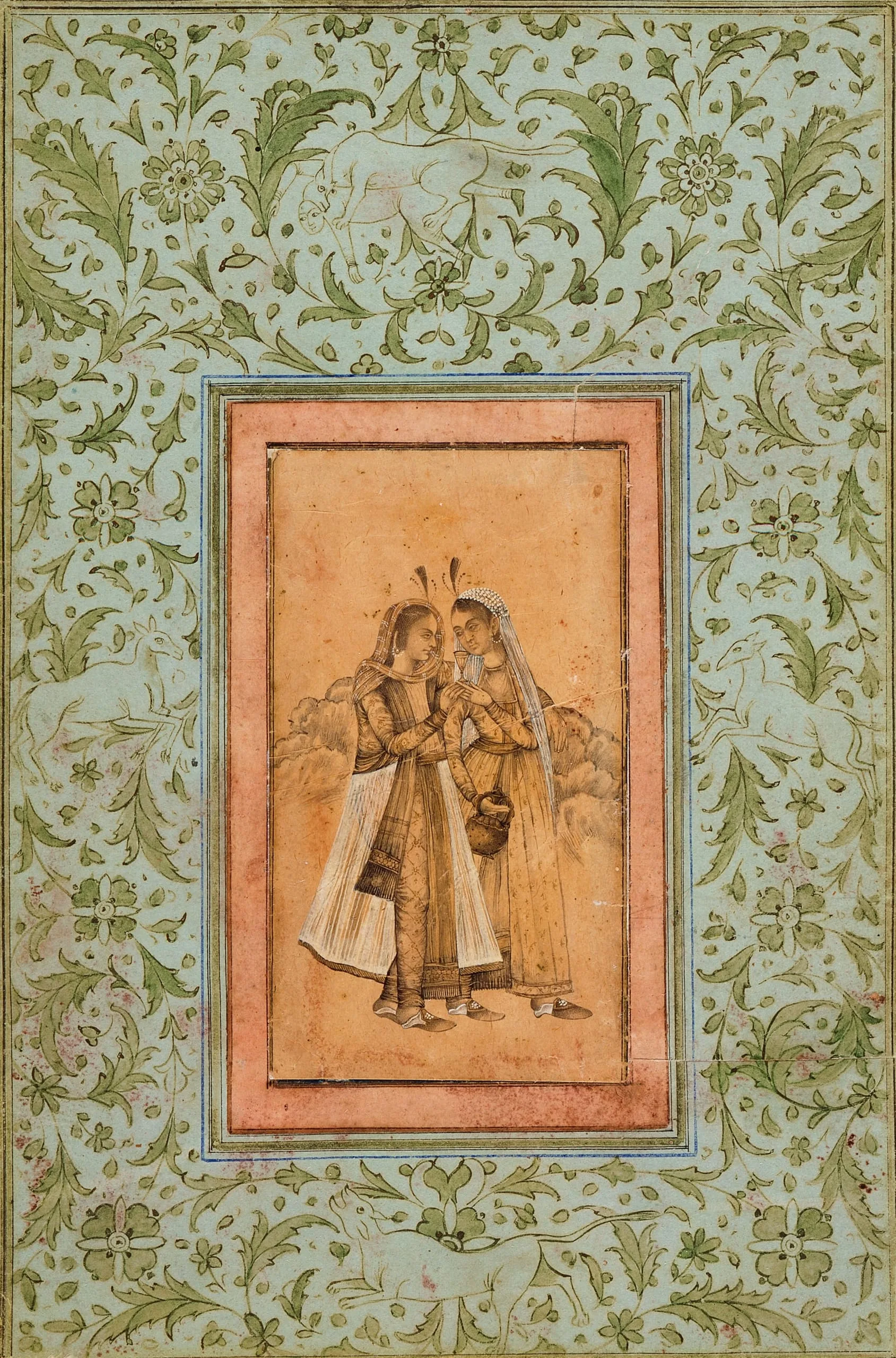
- Women Sharing Wine
- Date Made
- early 18th century
- Medium
- Ink, opaque watercolor, and gold on paper
- Dimensions
- Sheet: 11 3/8 x 7 5/8 in. (28.89 x 19.37 cm); Image: 5 1/4 x 2 7/8 in. (13.34 x 7.3 cm)
- Accession Number
- M.77.154.4
- Curatorial Notes
In this nim qalam (half-pen) lightly tinted drawing, two elegantly attired women are portrayed walking together side-by-side. They look deeply into each other’s eyes while they embrace and share a cup of wine. Their amorous relationship is conveyed by their intertwined fingers holding the wine cup as well as the arm of the woman on the left being draped around her companion’s shoulders. Scenes of female companionship or intimacy in a harem or zenana (women’s quarters) were a popular theme in 18th-century Indian painting. Their encounters include lounging on a terrace while listening to music and partaking of wine and delicacies (see M.72.36.2 and M.84.228.1) and being tenderly consoled by a close confidante or sakhi (see M.77.154.24). These idealized portraits of women imbibing or pining on terraces parallel thematically similar representations of heroines (nayikas) in various emotional states, often yearning to be united with their paramours.
The distinctive wine carafe is a type of two-handled earthenware bottle. It has a globular body with a band of raised flower petals with scalloped edges forming the shoulder. There are two handles with fluted edges, connecting the shoulder to the mouth of the container, which has a domed cap. For a Hyderabad vessel with a similar fluted handle, see a brass ewer in the Victoria and Albert Museum, London (IS.2634-1883). A related typological example attributed to Mumbai, circa 1885 is in the Victoria and Albert Museum (IM.61-1921).
- Selected Bibliography
- Pal, Pratapaditya and Catherine Glynn. The Sensuous Line: Indian Drawings from the Paul F. Walter Collection. Los Angeles: Los Angeles County Museum of Art, 1976.