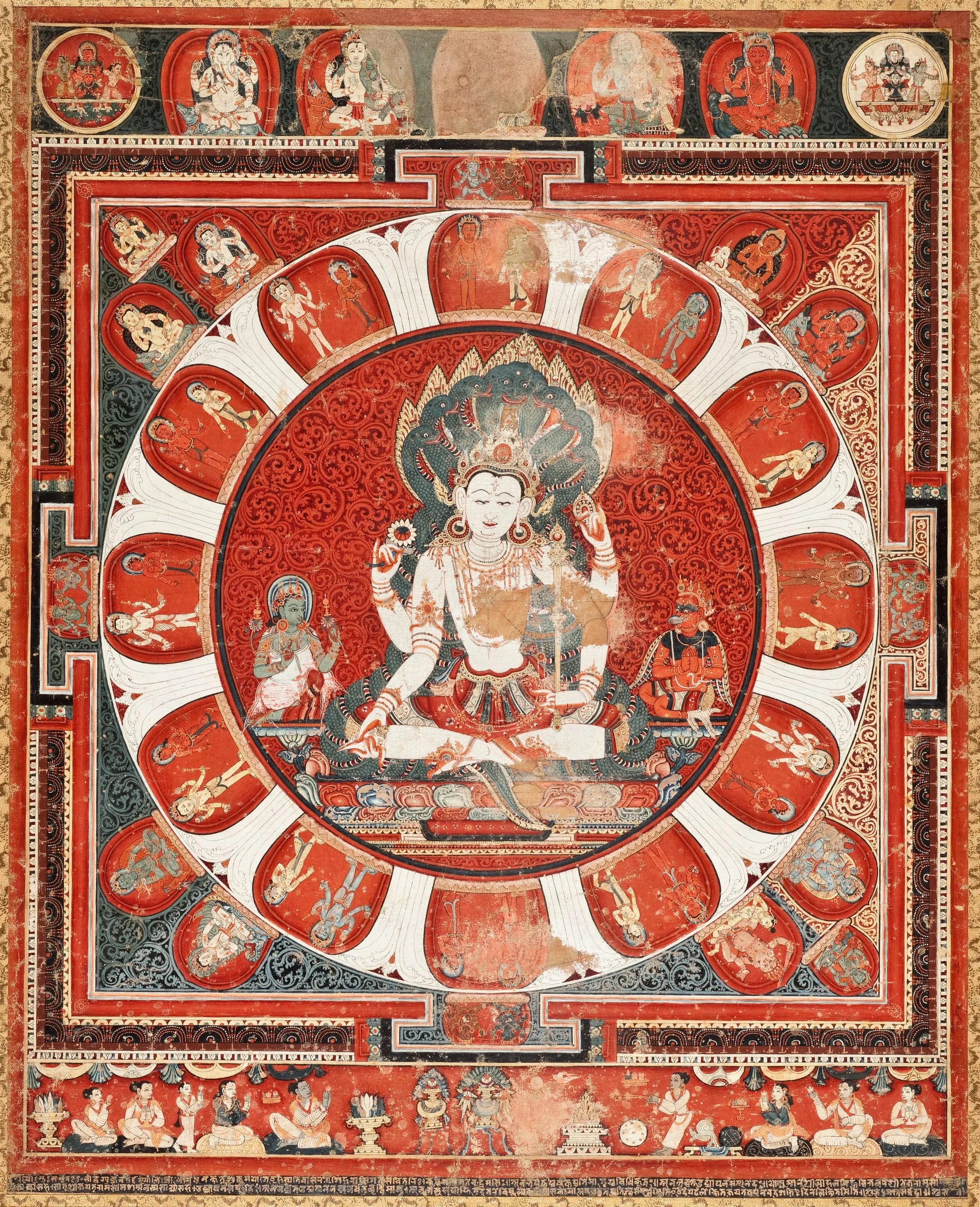
This painting commemorates the performance of the anantavrata (vow to Ananta) ritual which was very popular in Nepal during the later Malla period (1482-1769). During this rite, Vishnu’s serpent Ananta is worshipped by devotees and stories about Vishnu are recited. Often, an image of Vishnu as Ananta would be made of darbha grass, placed in a vessel of water and worshipped. Paintings were commonly made to commemorate the performance of the anantavrata and would be consecrated the same day that the ritual was performed.
At the center of a mandala, Vishnu is depicted seated on the coils of Ananta, flanked by his spouse Lakshmi and his half-avian mount Garuda. Surya, Ganesha, Shiva and Parvati, Vishnu and Lakshmi, Karttikeya, and Chandra are depicted along the top of the painting from left to right, with another deity in the center who is now lost. In the bottom register, the donor, Tejarama, and members of his family are depicted performing the anantavrata rite.
The Sanskrit inscription at the bottom of the painting reads:
In the year 540 [1420 AD] , on Thursday, the fourteenth day of the bright fortnight of the month of Bhadra, during the dhanishtha nakshatra and sukarman yoga, while the sun was in Leo and the moon in Aquarius, [on this day] the Ananta painting, book and image, the ritual [consecrations of all] three were performed. The anantavrata was concluded. The donors were the twice-born Shritejarama Somasharman of Shrilohalanimha together with his wife and younger brother Shrijayatarama Somasharman together with his wife.
The conclusion [of the ritual] was performed. From [the merit of] this bringing to conclusion, may [the donors’] family and wealth increase; from the desire to obtain endless happiness, and in the next world residence in Vishnu’s paradise, the anantavrata was [performed and] consecrated. This painting was painted by Jayateja Puna in ten days. May it be good for all time.
(Translation by Ian Alsop, Dhanavajra Vajracharya, and Hemraj Shakya.)