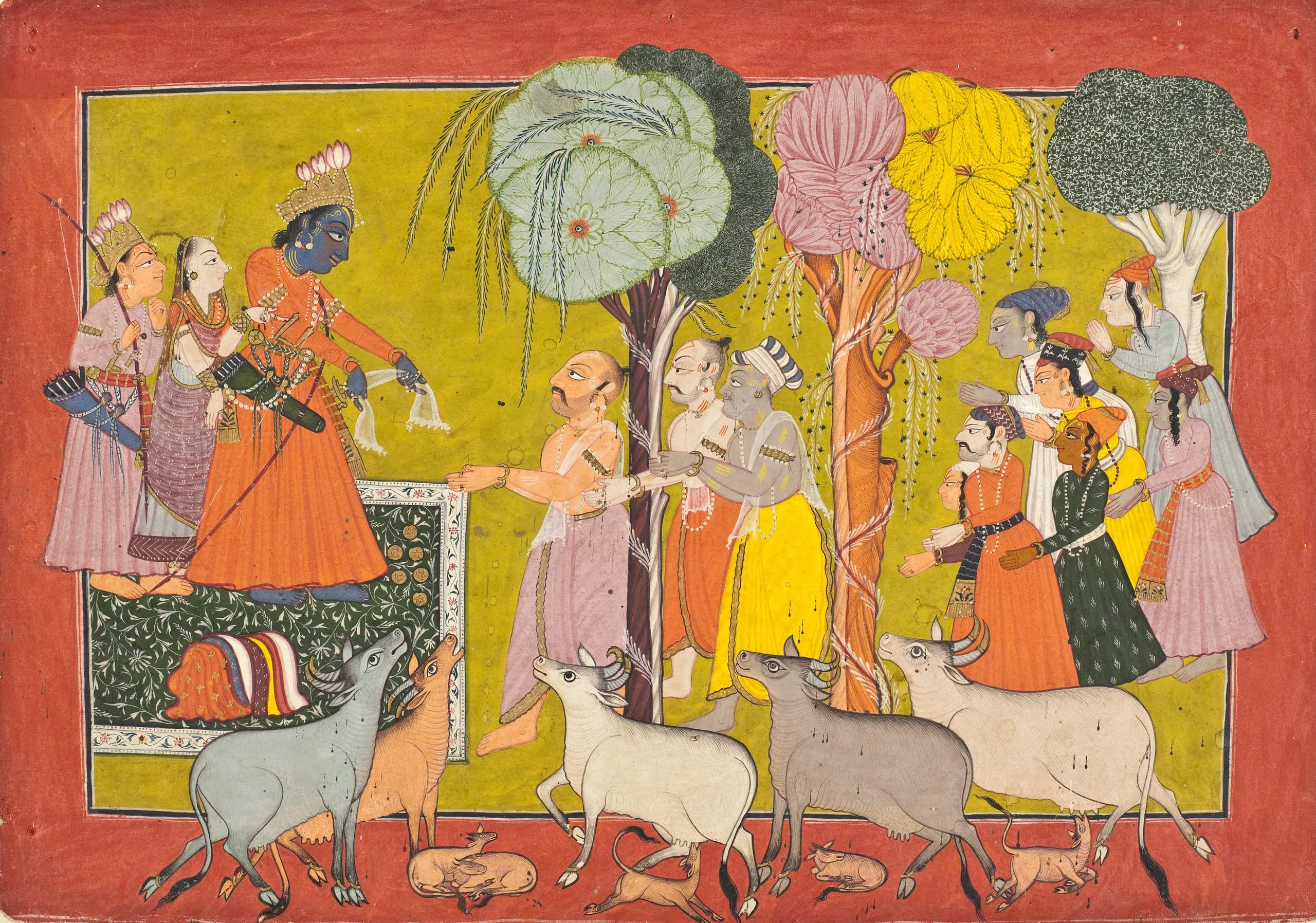
This masterful painting depicts the well-known episode in Book 2 (Ayodhya kanda) of the Hindu epic, the Ramayana (Adventures of Rama), when Prince Rama gives away his possessions before being unjustly banished to his fourteen-year forest exile. He is accompanied by his wife Sita and his brother Lakshmana.
A subtle but critical detail of the painting is the presence of what appear at first glance to be small drips of paint that are strewn across the lower half of the painting. Significantly, all of the “drips” are beneath the level of the blue-skinned Rama’s hands bestowing the scarf, all are precisely rendered circles or teardrops with trailing lines indicating downward directionality, and all stand out against plain backgrounds. Rather than being accidental paint drips or mere rain from the heavens, their proper interpretation can be gleaned from the simile used in the text to describe Rama’s generosity: “Summon the two eminent Brahmins Agastya and Kaushika and in homage shower precious objects on them, Saumitri [Lakshmana], as crops are showered with rain.” (Ramayana 2.29.12)
Thus, the “paint drips” are actually intended to be rain drops that brilliantly symbolize Rama’s largesse in visual terms as an abundance of treasures “raining” on the recipients. The recognition of this visual simile is crucial for definitively identifying the Ramayana verse illustrated by this painting.
This painting, and its series mates M.74.5.11, M.83.105.9, M.87.278.2, and M.91.348.2, are from a widely dispersed large series known as the "Shangri" Ramayana, so called because it was formerly in the ancestral collection of the Shangri branch of the royal family of Kulu, Himachal Pradesh.