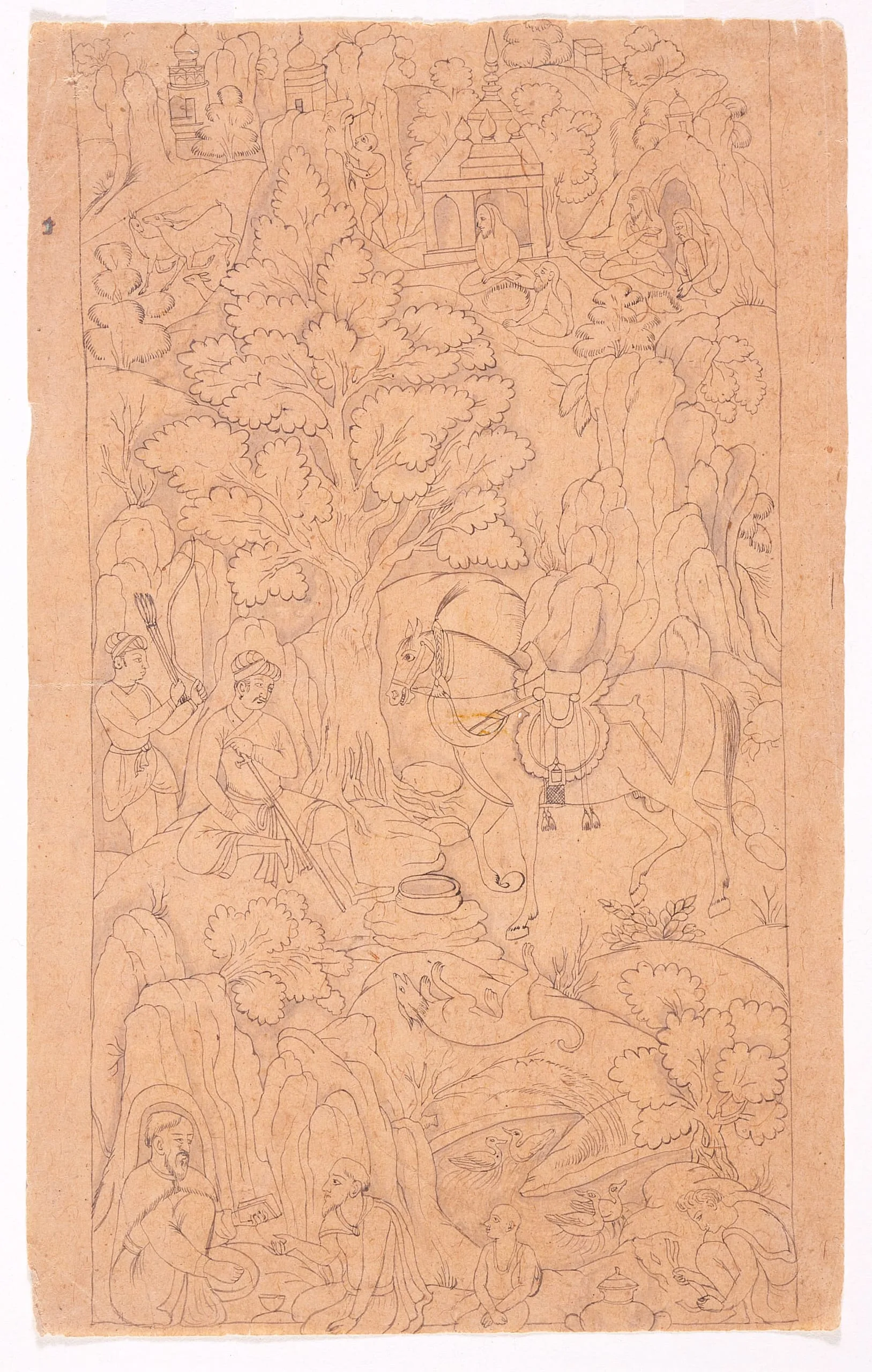
Attributed to early 19th-century Delhi, this ink drawing is a copy of an earlier nim qalam (half-pen) lightly tinted drawing dating from circa 1600–1605 (M.84.32.7). Attributed to the great Mughal painter Miskin (active late 1570s–circa 1604), the original composition likely depicts Prince Salim (the future Emperor Jahangir, r. 1605–1627) resting during a hunt. Pratapaditya Pal has suggested that the folio may have been from a Shikarnama (Hunting Album) prepared for Salim (see also M.83.137). Alternatively, it may have been an expression of a moralistic tale related to those found in the Anvar-i Suhayli (circa 1499–1500) or Khamsa of Nizami (circa 1173–1202). Assuming literary antecedents were the source of the visual motif, then the dog was perhaps poisoned by toxic water from the nearby dog bowl or impulsively killed by the prince for spilling the water. Intriguingly, the footed bowl is overturned in the earlier tinted drawing, but in this later drawing the overturned bowl becomes a basin that is not upended. See M.84.32.7 for an identification of the various vignettes represented in the two artworks. Although there are minor compositional variances, such as the water behind the horse not being clearly delineated in this later drawing, generally the differences are stylistic rather than compositional.
See Robert Del Bontà, "Late or Faux Mughal Painting: A Question of Intent," in After the Great Mughals: Painting in Delhi and the Regional Courts in the 18th and 19th Centuries, ed. Barbara Schmitz (Mumbai: Marg Publications, 2002): pp. 150–152, figs. 1–2; and Catherine Glynn, "An Early Mughal Landscape Painting and Related Works," Los Angeles County Museum of Art Bulletin 20:2 (1974), p. 66.