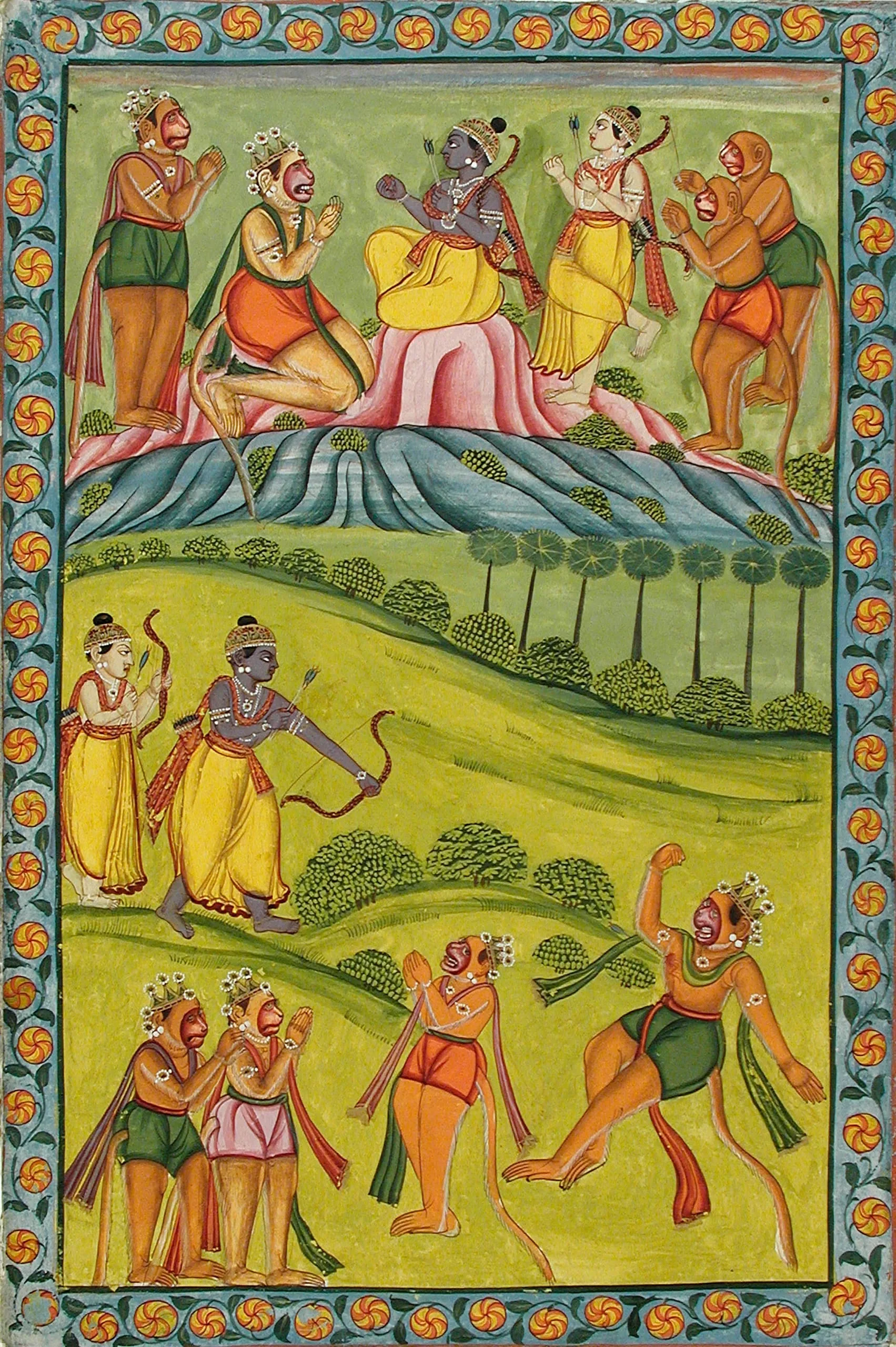
The Ramayana narrates the epic saga of the valiant Prince Rama and his dutiful wife, Princess Sita, who was abducted by Ravana, the arrogant ten-headed King of Lanka (probably modern Sri Lanka), during Rama's unjust fourteen-year forest exile. To rescue Sita, Rama and his faithful brother Lakshmana assembled a great army of monkeys and bears led by the Monkey-King Sugriva and his Monkey-General Hanuman. After several magical battles, the princess was freed, and the happy couple triumphantly returned home to rule Ayodhya. Rama and Sita epitomize the ideal ruler and the paragon of fidelity in traditional Hindu culture.
In this painting, the technique of continuous narration is employed so that principal characters are repeated as the action unfolds. In the upper register, Rama and Lakshmana meet with Sugriva, who sought Rama’s help after his wife was seduced by his brother Vali. In the lower section, Rama shoots an arrow to kill Vali for his immorality.
On the reverse are two stamped impressions. The first is a seal dated 1775 of Sir Elijah Impey (1732-1809), the Chief Justice of the Supreme Court of Calcutta (1773-1782). The second is the signature of Dr W.B. Manley (1885-1972), who served in the Indian Police in the Bombay Presidency from 1905-1924 and as an officer in the Bengal Lancers from 1917-1919.
Additional folios from this dispersed series are in the British Library, London (Add.Or.5725) and the Asian Art Museum, San Francisco (2011.22).