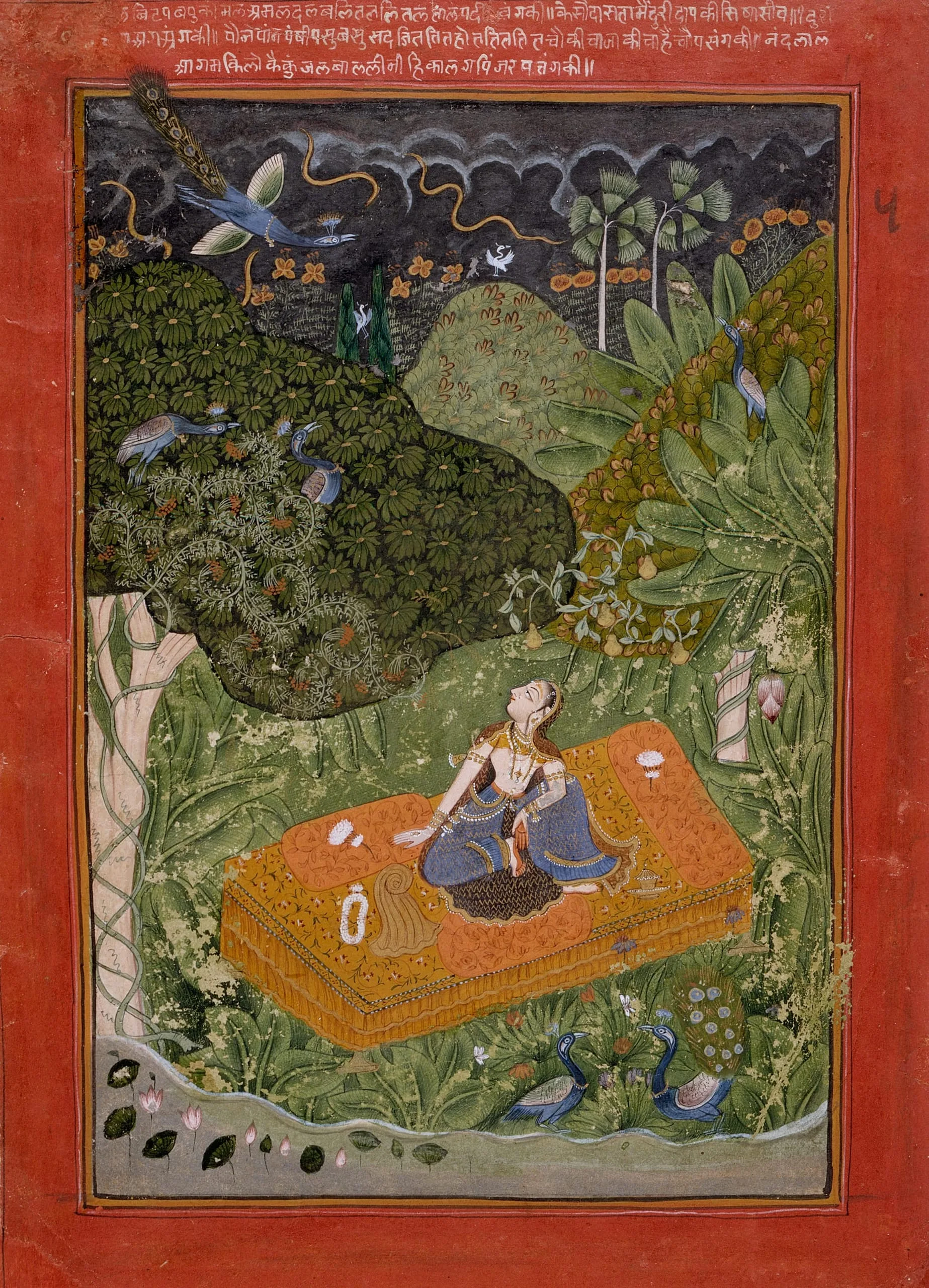
The Rasikapriya (Connoisseur’s Delights) was composed in 1591 in the Hindi dialect of Braj-Bhasa by the poet Keshavdas (1555–1617). He was the court poet of Kunwar Indrajit Singh and Raja Bir Singh Deo of Orchha (r. 1605-1627). The text portrays Radha and Krishna as ideal lovers and enumerates the eight archetypal male and female lovers (nayakas/nayikas) and their corresponding emotions and encounters.
This folio [#5] illustrates the Utka Nayika (Rasikapriya 7:211):
The nayika whose dear spouse restrained
By some cause, comes not to his home,
And with this grief whose heart is pained,
She is an utka nayika known.
(Translation by K. P. Bahadur.)
An almost identical version of this composition was formerly in the Stuart Cary Welch Collection, New Hampshire. The difference is noticeable in the treatment of the minor details. For example, the blossoming plant in the upper right corner of the LACMA painting has five blossoms, whereas there are only four blossoms in the corresponding plant in the Welch painting. Milo Beach has attributed the Welch painting to Mira Bagas (or Mir Baksh, active circa 1743-1777), who worked under Rao Raja Sardar Singh of Uniara (r. 1740-77). See Milo Beach, Rajput Painting at Bundi and Kota (Ascona: Artibus Asiae, 1974), fig. 54.
For an alternate subject identification and translation by V. P. Mishra, see Harsha V. Dehejia, Rasikapriya: Ritikavya of Keshavdas in Ateleirs of Love (New Delhi: D.K. Printworld, 2013), pp. 80, 225, verse and fig. 17.11.