LACMA

ShopMembershipMyLACMATickets
LACMA
Los Angeles County Museum of Art
5905 Wilshire Blvd.
Los Angeles, CA 90036
info@lacma.org
(323) 857-6000
Sign up to receive emails
Subscribe
© Museum Associates 2025

Museum Hours

Monday

11 am–6 pm

Tuesday

11 am–6 pm

Wednesday

Closed

Thursday

11 am–6 pm

Friday

11 am–8 pm

Saturday

10 am–7 pm

Sunday

10 am–7 pm


  • About LACMA
  • Jobs
  • Building LACMA
  • Host An Event
  • Unframed
  • Press
  • FAQs
  • Log in to MyLACMA
  • Privacy Policy
© Museum Associates 2025
Collections

Unknown
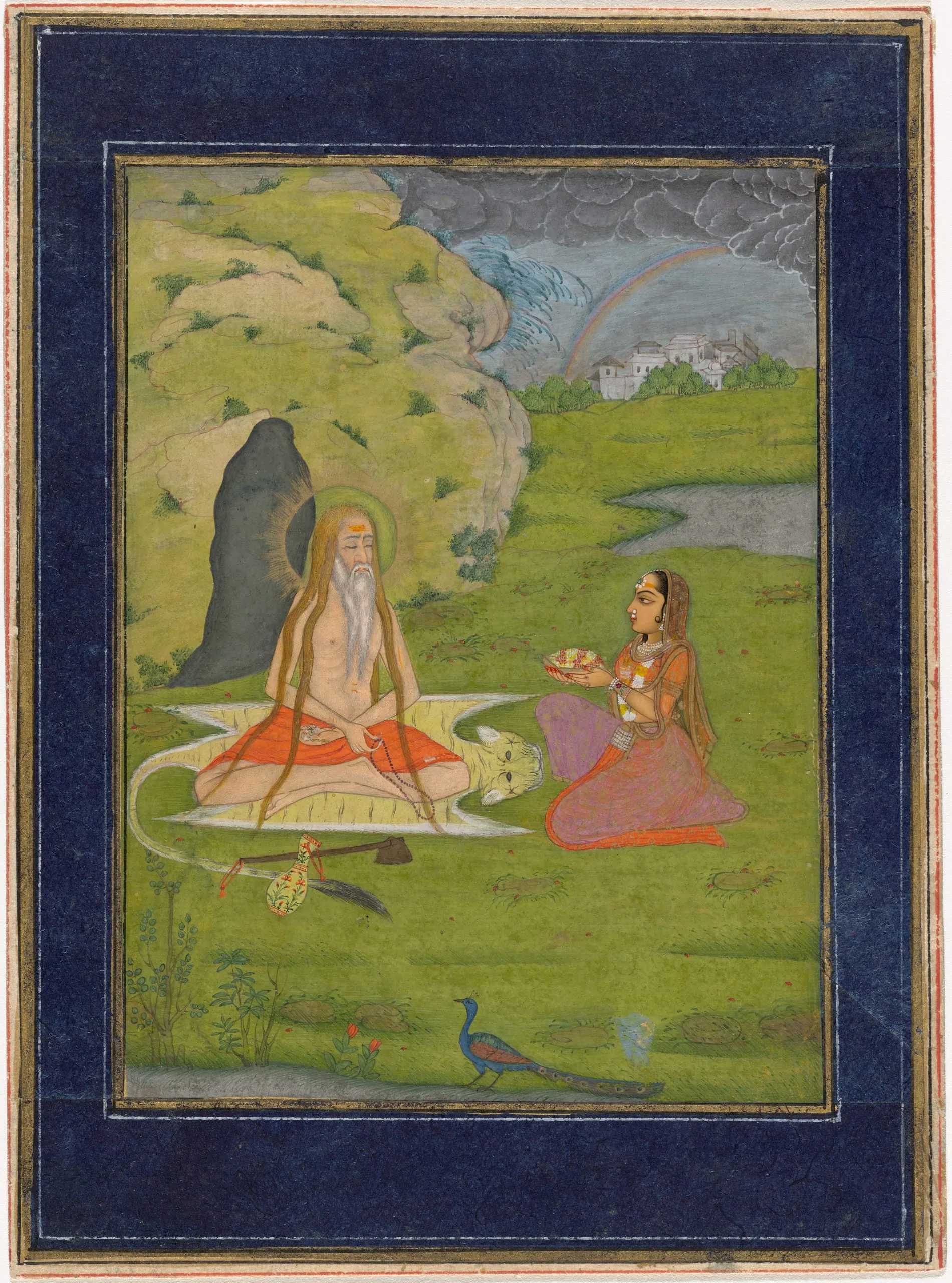
An Ascetic Receiving an Offering from a Courtly Womancirca 1725-1750

Not on view
Indian miniature painting, two figures on a green lawn — a bare-chested elderly man seated cross-legged and a young woman offering a tray — with rocky outcroppings, rainbow, and stormy sky
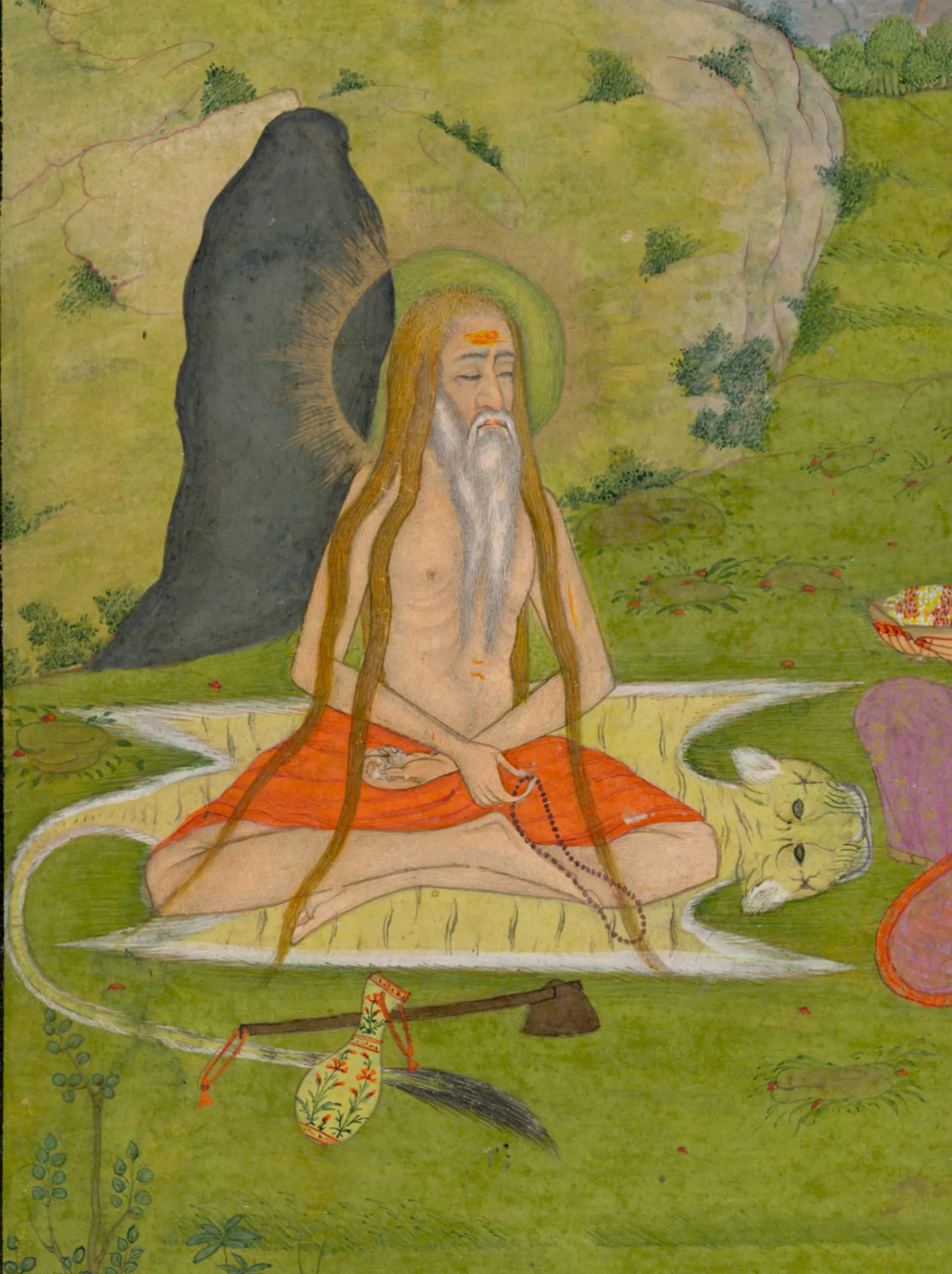
Mughal-style opaque watercolor of a seated ascetic in meditation pose on a tiger skin, wearing an orange dhoti with long white beard and halo, holding prayer beads, a rocky landscape behind him, small axe and bag in foreground.
Artist or Maker
Unknown
Title
An Ascetic Receiving an Offering from a Courtly Woman
Place Made
India, Rajasthan, Bikaner
Date Made
circa 1725-1750
Medium
Opaque watercolor, gold, and silver on paper
Dimensions
5 5/8 x 4 5/16 in. (14.2875 x 10.9538 cm) Frame: 19 × 14 in. (48.26 × 35.56 cm)
Credit Line
Purchased with funds provided by Dorothy and Richard Sherwood
Accession Number
M.72.88.2
Classification
Drawings
Collecting Area
South and Southeast Asian Art
Curatorial Notes

Hindu ascetics adept in yogic and tantric practices have been performing austerities in South Asia for millennia. Male ascetics (yogis or sadhus) are often members of a Shaiva sect worshipping the god Shiva. Female ascetics (yoginis) are often theologically affiliated with Parvati, Durga, or other Shaiva goddesses. Painted and sculpted images of male and female ascetics were common as both primary and ancillary subjects, including representations of royal supplicants seeking their guidance or blessings (see M.87.20.2). During the 18th century in particular, numerous northern Indian paintings depicted scenes of a princess or courtly woman visiting and venerating ascetics (see M.81.271.10 and AC1997.30.1).

In this painting, an elegantly attired princess wearing profuse pearl jewelry, an enameled wrist cuff, and a floral garland kneels to offer a bowl of floral garlands to a sadhu seated in front of his mountain cave. The sadhu’s esteemed spiritual presence is indicated by his halo. His ascetic nature is conveyed by his three horizontal sectarian markings (tiryakpundra), long dreadlocks, stylized treatment of his ribcage attesting to his austerities, and yogic “lotus posture” (padma asana). His ascetic attributes include his rosary, tiger skin rug, and a water flask and ladle used for holy water in religious rites. Interestingly, the water flask is adorned with flowering plants and may be intended as a ceramic vessel. In the distance, a rainbow heralds the auspicious occasion.
Selected Bibliography
  • Trabold, J. The Art of India, An Historical Profile. Northridge, CA: California State University Press, 1975.