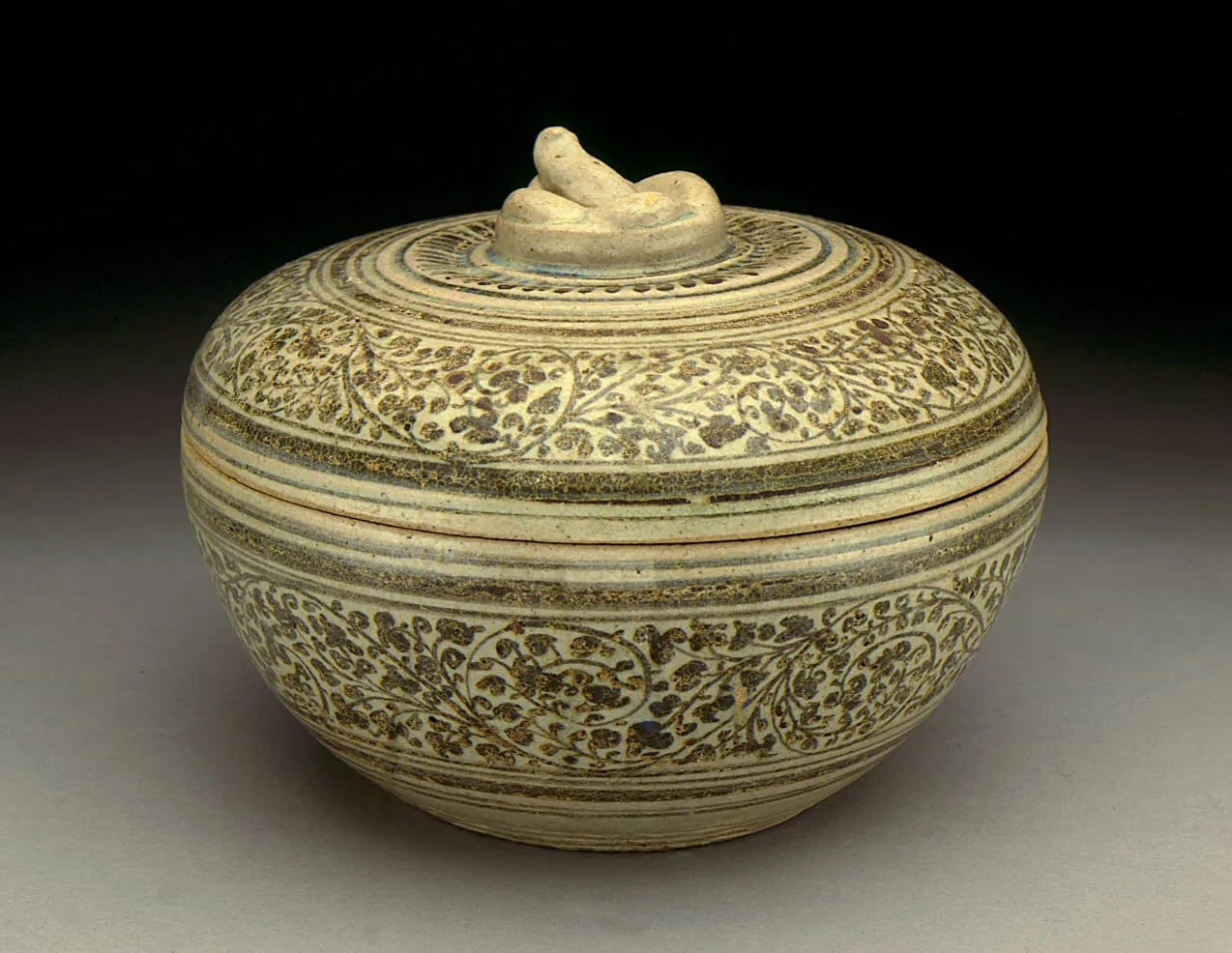
From the fourteenth to sixteenth centuries Thai ceramics enjoyed brisk production and wide dispersal throughout Southeast Asia. The friendly interaction of the emerging Thai state with China and other Southeast Asian states assured an exchange of goods and technology and aided their success. Trade contact with the hard-bodied, glazed, nonporous ware of China and Vietnam spurred development of indigenous Thai earthenware and stoneware.
Examples of Thai ceramics have survived in burial sites of the Southeast Asian archipelago and in waste heaps of Thai kiln sites and are preserved among temple and heirloom treasures. Recent archaeological discoveries reveal that both Sukhothai and Sawankhalok ware were prominent in the ceramic trade during the fifteenth century. According to textual sources, the kilns at Sawankhalok eventually superseded those at Sukhothai and prospered until the sixteenth century.
Sukhothai potters produced bowls, heavy jars, and roof tiles in a coarse-bodied glazed ware with underpainted dark brown designs. Sawankhalok potters, with a better-quality clay, made a variety of small delicate vessels, antic figurines, containers, and architectural ornaments. Bisque and glazed, Sawankhalok ware had underglaze iron-black decoration and a glaze of brown, pearly white monochrome, or green celadon.
This unusually large, fruit-shaped covered bowl is a characteristic Thai form. The bowl is decorated with iron-black scrolls over gray slip. Its clear glaze, tinged blue where it pools, is typical of Sawankhalok ware.