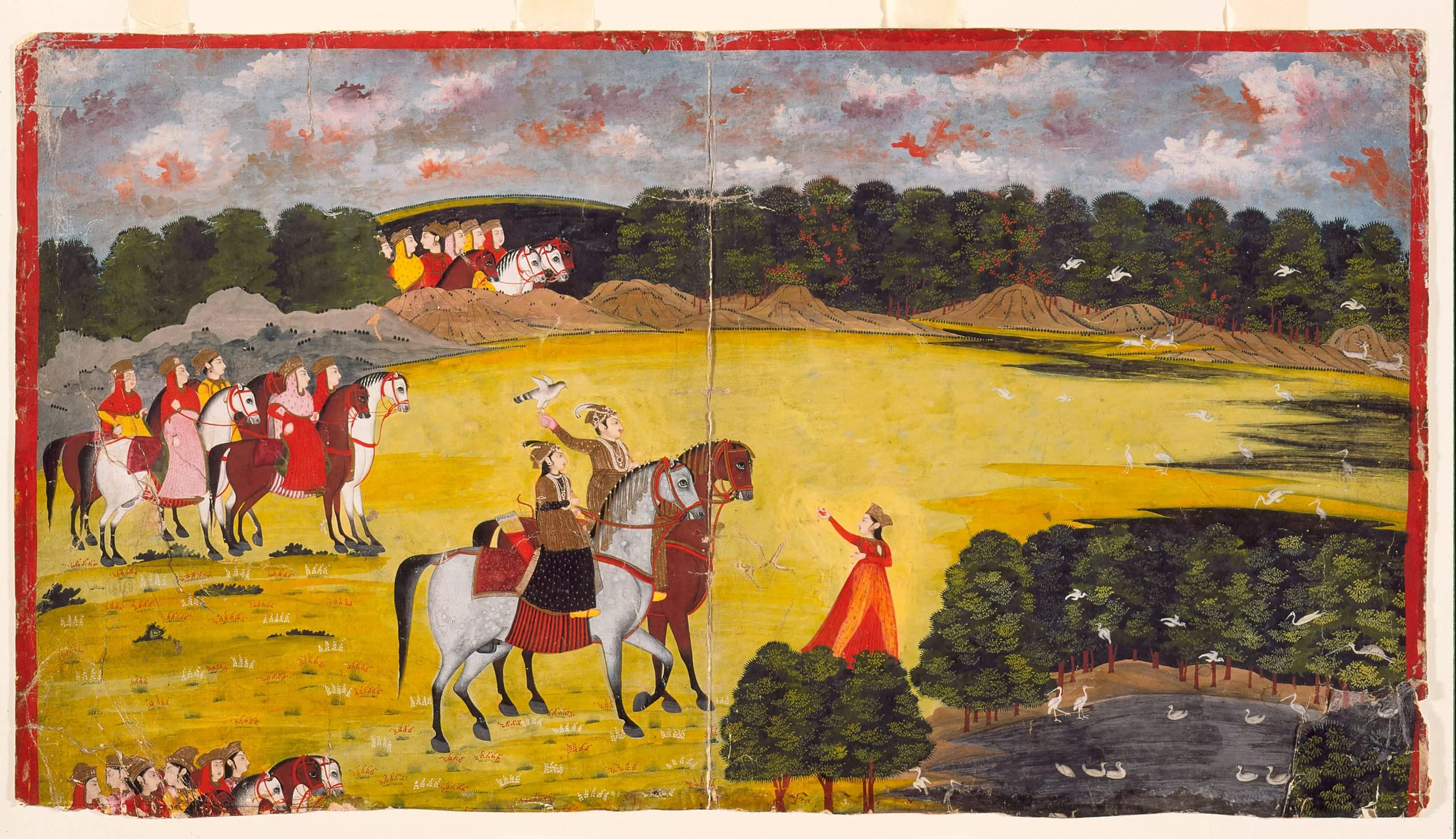
This painting illustrates the famous love story of Sultan Baz Bahadur (r. 1555-1562) and his beloved Hindu Queen Rupmati who ruled the Malwa Sultanate from the capital of Mandu. Baz Bahadur and his forces were defeated by the invading Mughal army of Emperor Akbar (r. 1556-1605) in the battle of Sarangpur in 1561. Rupmati was captured and, in accordance with the age-old Hindu marital practice, virtuously committed suicide. According to the tragic tale, Rupmati kept her husband from straying by joining him on midnight hunts. Illustrations of the royal couple hunting typically portray them on horseback riding through a forest or hunting antelope or sometimes hawking.
In this painting, Baz Bahadur and Rupmati are on horseback together in the center of the composition. A trained falcon for hunting small prey is about to take flight from Baz Bahadur’s upraised arm. A female falconer (curiously shown without a gauntlet) beckons before them to receive the raptor. Three groups of courtly maidens on horseback accompany them. The composition is related to another rendition from circa 1740-1750 that is attributed to Mir Kalan Khan (active circa 1730-1780), now in the Eva and Konrad Seitz Collection and on loan to the Metropolitan Museum of Art, New York. The treatment of the landscape is similar to that of M.71.49.5.
See also M.77.154.5, M.80.55, and M.81.271.11.