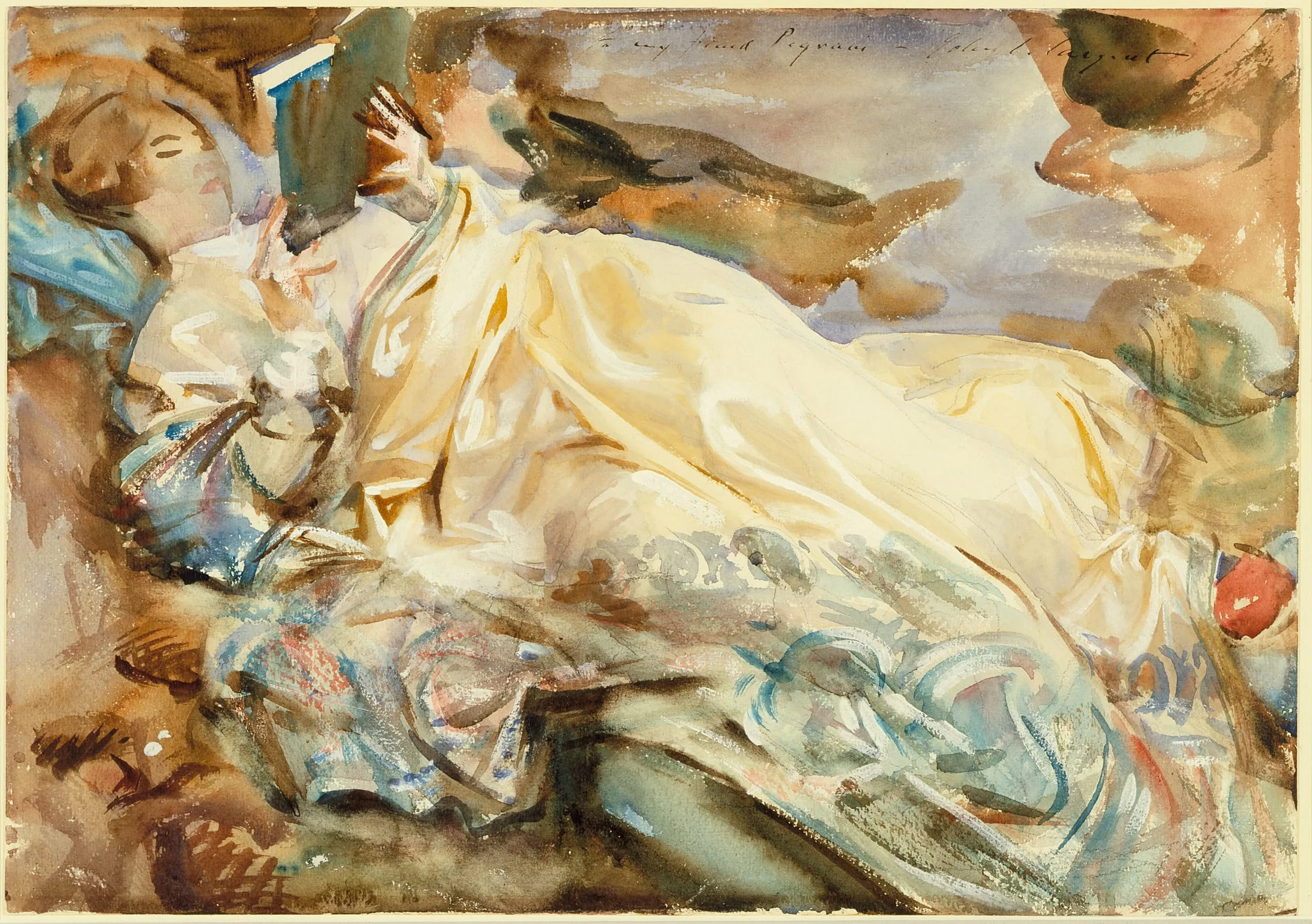
Rose-Marie Ormond (1893-1918), daughter of John Singer Sargent’s sister; Violet Sargent Ormond, was one of the artist’s favorite models during his later years. Weary of portrait painting, around 1908 Sargent turned increasingly to more informal figurative paintings in oil and watercolor. At about the same time he also began summering with the Ormond family in the Alps, near Val d’Aosta and Simplon. During these vacations he painted many compositions of young women reclining in open landscapes. Often they are draped in elegant cashmere shawls, as is Rose-Marie in this watercolor. Although the shawl -- which would have come from Kashmir or have been derived from Kashmiri prototypes -- may have been an allusion to Rose-Marie’s fondness for reading Mughal poetry, Sargent no doubt included the wrap because of its decorative character; and in this watercolor the drape’s ornamental design becomes a maze of loose brush strokes surrounding the figure.
Sargent found that sketching in watercolor enabled him to combine drawing with painting. A virtuoso of bravura brushwork, Sargent here used techniques ranging from dry brush in the shawl to wet-into-wet strokes in the foreground. Utilizing transparent washes, gouaches, and the white of the paper, Sargent captured the brilliance of reflected sunlight. Rose-Marie’s white dress picks up the blues and browns cast by her surroundings. The colors, flickering sunlight, and mass of zigzag and circular strokes contribute to an active optical impression, which at first hinders the reading of the image. In his Alpine watercolors Sargent moved a step closer to abstraction as color and brushwork assumed precedence over narration.
Sargent gave the painting to Henry Alfred Pegram (1862-1937), a minor English sculptor, and it remained in his family’s possession until acquired by the museum.