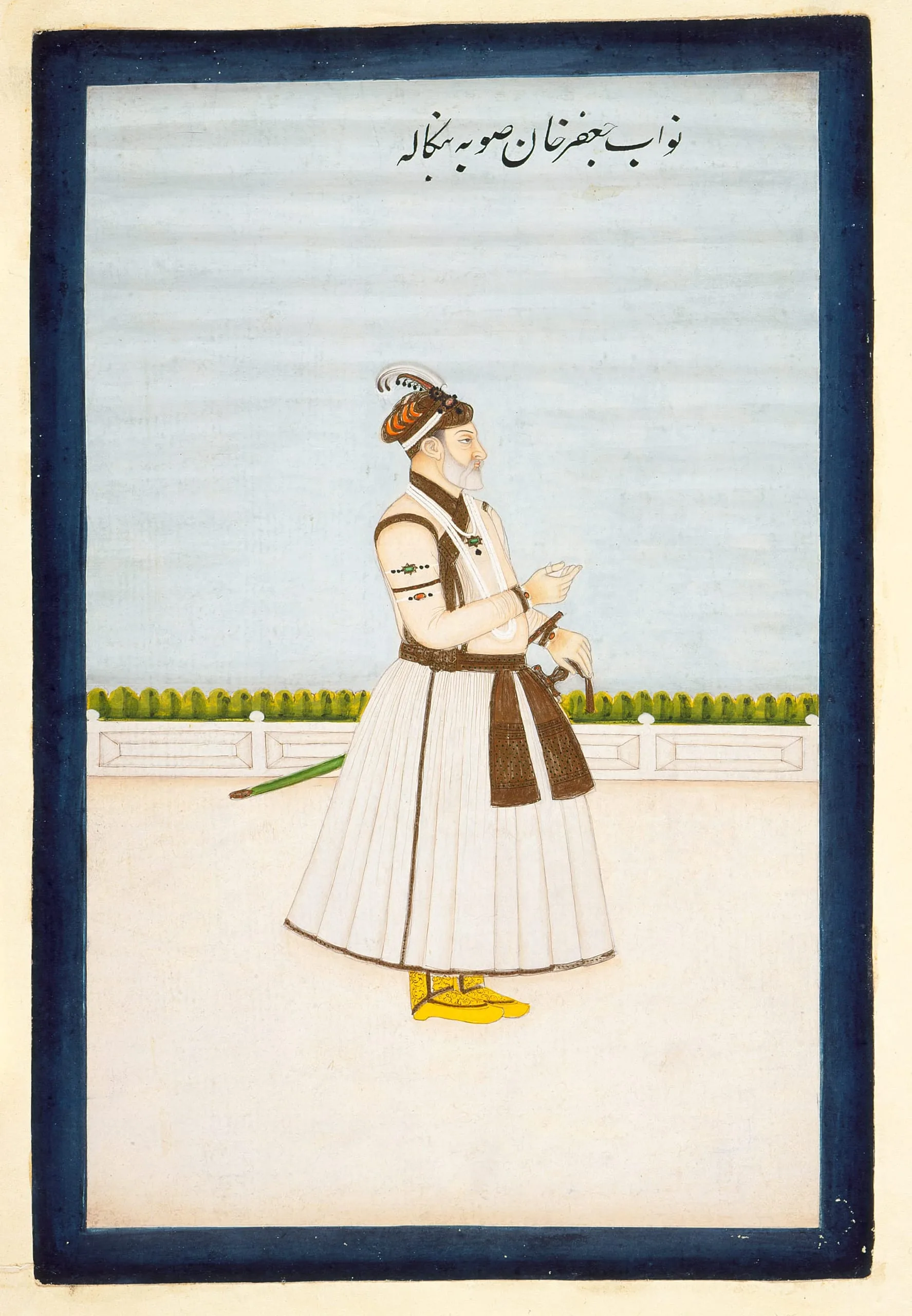
The inscription on this portrait identifies the subject as Nawab Jafar Khan. This is very likely Sayyid Mir Jafar Ali Khan Bahadur, known as Mir Jafar (1691-1765). He was the governor (nawab) of the Mughal province of Bengal (modern Bangladesh, West Bengal, Bihar, Jharkhand, and Odissa [formerly Orissa]) in 1757-1760 and 1763-1765. He was previously the commander of the Bengali army under Siraj al-Daula, the Nawab of Bengal (r. 1756-1757), but defected to the British under Major-General Robert Clive (1725-1774) during the Battle of Plassey in 1757 and was installed as the new puppet Nawab of Bengal.
Mir Jafar wears an orange-and-gold turban adorned with a feather plume, jigha (ornament similar to an aigrette), and a sarpati (horizontal tripartite ornament). Around his neck he has strands of pearl with an emerald pendant. He wears an emerald armlet, a ruby armlet and matching bracelets, and an archer’s thumb ring (zihgir; see AC1995.168.1). Around his waist is a gold brocaded sash that matches the gold brocaded border and trimming where his long coat (jama) is tied under his right shoulder, indicating he is a Muslim. He has yellow shoes with floral scrolls. Tucked into his sash on his far side is a sword and the handle of a push dagger (katar; see M.74.101a-b).
On the reverse is a stamped signature of the English collector Dr W.B. Manley (1885-1972), who served in the Indian Police in the Bombay Presidency from 1905-1924 and as an officer in the Bengal Lancers from 1917-1919.