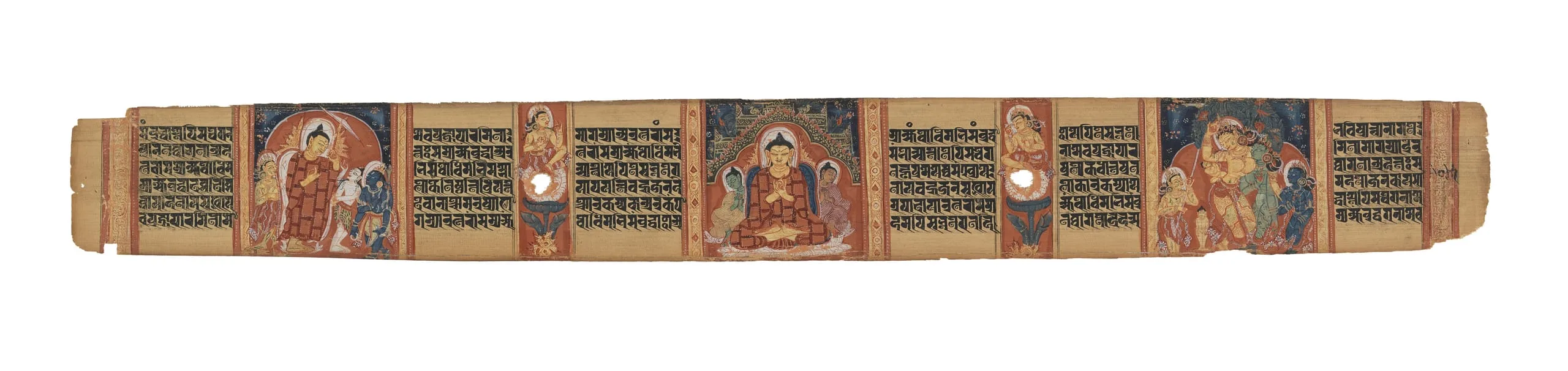
The Ashtasahasrika Prajnaparamita (Perfection of Wisdom in 8,000 Verses) is one of the most basic texts of Mahayana Buddhist philosophy. As commissioning a copy of this text and donating it to a monastery was considered to be an especially meritorious act, Nepalese and Tibetan monks and pilgrims brought numerous copies of this sacred text back with them to their own monasteries where they in turn inspired local artists.
Manuscripts of the text were often illustrated with scenes of the eight important episodes from the life of the Buddha (traditionally dated to 563–483 BCE). Three such events are depicted here. The scene on the right is the birth of the Buddha in the Lumbini Park, Nepal. Queen Mayadevi, represented with yellow skin, stands under a flowering Sala tree (Shorea robusta) while the infant Buddha issues forth from her side with his hands joined in the gesture of adoration (anjali mudra). The child is shown again standing to her right, which likely symbolizes the seven steps he took immediately after his first bath to announce his spiritual sovereignty over the world. Mayadevi’s sister, the green-skinned Mahaprajapati, supports her sibling. To their right, Indra, the king of the gods, holds an honorific parasol over Mayadevi. An unidentified blue-skinned goddess completes the ensemble on the other side of Mahaprajapati. The central scene depicts the great miracle of Shravasti when the Buddha multiplied himself in front of a congregation of heretics to establish his superior magical abilities. The larger central Buddha has his hands held in the teaching gesture of Turning the Wheel of the Law (dharmachakra mudra). He is flanked by two smaller Buddhas wearing different colored robes. All three Buddhas sit on a lotus base underneath a tiered shrine. The scene on the left depicts the miracle of the Buddha’s descent from the Trayastrimsha Heaven at Sankisya, Uttar Pradesh. The Buddha stands in the center of a white nimbus and aureole (prabhavali) wearing his customary patchwork robe. Behind him, the yellow-skinned Indra with his thousand eyes holds an honorific parasol over the Buddha. In front of him, two Hindu gods stand: An ash-colored Shiva with a third eye and wearing a tiger skin around his waist and the four-armed, blue-skinned Vishnu holding his conch, lotus, and mace attributes with his fourth hand held in front of his chest in what may be the gesture of discourse (vitarka mudra). There are two scene dividers with yellow-skinned figures seated on lotuses.