LACMA

ShopMembershipMyLACMATickets
LACMA
Los Angeles County Museum of Art
5905 Wilshire Blvd.
Los Angeles, CA 90036
info@lacma.org
(323) 857-6000
Sign up to receive emails
Subscribe
© Museum Associates 2025

Museum Hours

Monday

11 am–6 pm

Tuesday

11 am–6 pm

Wednesday

Closed

Thursday

11 am–6 pm

Friday

11 am–8 pm

Saturday

10 am–7 pm

Sunday

10 am–7 pm


  • About LACMA
  • Jobs
  • Building LACMA
  • Host An Event
  • Unframed
  • Press
  • FAQs
  • Log in to MyLACMA
  • Privacy Policy
© Museum Associates 2025
Collections

Unknown
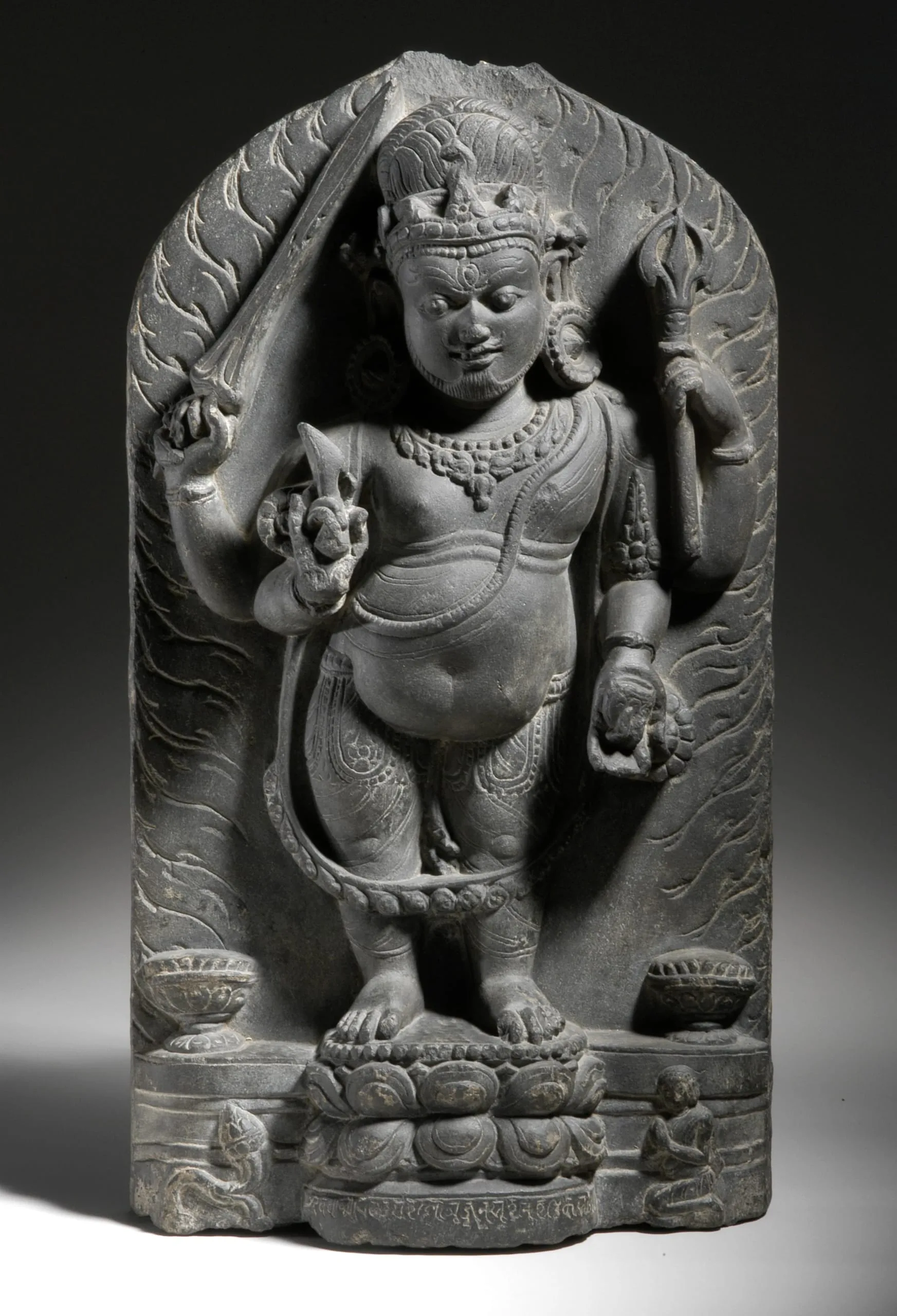
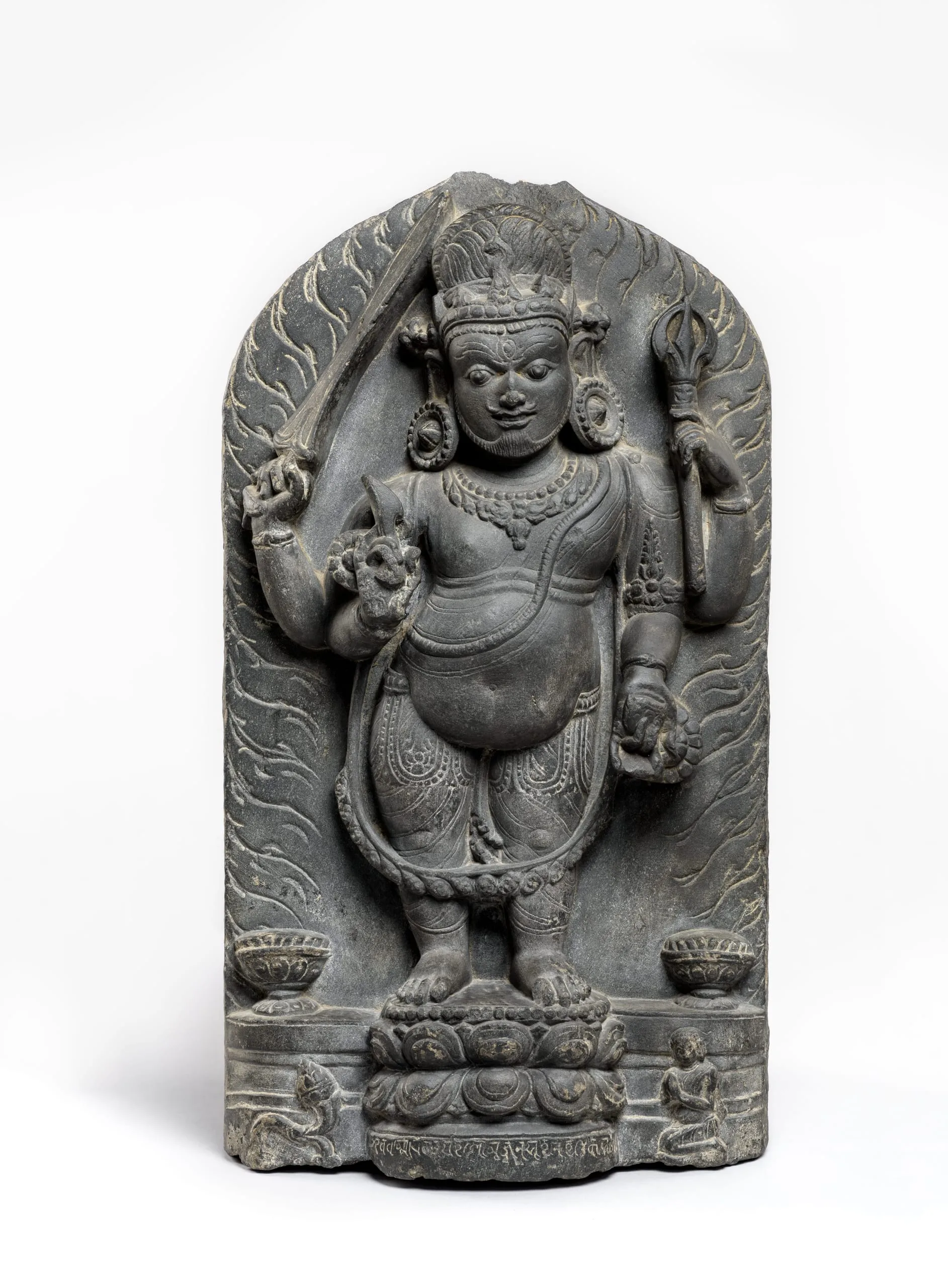
The Buddhist Deity Wisdom Mahakala (Jñana Mahakala)circa 9th century

On view:
Resnick Pavilion, floor 1
Dark gray stone relief sculpture of a four-armed deity with crown and jewelry, standing on a lotus base within a flame-bordered arch
Dark gray stone stele depicting a four-armed standing deity in tribhanga pose atop a lotus pedestal, adorned with crown, necklaces, and ornamental bands, holding a sword, lotus, and additional attributes, set within a flame-edged arch with two small offering vessels at the base.
Artist or Maker
Unknown
Title
The Buddhist Deity Wisdom Mahakala (Jñana Mahakala)
Place Made
India, Bihar
Date Made
circa 9th century
Medium
Chlorite schist
Dimensions
14 1/4 x 7 7/8 x 2 5/8 in. (36.2 x 20 x 6.67 cm)
Credit Line
Gift of Paul F. Walter
Accession Number
M.71.110.3
Classification
Sculpture
Collecting Area
South and Southeast Asian Art
Curatorial Notes

By the 9th century, eastern Indian artists during the Pala Dynasty (750–1161) had developed a visual vocabulary for the depiction of various wrathful and protective deities associated with early esoteric formulations of Buddhist doctrine and practice. Such deities are often terrifying to behold in later Vajrayana Buddhist art. Pala artists portrayed them more benignly, as can be seen in this 9th-century sculpture of Jñana (Wisdom) Mahakala (Great Black One). Such images, complex in iconography and symbolism, derived from much earlier representations of bodhisattvas with fierce dwarf attendants. While these attendant figures have parallels in the personified weapons of Hindu gods, in a Buddhist context they represent a bodhisattva’s protective powers.

Mahakala holds a flaying knife (kartrika) and the sword of transcendental wisdom (prajna) in his right hands, weapons to destroy obstacles on the Buddhist path. In his left hands, he holds a ritual staff (khatvanga) and an offering cup. Two offering bowls are on the plinth flanking him. On the base are the donor monk and a censer. The image is surrounded by an aureola of flames.

The dedicatory inscription on the lotus pedestal reads,

Success! This is a meritorious gift of Nanudika, the son of Shoañjana.

(Translation by Gouriswar Bhattacharya.)
Selected Bibliography
  • Little, Stephen, Tushara Bindu Gude, Karina Romero Blanco, Silvia Seligson, Marco Antonio Karam. Las Huellas de Buda. Ciudad de México : Instituto Nacional de Antropología e Historia, 2018.
  • Little, Stephen, and Tushara Bindu Gude. Realms of the Dharma: Buddhist Art across Asia. Los Angeles: Los Angeles County Museum of Art, 2025.