LACMA

ShopMembershipMyLACMATickets
LACMA
Los Angeles County Museum of Art
5905 Wilshire Blvd.
Los Angeles, CA 90036
info@lacma.org
(323) 857-6000
Sign up to receive emails
Subscribe
© Museum Associates 2025

Museum Hours

Monday

11 am–6 pm

Tuesday

11 am–6 pm

Wednesday

Closed

Thursday

11 am–6 pm

Friday

11 am–8 pm

Saturday

10 am–7 pm

Sunday

10 am–7 pm


  • About LACMA
  • Jobs
  • Building LACMA
  • Host An Event
  • Unframed
  • Press
  • FAQs
  • Log in to MyLACMA
  • Privacy Policy
© Museum Associates 2025
Collections

Unknown
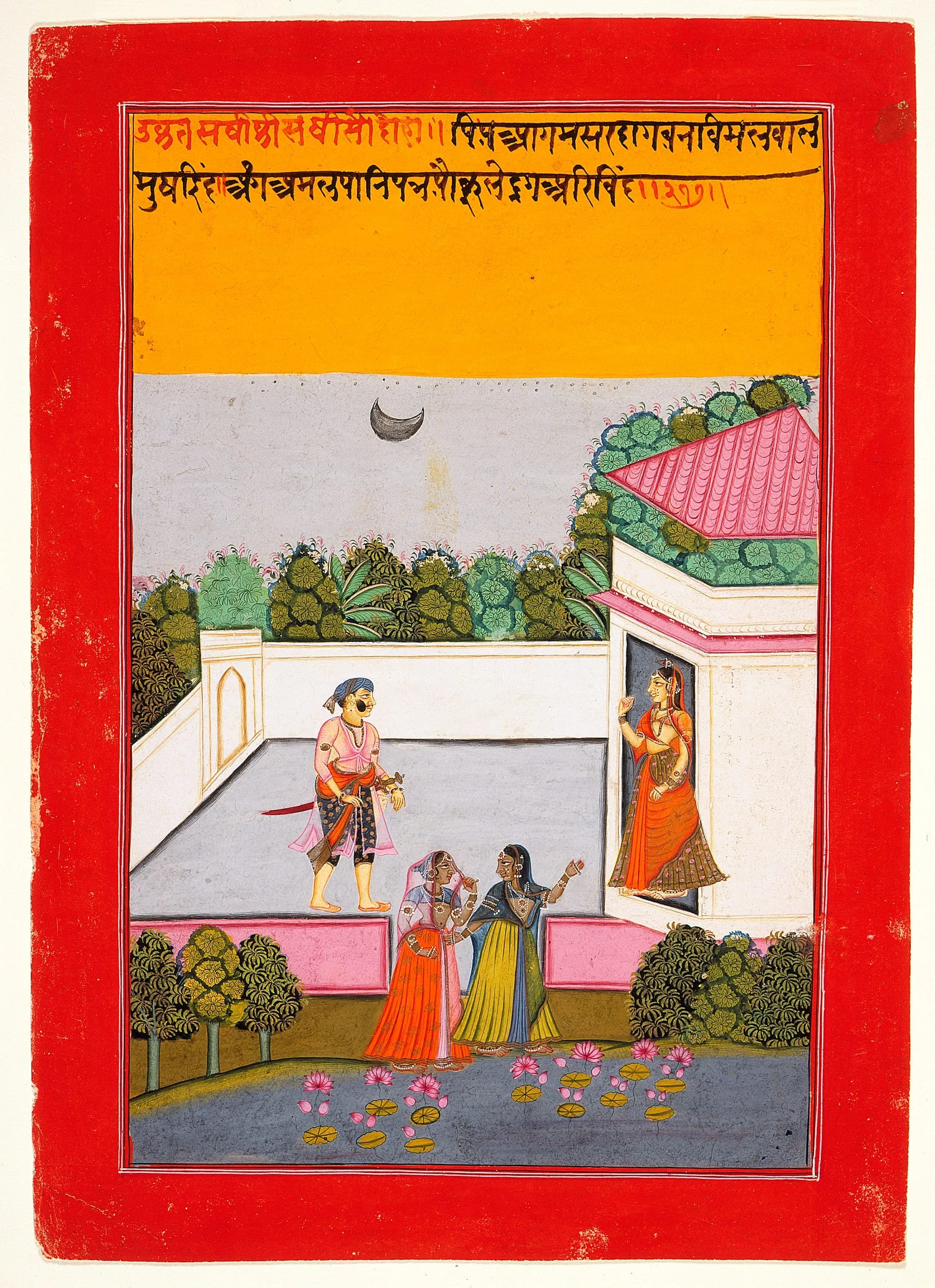
Pleasure at the Lover's Arrival (Madhya Agatapatika), Folio from a Rasraj (King of Sentiment) of Matiram (1603-1693 or 1617-1716)circa 1770

Not on view
Indian manuscript painting with figures on a terrace: a blue-skinned male figure faces two women in colorful saris, with a fourth woman visible in a doorway, lotus pond below, and text in Indic script above
Artist or Maker
Unknown
Title
Pleasure at the Lover's Arrival (Madhya Agatapatika), Folio from a Rasraj (King of Sentiment) of Matiram (1603-1693 or 1617-1716)
Place Made
India, Madhya Pradesh, Datia
Date Made
circa 1770
Period
18th century
Medium
Opaque watercolor, gold, silver, and ink on paper
Dimensions
Sheet: 12 7/8 x 9 1/8 in. (32.7 x 23.18 cm); Image: 8 1/8 x 7 in. (20.64 x 17.78 cm)
Credit Line
Gift of the Felix and Helen Juda Foundation
Accession Number
M.72.2.3
Classification
Drawings
Collecting Area
South and Southeast Asian Art
Curatorial Notes

The Rasraj (King of Sentiment) was composed in 1633-1643 in the Hindi dialect of Braj-Bhasa by the poet Matiram (1603-1693 or 1617-1716), who lived in Tikwapur near Kanpur, Uttar Pradesh. It presents idealized portraits of nayikas (heroines) that are intended as representations of emotional states. The nayikas typically yearn to be united with their lovers (nayakas) and their yearning is seen as synonymous with the soul’s quest to unite with the divine. Here, the lover arrives at his lover’s pavilion in the night.

The poetic verse inscribed in the header is numbered 217, but the same textual verse is alternatively numbered 220 in Harsha V. Dehejia and Vijay Sharma, Painted Words: Kangra Paintings of Matiram’s Rasraj (D.K. Printworld, New Delhi, 2012), p. 64:
When she heard that her beloved had returned from abroad, her face became as radiant as the moon, her body was an ocean of happiness, and her lotus-like eyes opened.

A seal stamp on the reverse states that the painting was formerly inventory number 166 in the Datia royal collection, which was dispersed in the 1950s.

Two additional folios from this dispersed series are in the Chazen Museum of Art, University of Wisconsin, Madison (2005.1.8 and 2005.1.9). Six more folios are illustrated in Dehejia and Sharma, Painted Words: Kangra Paintings of Matiram’s Rasraj, pp. 182-183. Two more folios are in Simon Ray: Indian & Islamic Works of Art (London 2017), nos. 36-37.