- Title
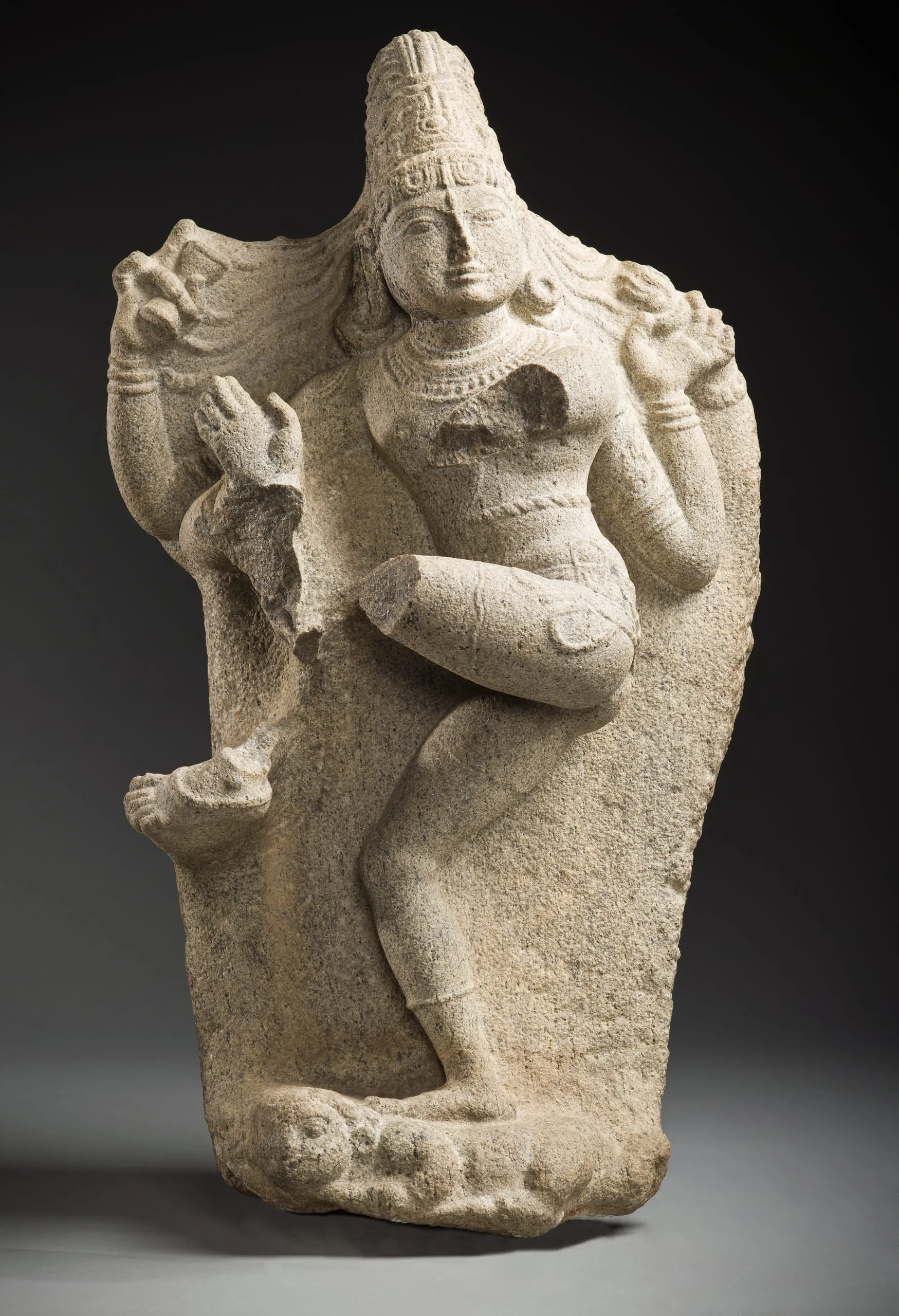
- Shiva as the Lord of Dance
- Date Made
- circa 1100
- Medium
- Granulite
- Dimensions
- 33 x 19 x 13 in. (83.82 x 48.26 x 33.02 cm)
- Accession Number
- M.71.82
- Curatorial Notes
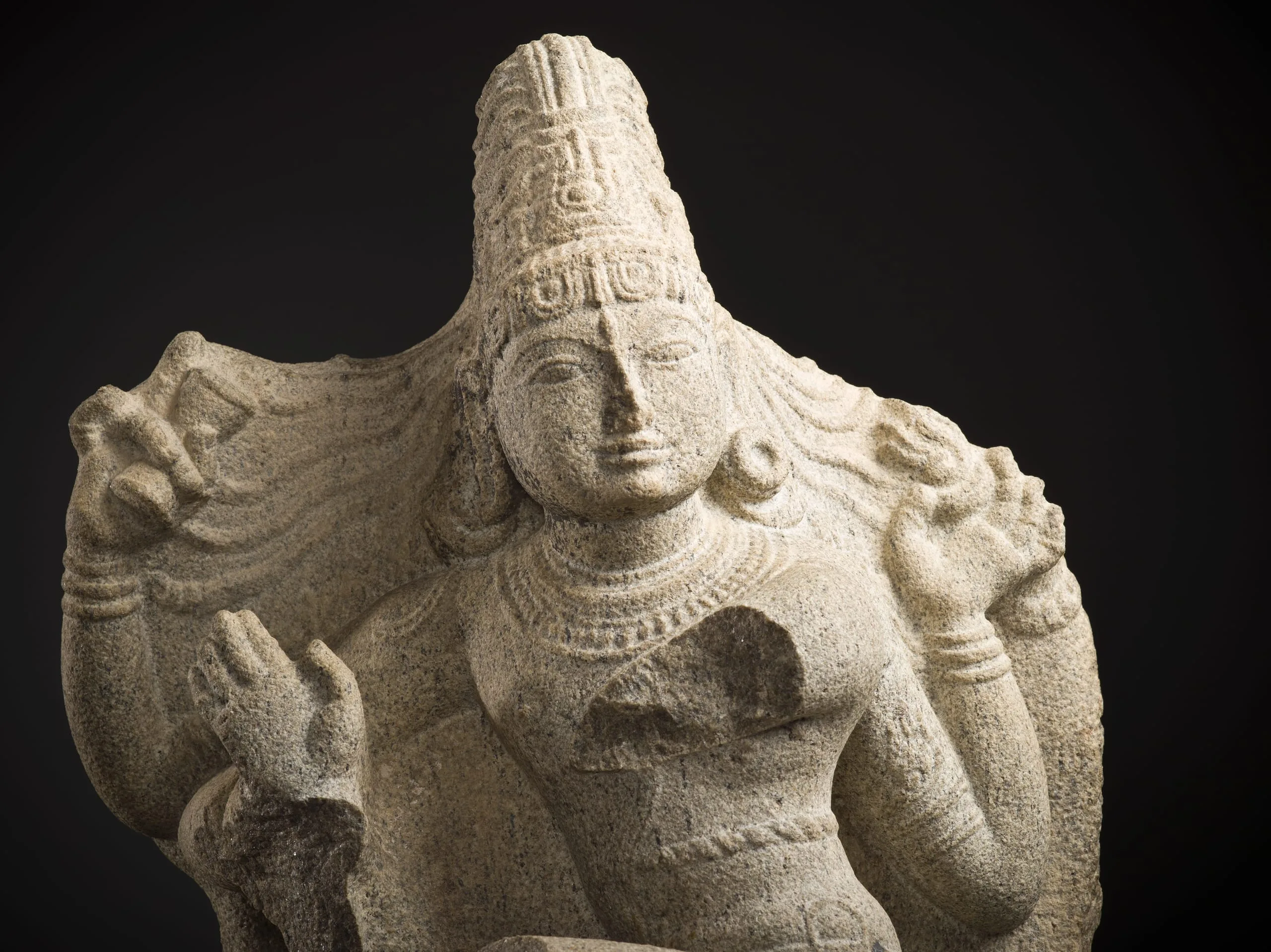
The Hindu god Shiva is represented here as the cosmic dancer Nataraja (Lord of Dance) whose dance engenders the creation of the universe. Shiva performs the Dance of Bliss (ananda tandava) with his right leg planted firmly on the Dwarf of Ignorance (Apasmara Purusha) and his left leg held aloft in front of his right leg as a symbol of liberation. The Dance of Bliss is one of the 108 dance postures described in texts such as the Natyashastra (200 BCE-200 CE) and the south Indian agamas (religious scriptures that have come down as tradition).
Shiva has an ascetic’s piled hair (jata mukuta). His long locks stream out to the side due to the frenzy of the dance. He has a third eye of wisdom (jñana netra). He wears standard jewelry, including the Brahmanical sacred thread (yajñopavita) worn over his left shoulder. Originally, he had four arms, two are now fragmentary. In his upper right hand, Shiva holds the drum representing the primordial sound at the creation of the universe. His lower right hand is held in the gesture of reassurance (abhaya mudra). In his upper left hand, he holds the fire that will destroy the universe at the end of the cosmic cycle of time (kalpa). His now-missing lower left arm would have pointed to his left foot to show devotees the path of salvation through his trampling of the Dwarf of Ignorance. See also M.75.1, M.82.42.4, and M.87.105.
- Selected Bibliography
- Pal, Pratapaditya. Indian Sculpture, vol.2. Los Angeles: Los Angeles County Museum of Art; University of California Press, 1988.
Pal, Pratapaditya. The Divine Presence: Asian Sculptures from the Collection of Mr. and Mrs. Harry Lenart. Los Angeles: Los Angeles County Museum of Art, 1978.
- Newman, Richard. The Stone Sculpture of India: a Study of the Materials Used by Indian Sculptors from ca. 2nd Century B.C. to the 16th Century. Cambridge, MA: Center for Conservation and Technical Studies, Harvard University Art Museums, 1984.
El Universo de la India: Obras Maestras del Museo de Arte del Condado de Los Angeles. Santiago: Centro Cultural Palacio La Moneda, 2012.