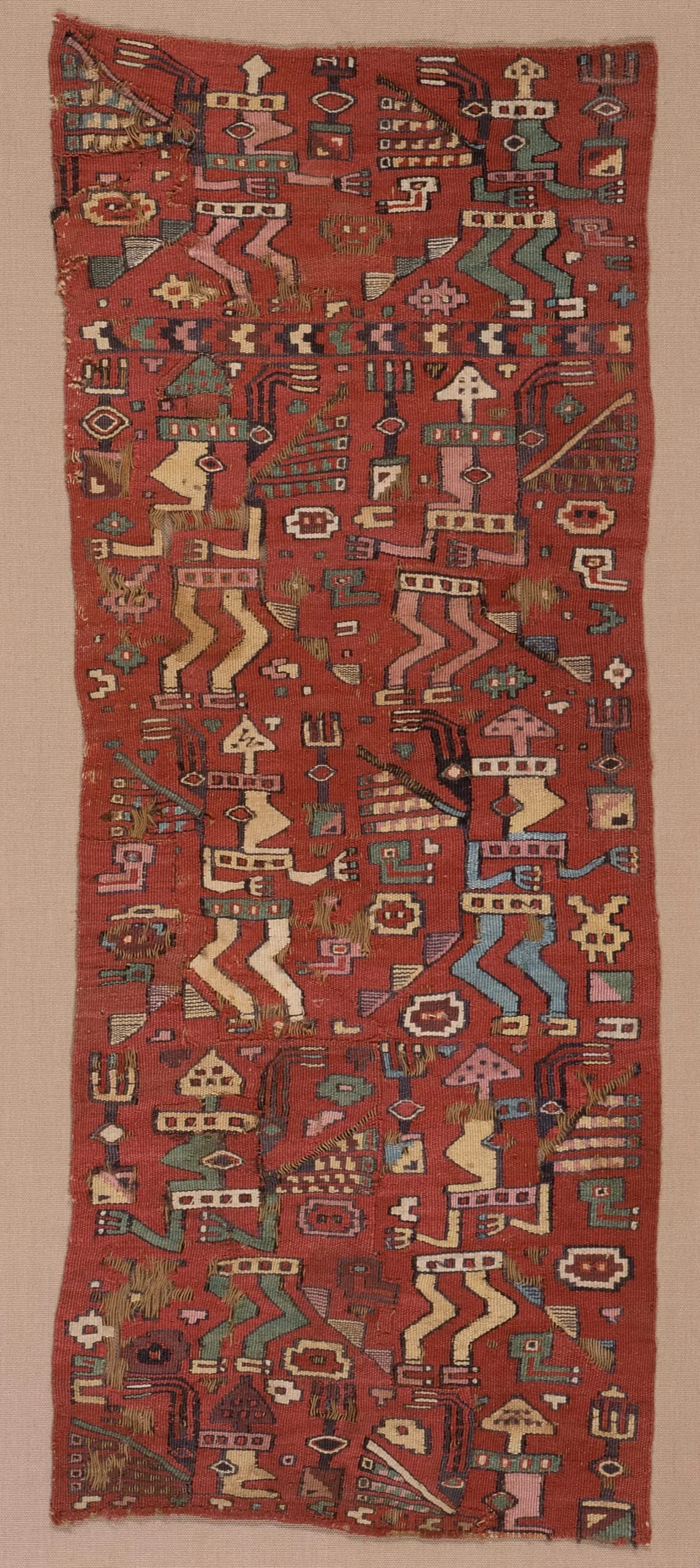
Two cities stood as the centers of the dominant empires during the Middle Horizon period (c. 6001000): Wari, in the central highlands of Peru, and Tiwanaku, located on Lake Titicaca on the present-day border between Peru and Bolivia. Although the nature of the relationship between these two independent states is not well understood, it is clear they shared fundamental elements of religious iconography that originated in the earlier Pucará culture.
The principal icons are carved on the Gateway of the Sun at the site of Tiwanaku. Winged, “running” attendants in profile holding large staffs surround a frontal view of an elaborately costumed, staff-bearing figure in the center of the gate. The running attendant Staff Bearer is shown as both a human and a human-bird composite.
The figure repeated here is a regional (North Central Coast) adaptation of the more representational Staff Bearer. The eye is a concentric (rather than bisected) oval, the staff is only half-complete, and the legs turn in a different direction than the standard attendant. Costume and filler elements float in a void, and the abstracted components lack the “jigsaw puzzle” cohesiveness of classic Wari composition.
Nicole LaBouff via Kaye Spilker
2009