- Title
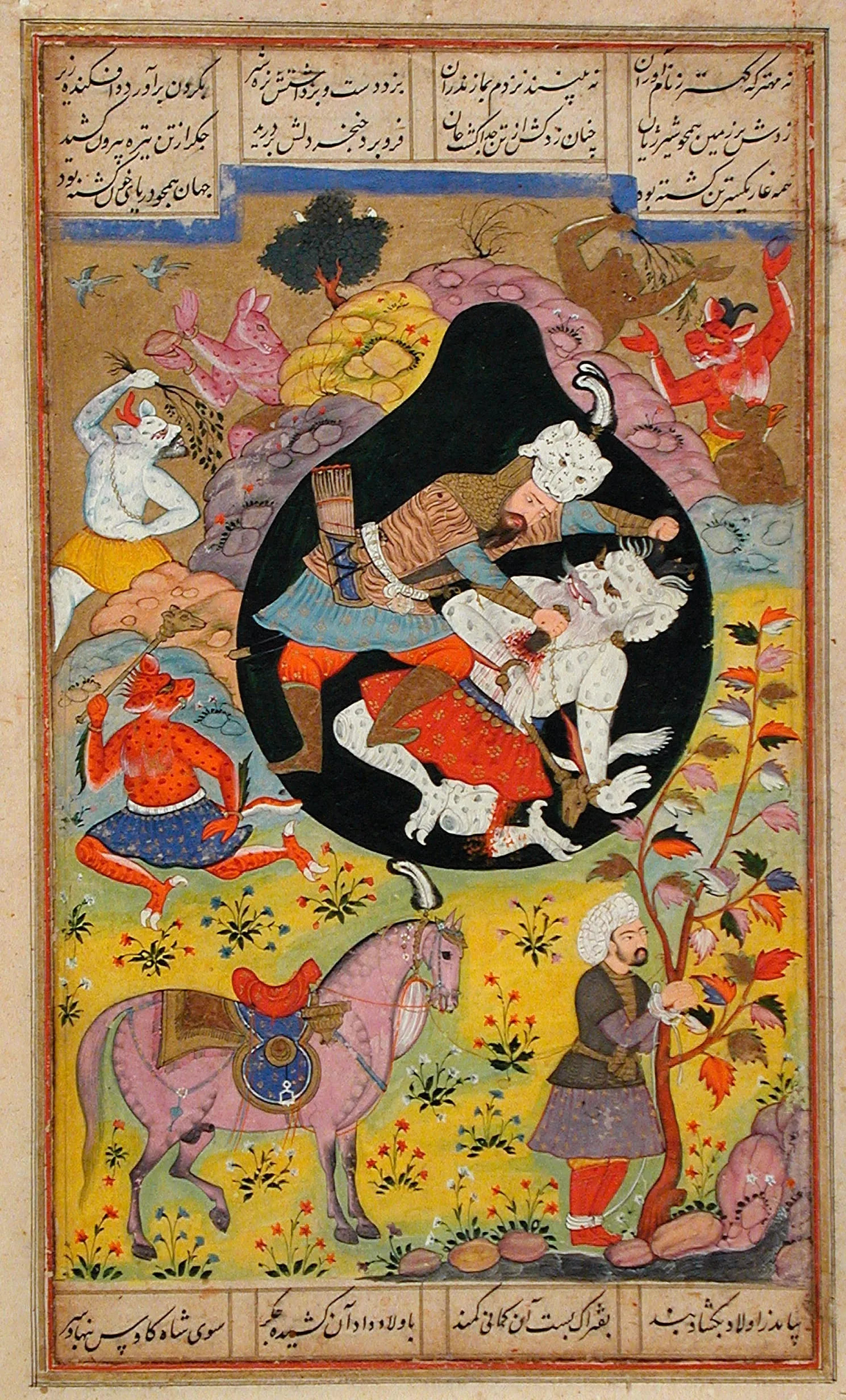
- Rustam Slays the White Div (recto), Text (verso), Folio from a Shahnama (Book of Kings)
- Date Made
- 1608
- Medium
- Opaque watercolor, gold, and ink on paper
- Dimensions
- Image: 6 3/4 x 4 3/4 in. (17.15 x 12.07 cm); Sheet: 9 1/4 x 5 3/4 in. (23.5 x 14.61 cm)
- Accession Number
- M.71.49.3
- Curatorial Notes
The Shahnama (Book of Kings) is an epic Persian poem composed by Firdausi (or Ferdowsi; circa 934-1020) in circa 977-1010. It narrates the legendary and historical past of the Persian Empire until the Arab Muslim conquest in the 7th century. Shahnama manuscripts were frequently produced throughout the Islamic world, including the Mughal Empire (see M.78.9.5).
This folio is from a manuscript that is reportedly dated 1608 (AH 1017). Another folio from this manuscript is in the San Diego Museum of Art (1990.322).
This folio depicts an episode from the Shahnama in which Rustam kills a monstrous demon chief, the White Div (Div-e Sepid), as his heroic Seventh Labor performed on his way to the legendary Mazandaran to rescue the mythical King Kay Kavus (or Kai Kaus), who had been blinded by the White Div and imprisoned with his army’s commanders. Rustam slays the White Div by grasping one of his horns and stabbing him in the heart with his dagger. He then uses the blood of his heart to cure the blindness of the king and save the captured officers. In the center of the painting, Rustam battles the White Div in a pear-shaped black area that may represent a cave dungeon. Rustam is distinguishable by his leopard head-helmet and tiger skin-jacket. King Kai Kavus is tied by his hands and feet to a tree. Behind him is Rustam’s faithful steed, Raksh. Several agitated demons run around excitedly. The White Div and the lowermost demon wield an ox-headed mace (gorz). The verso has text only.
- Selected Bibliography
- Pal, Pratapaditya. Indian Painting, vol.1. Los Angeles: Los Angeles County Museum of Art, 1993.