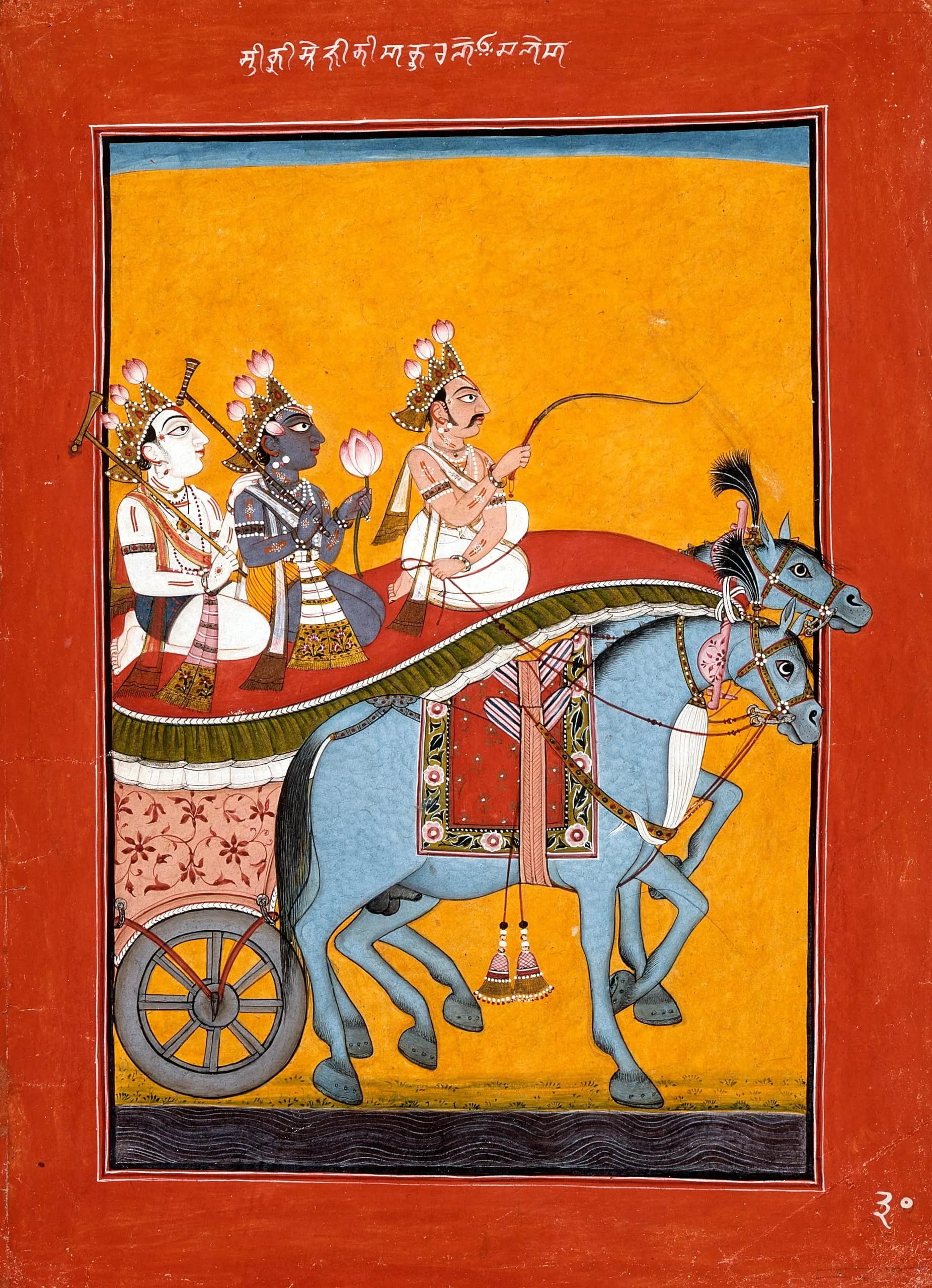
The Bhagavata Purana (Ancient Stories of the Lord) is traditionally ascribed to the legendary poet-sage Vyasa in the 8th-10th century CE. It stresses the path of devotion (bhakti) to Krishna, the eighth incarnation of Vishnu, the Hindu God of Preservation. To fulfill his role as the guardian of the world and savior of humanity, Vishnu appears as a succession of heroic animals and semi-mortal saviors, called avatars, through which he intervenes in times of crisis or unrighteousness.
This illustration depicts Krishna and Balarama being driven by their uncle Akrura in his chariot from their home in Vrindavan to Mathura, where the evil King Kamsa planned to have them slain during a wrestling competition (Bhagavata Purana 10:39). Akrura is the charioteer. The blue-skinned Krishna holds a lotus and a shepherd's crook. The white-skinned Balarama holds a shepherd's crook and has his left hand on Krishna’s shoulder. A caption in white takri script in the upper border identifies the subject. A later Mankot illustration of the same episode, attributed to circa 1760, includes various gopis (cow-herdswomen). It is in the Victoria and Albert Museum, London (IS.18-1960).
See also its series mate M.88.227. This dispersed series was formerly in the royal collection of Raja Dhruv Dev Chand of Lambagraon, Kangra. Additional folios are in the British Museum, London (1966,0725,0.2) and the San Diego Museum of Art (1990.1071).