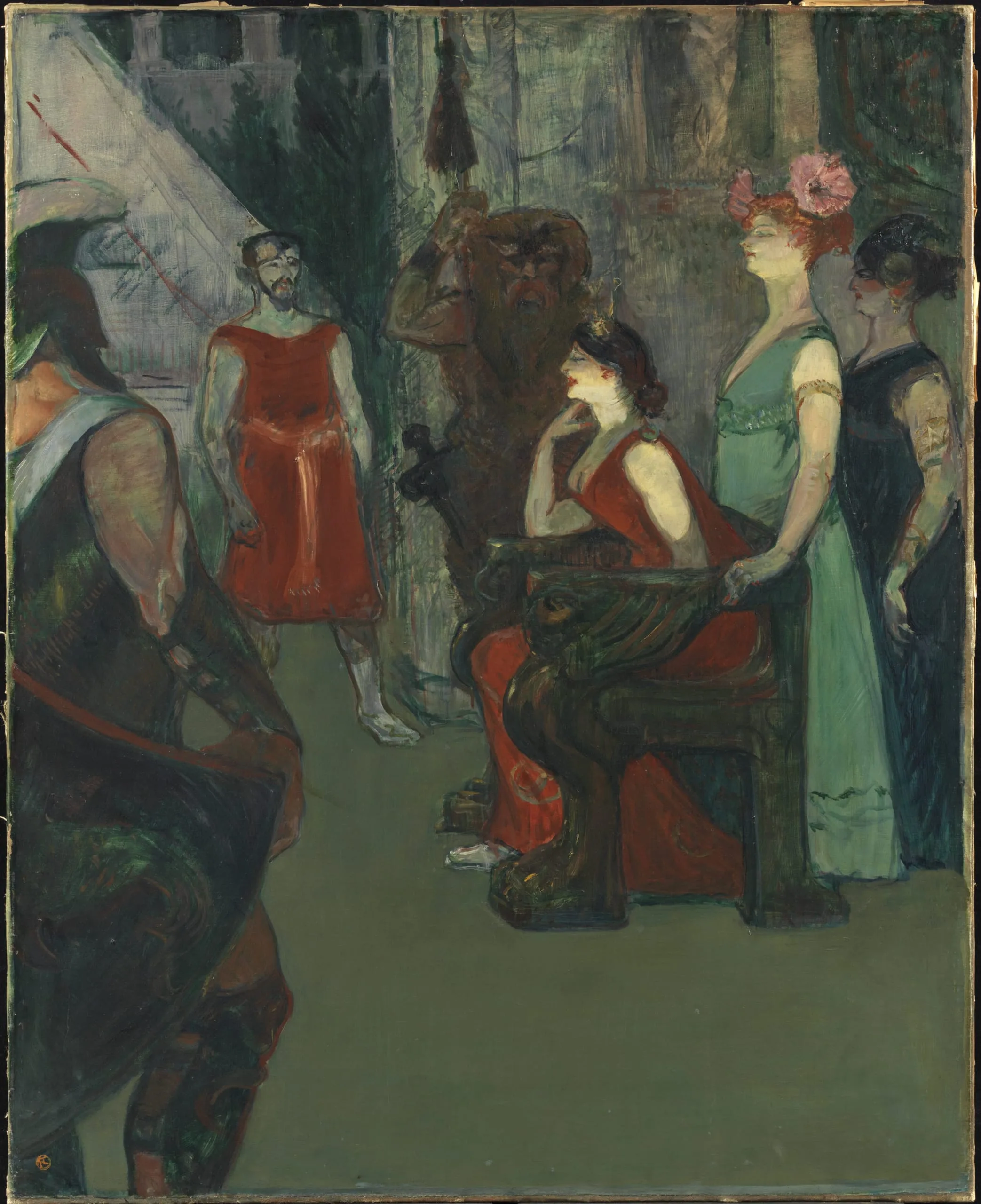
Henri de Toulouse-Lautrec is celebrated for his vivid depictions of modern life in fin-de-siècle France, especially scenes drawn from the worlds of theater, performance, and popular entertainment. Messalina (Messaline) belongs to the final period of the artist’s brief career, when he was working with urgency and extraordinary concentration. From October 1900 to April 1901, under the care of Dr. Paul Viaud, Toulouse-Lautrec stayed in Bordeaux, where periods of relative sobriety spurred renewed artistic activity. During these months, he became deeply absorbed by Isidore de Lara’s opera Messaline (1899), a melodrama of desire, betrayal, and violence set in ancient Rome.
This painting captures a climactic moment from the final act of the opera. The empress Valeria Messalina sits enthroned at center stage as her former lover, the poet Harès, appears to kill her. In the ensuing confrontation, Hélion—her current lover—kills his own brother in order to protect her. Toulouse-Lautrec heightens the drama through his composition and handling of light. The bright theatrical illumination that falls on Messalina and her attendant sharply contrasts with the darker figures emerging from the wings, creating an image that is at once staged, unstable, and intensely immediate. The painting reflects the artist’s fascination with the visual language of performance: costume, gesture, lighting, and spatial tension all become active components of the composition.
Toulouse-Lautrec approached the subject with unusual intensity. He attended performances, made sketches from life, and consulted photographs of the sets as he developed the series. Like many avant-garde artists of the period, he worked serially, returning to the same subject in multiple variations. At least six paintings of Messaline are known, each differing in degree of finish and emphasis. This repetition allowed Toulouse-Lautrec to explore the expressive possibilities of the theatrical scene from different perspectives, testing how paint could convey both the artificiality of stage production and the psychological charge of performance. At LACMA, Messalina joins The Opera “Messalina” at Bordeaux (Messaline descend l’escalier bordé de figurants), offering another view of the production that so captivated the artist during his final months.
The painting entered LACMA through the generosity of the Henry and Rose Pearlman Foundation, whose gifts have strengthened the museum’s collection of late nineteenth-century French art and extended Henry and Rose Pearlman’s commitment to sharing major works of art with the public.