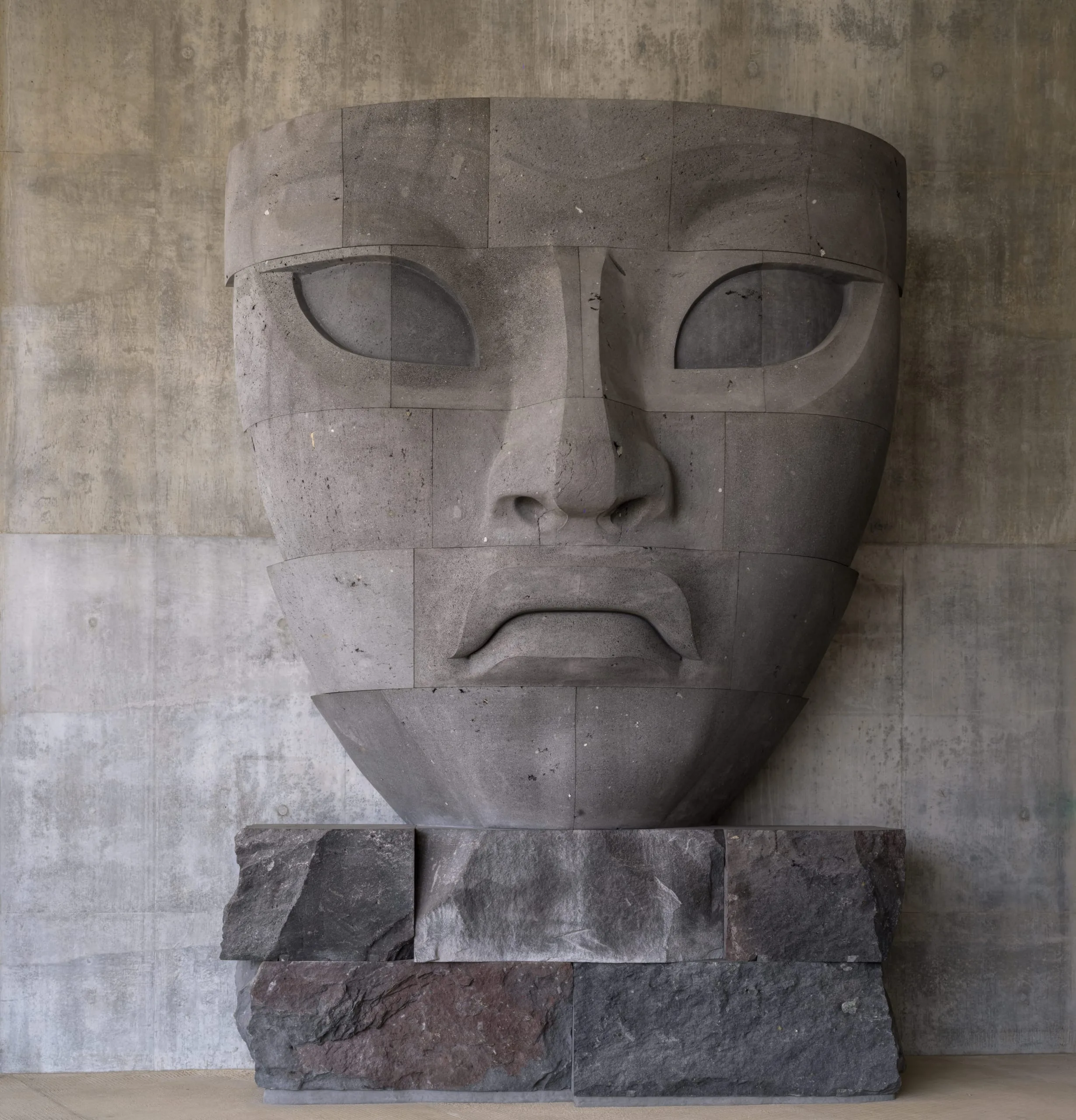
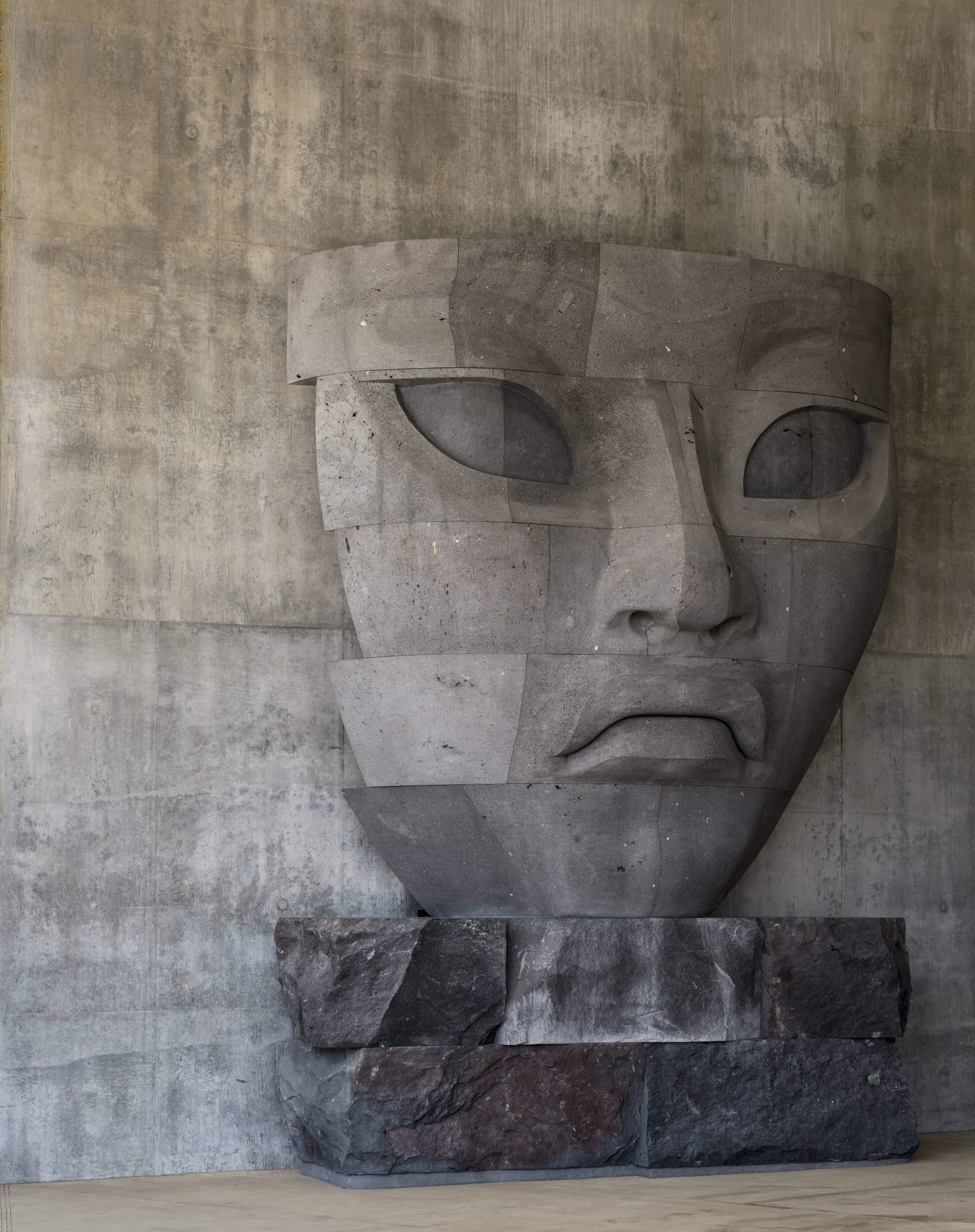
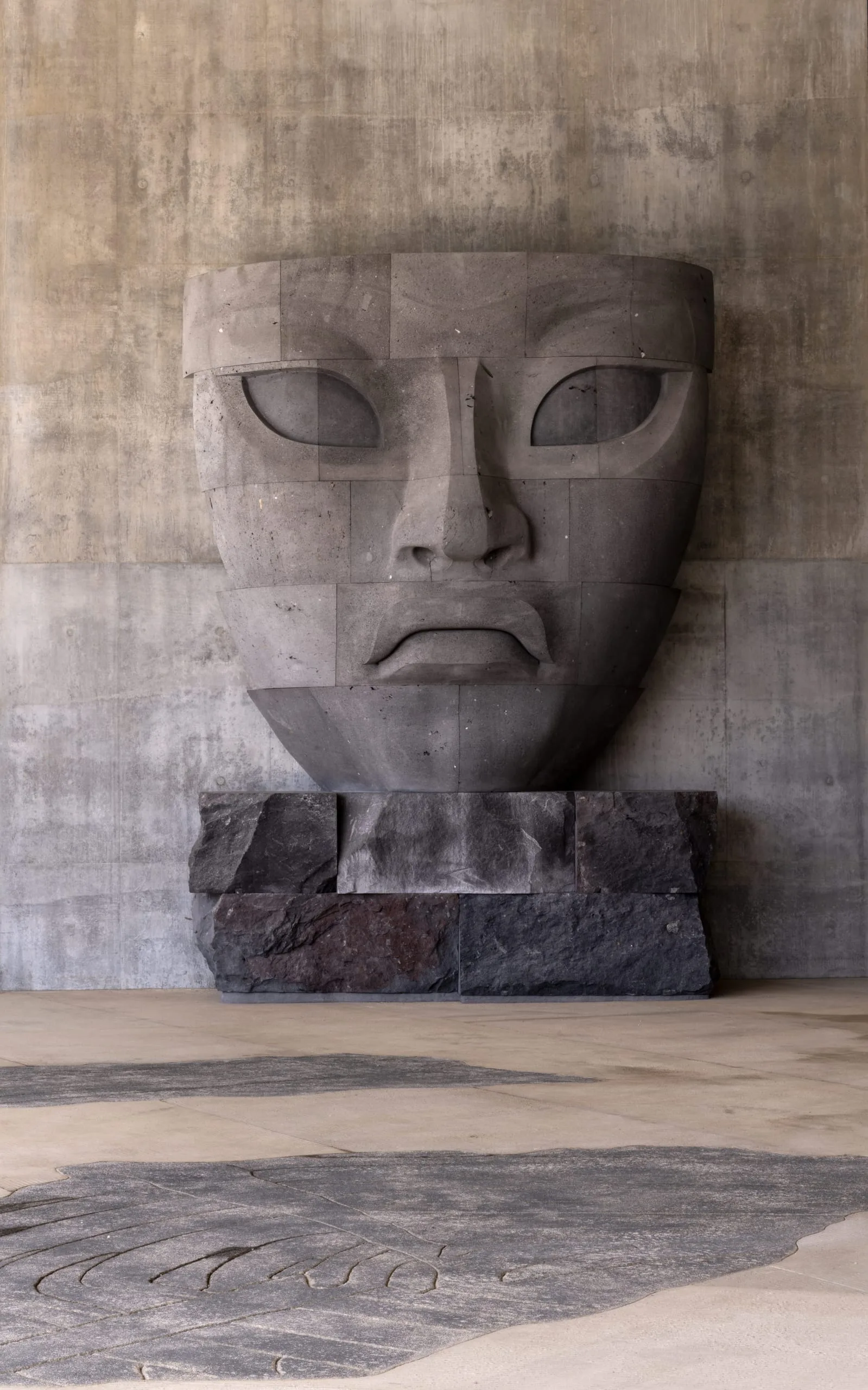
Trained as an architect, Mexican artist Pedro Reyes engages with social and political issues through activism, pedagogy, participatory theater, and various artistic mediums, including video, painting, and sculpture. His projects range from the ephemeral to the monumental. Tlali is an eighteen-foot sculpture assembled of individual blocks of carved volcanic stone inspired by the colossal scale of Olmec heads found in Veracruz, Mexico. His original design represented a complete head. LACMA’s version, instead, consists of a fragmented head (from the forehead to the chin), supported by a stone base and a steel armature. While still monumental in scale, the sculpture recalls, in both form and iconography, some of the smaller Olmec works in LACMA’s collection (see, for example, AC1992.134.2 and M.86.311.6).
Reyes’s monumental sculpture combines human and zoomorphic features commonly found in depictions of Olmec otherworldly beings—a human nose and smooth arched eyebrows, feline jaguar eyes, a downturned mouth, and a flaring upper lip. These formal affinities exemplify one way in which contemporary artists have continued to draw inspiration from ancient artifacts for their work. Reyes sourced the stone from a quarry on the flanks of the Popocatépetl volcano in Central Mexico and shaped it using a technique called direct stone carving, which has a rich history in ancient Mexico and also in modernist public sculpture. The sculpture’s title, Tlali, comes from the Nahuatl word tlalli, meaning “land” or “earth.” Classical Nahuatl was used in the Aztec Empire, and its contemporary variations continue to be spoken by more than 1.5 million people today.
Reyes’s first iteration of the sculpture was the subject of much controversy. It was commissioned in 2021 by Mexico City’s government to replace a statue of Christopher Columbus located at the center of a traffic roundabout (glorieta) on Paseo de la Reforma, one the city’s main avenues. The announcement of the commission, however, was met with mixed reviews, leading Mexico’s arts and culture community to petition for its cancellation and the selection of a different monument. Today, it is known as La Glorieta de la Mujeres que Luchan (the Roundabout of the Women Who Fight), acknowledging Mexico’s victims of femicide and the ongoing struggles of women.
The version of Tlali installed at LACMA places the work in conversation with other prominent outdoor works as well as ancient American artifacts present in the inaugural installation of the north and south entrances of the David Geffen Galleries.
2026