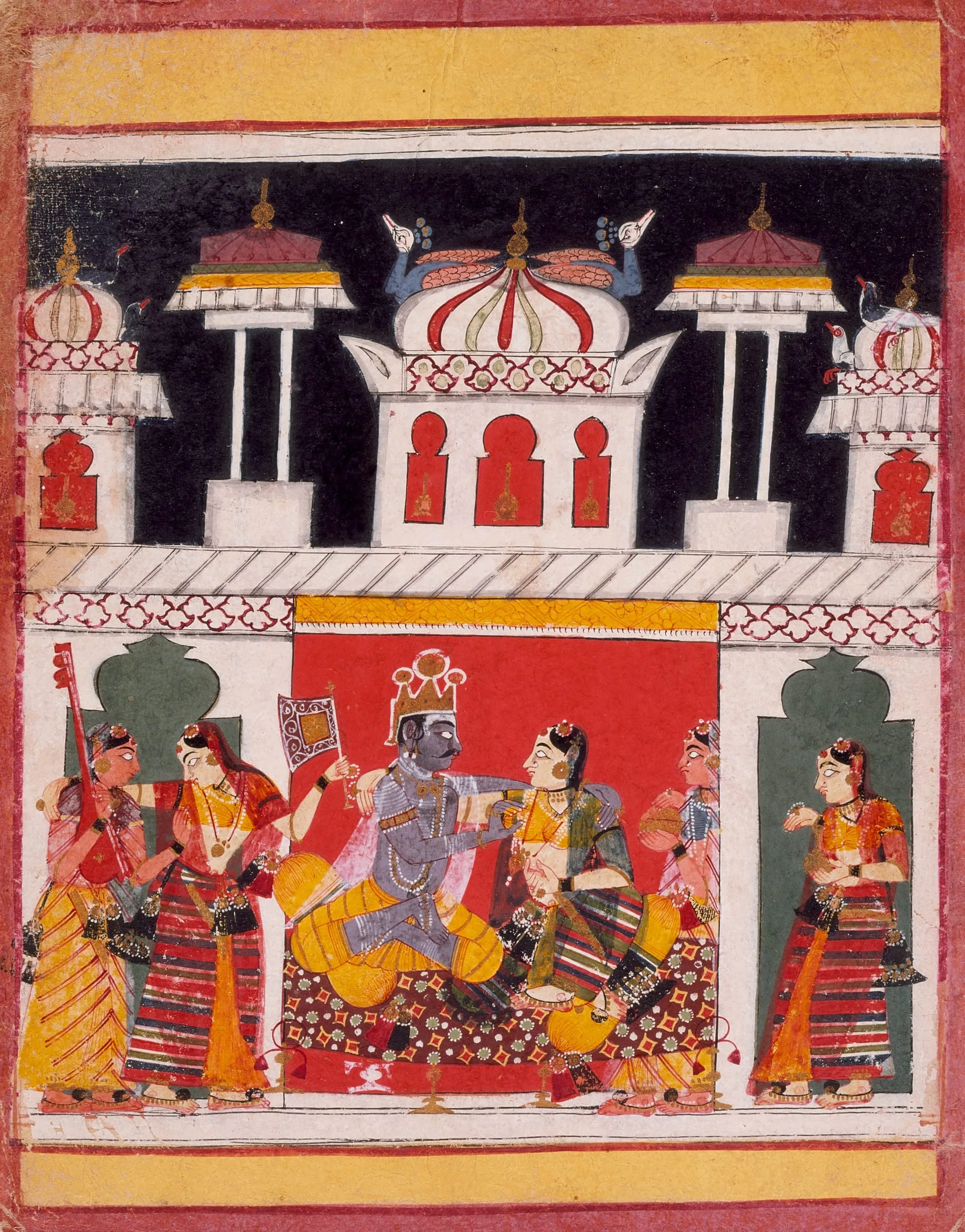
An inscription on the reverse in the Braj dialect of Hindi identifies the melody as “Bhairava Raga” and has a descriptive verse. A seal stamp documents that it was formerly in the collection of the Maharaja of Datia in Bundelkhand. The series was dispersed in the 1960s.
Bhairava Raga is the first raga in the predominant ragamala (garland of melodies) classification system generally known as the Rajasthani system. It is a plaintive melody associated with the early morning and Autumn (September–November). Bhairava Raga is personified as a crowned hero or the god Shiva seated with his consort in a pavilion. When envisioned as Shiva, as is the case here, he wears a tripartite crown and has ashen blue skin iconographically derived from Shiva smearing himself with the ashes of a cremation ground. A comparable Bhairava Raga, attributed to Orchha, Madhya Pradesh, circa 1640-1650, is in the Museum of Fine Arts, Boston (17.2371). Bhairava Raga is sometimes portrayed alternatively as the blue-skinned Krishna wearing his distinctive peacock feather crown. (For example, see a Bhairava Raga attributed to Malwa, Madhya Pradesh, circa 1660, in the Victoria and Albert Museum, London (IS.55-1952). The couple are attended by four maidservants. One holds a drone instrument (tambura), another waves a fan, and two bear covered bowls of delicacies.
Additional folios from this series are in the Virginia Museum of Fine Arts, Richmond (68.8.66–.67) and San Diego Museum of Art (1990.950 and 1990.955).