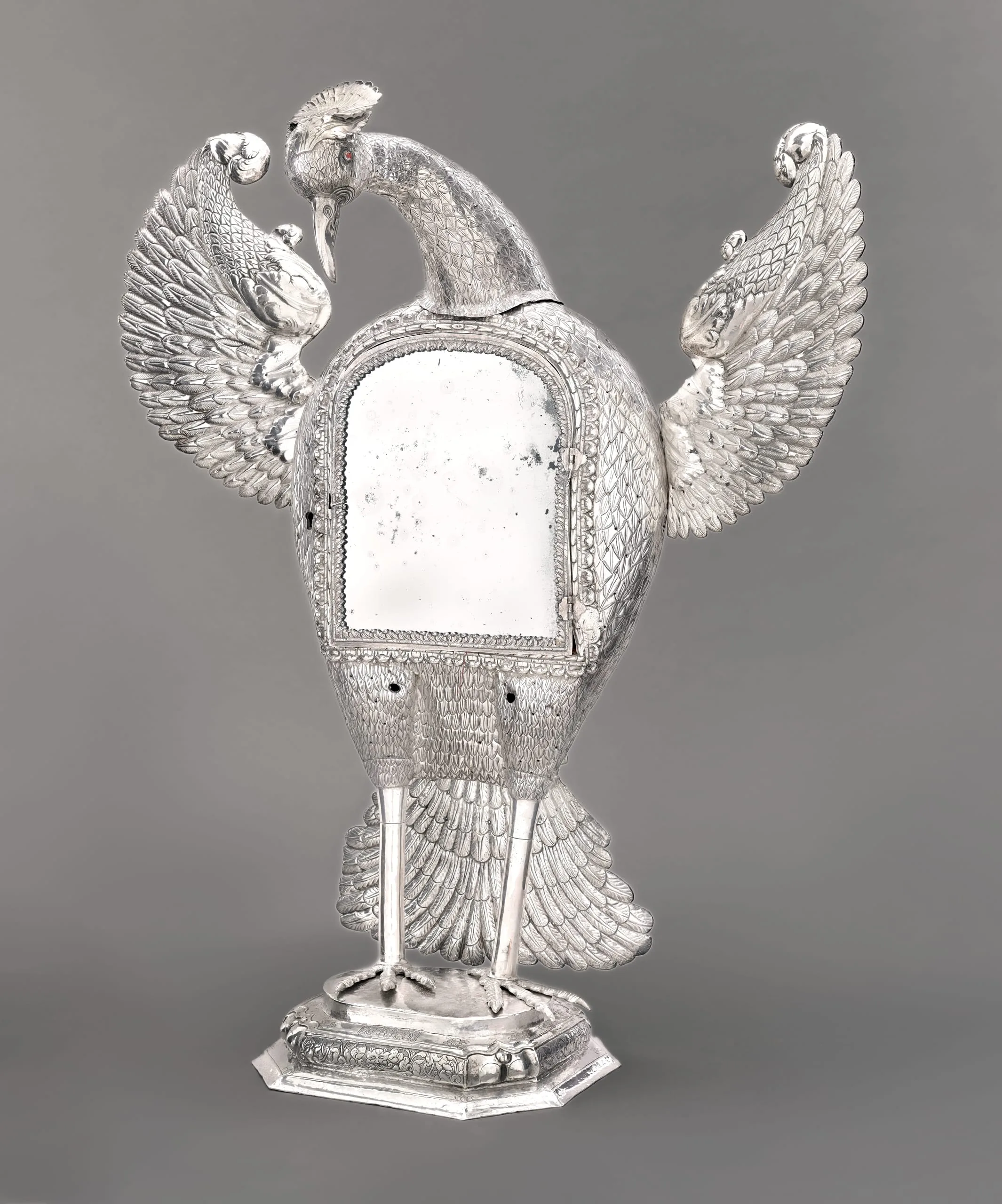
This imposing Eucharistic pelican with outstretched wings and standing on a lavish octagonal pedestal was created in Bolivia, which was part of the Viceroyalty of Peru. Pelicans were a traditional symbol of Christ’s sacrifice for humanity. Silver containers such as this were used to store the consecrated host for the celebration of the communion on Holy Thursday and were displayed on the main altarpiece. This is one of the largest works of its type, which also stands out due to the extravagant use of silver. All the elements—body, neck and head, wings, tail, legs, and base—were wrought separately. The pelican resembles a large South American bird known as a chajá, demonstrating how traditional Western symbols were refashioned to suit new forms of religiosity that developed in the Andes. The work signaled the wealth and power of viceregal society.
Silver was closely associated with empire-building in the early modern world. In 1545, the Spaniards found the world’s richest silver deposit, the Rich Hill of Potosí, in present-day Bolivia. This discovery, as well as the establishment of the Imperial Villa of Potosí, transformed the global economy. The mine fueled a veritable silver rush, attracting people from every corner of the world hoping to strike it rich. The city also drew hundreds of Indigenous laborers (mitayos), who, along with enslaved Africans, were forced to work under dismal conditions to extract the precious metal. Objects such as this capitalized on the expert knowledge of Indigenous artists who had worked with precious metal for centuries, drawing on European traditions and motifs to satisfy the taste of their increasingly sophisticated patrons.
Ilona Katzew
2024