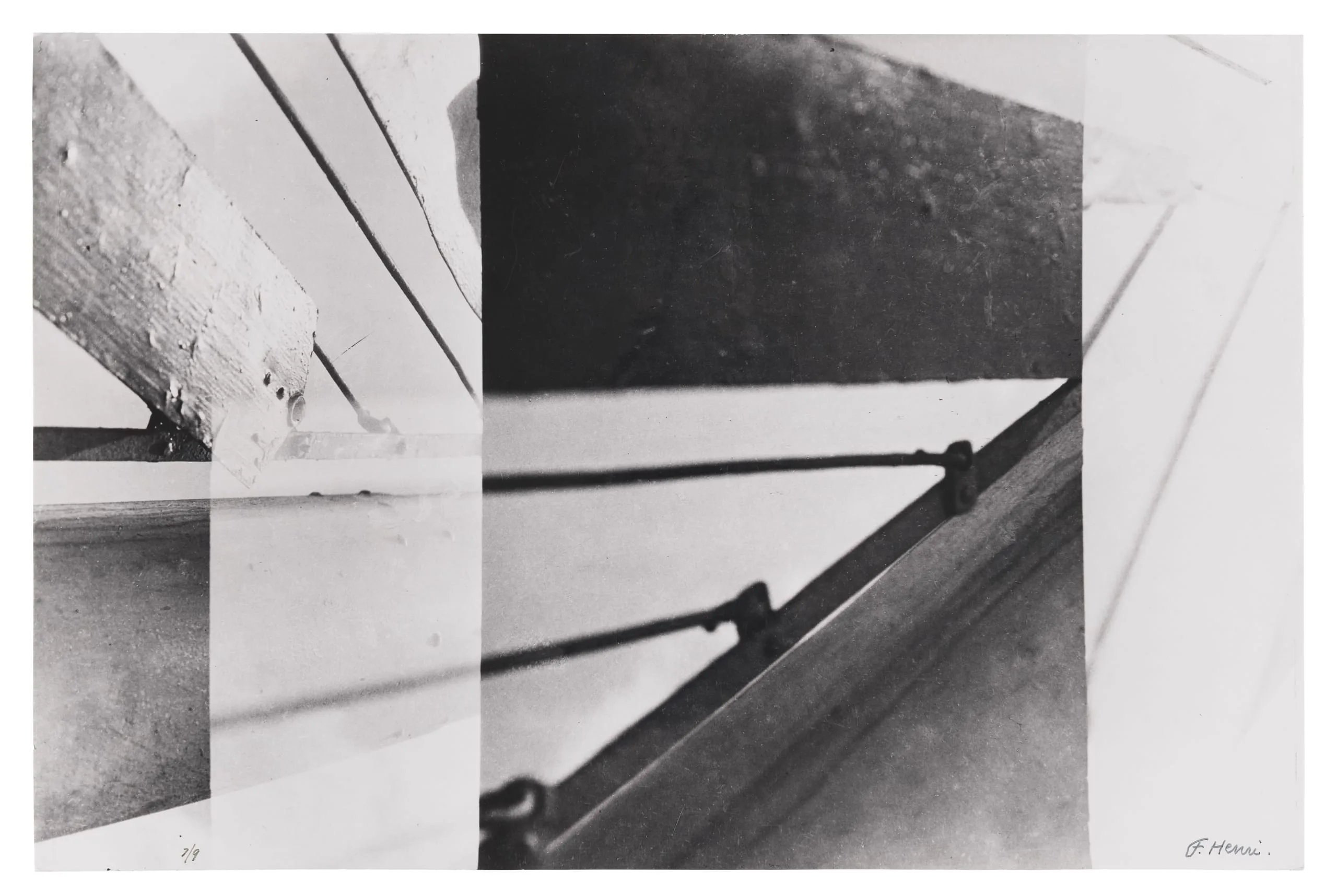
Florence Henri was a major contributor to geometric abstraction in photography. She often used mirrors, prisms, and hard-edged reflective materials to create depth and extend space. The resulting small-scale black-and-white photographs explore a wide range of subjects, including self-portraits, still lifes, the nude, street photography, and photomontage; however, it was her interest in form rather than subject that motivated her experimentation. Abstract Composition combines a wide tonal range of triangles, dark lines, and a wood plank, as well as a very faint reflection of clouds. The physical space is unrecognizable and instead promotes Henri’s interest in geometric abstraction by way of industrial materials.
Born in New York, Henri moved to Europe with her father upon the death of her mother in 1895, landing first in Silesia (then Germany), and then relocating to a variety of cities including Paris, Munich, and Vienna. When her father died in 1908, she moved to Rome to live with her uncle, the poet Gino Gori, who was involved with the Italian Futurists and introduced Henri to the avant-garde. At the age of nine, she began learning piano in Paris, continuing her studies in Rome and Berlin, while working as a silent film accompanist during World War I. She abandoned music for painting, concentrating on linear abstraction at the Berliner Akademie in 1914, but was never fully satisfied with the results.
Henri turned to photography in 1927 after auditing a class with László Moholy-Nagy at the Bauhaus in Dessau. Worm’s-eye and bird’s-eye views, multiple exposure, and photomontage echoed through her work, embodying the experimentation of New Vision photography. She was influenced substantially by Lucia Moholy (wife of Moholy-Nagy), who was interested in Bauhaus architecture. In Paris in 1929, Henri cofounded Cercle et Carré, a group that promoted abstract art with an emphasis on structure and geometry rather than the irrationality of Surrealism. In the late 1920s and early 1930s, she explored advertising photography, had a significant exhibition record, then returned to painting in the 1950s and 1960s.
Rebecca Morse, Curator, Wallis Annenberg Photography Department
2024
Bibliography
Florence Henri: Artist-Photographer of the Avant-Garde. San Francisco: San Francisco Museum of Modern Art, 1990.