Shringara Rasa (Erotic Sentiment) is the "King of Sentiments" (rasa raja) among the nine major rasas (literally, juice or essence) of classical Indian aesthetic theory. Rasas are used to categorize the underlying emotional flavors or essence imbued in a visual, literary, or musical work that evoke a response in the viewer, reader, or audience. Rasa theory was expounded in the Natya Shastra (Treatise of Drama), composed in Sanskrit and attributed to the sage Bharata Muni (200 BCE–200 CE), and a later commentary on the Natya Shastra called the Abhinavabharati (new Bharata) by the Kashmiri polymath Abhinavagupta (circa 950–1016). The nayika-bheda (classification of heroines) is a taxonomic system within the context of the Shringara Rasa that categorizes the eight archetypal male and female lovers (nayakas/nayikas) based on their emotional states, behavioral responses, and romantic situations. The nayika-bheda was popularized in northern India by the Rasikapriya (Connoisseur’s Delights) composed in 1591 in the vernacular Braj-Bhasa by the poet Keshavdas ( 1555–1617). He was the court poet of Kunwar Indrajit Singh and Raja Bir Singh Deo of Orchha (r. 1605-1627). See B. N. Goswamy, Essence of Indian Art (San Francisco: Asian Art Museum and Ahmedabad: Mapin Publishing, 1986).
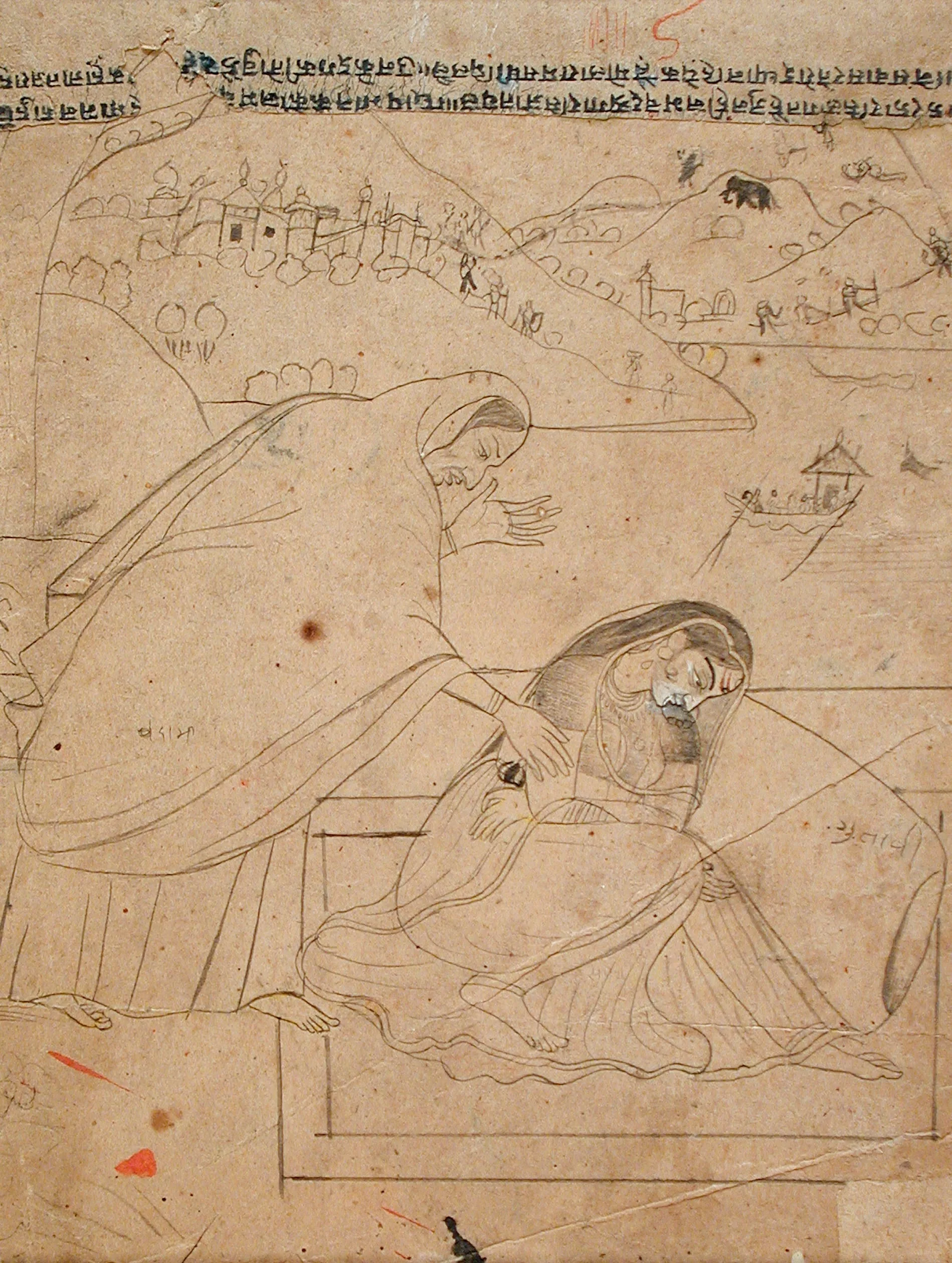
This preparatory drawing illustrates the Vipralambha Shringara (Love in Separation) mode of the Shringara Rasa. It is embodied by a specific sub-type of nayika: the virahini nayika (lovesick heroine in separation). The heroine is accompanied by an experienced older confidante (sakhi) who attempts to console the disconsolate nayika pining over her absent lover. They are on a terrace with a lake and a populated landscape in the distance.
The primary (inverted) Hindi inscription reads, Creating a form [such that to a] lover it appears as though [there is] no moon in the sky; having abandoned the shringara-bed [bed of love], even now, of prideful anger, what birth [origin]... Night and day, the remembrance of you resides in [her] heart. [The artist and poet] Mola Ram [says]: "O friend, go and meet [him], so that [the thirst] of their eyes may indeed be quenched." (Translation by Google.)
Additionally, there are small color-coding and identifying labels for the artist to follow in creating the finished painting. See also AC1999.127.4.