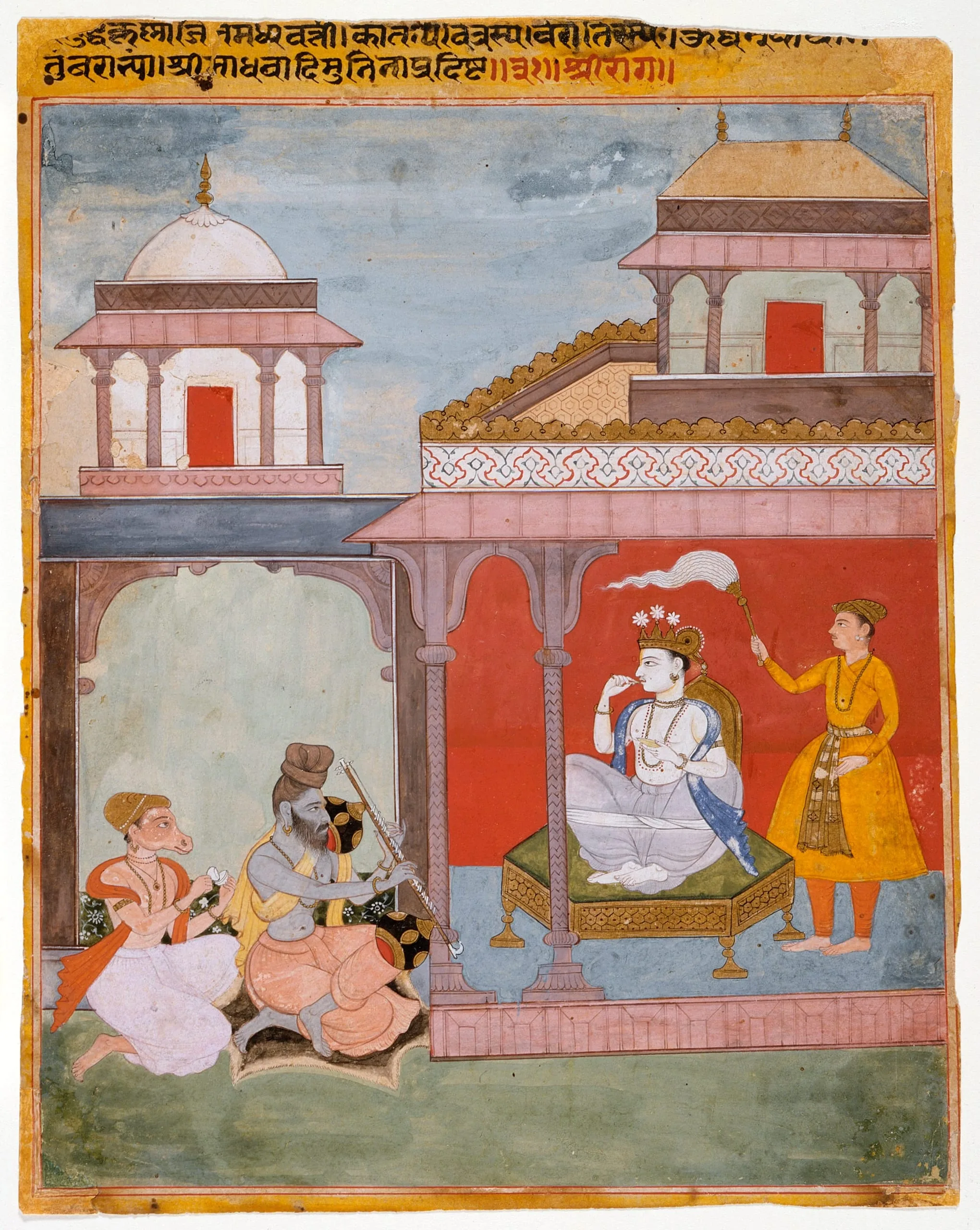
The poetic Sanskrit inscription in the upper border identifies the musical mode as Shri Raga and describes him as a man of matchless beauty and as lovely as the autumn moon, who, seated on an elegant throne, listens to the stories sung by Narada and Tumburu. The verse is ascribed to Madhava and other sages.
Shri Raga is the sixth raga in the predominant ragamala (garland of melodies) classification system generally known as the Rajasthani system. It is a melancholic melody associated with late afternoon or early evening and Winter (December-January). Here, Shri Raga is envisioned as an enthroned prince with a white moon-colored complexion seated in a pavilion verandah. Behind him, an attendant waves an honorific fly whisk made of the white tail-hairs of a yak (cauri or chowri). He is listening to a musical performance by a bearded musician, customarily identified as the legendary poet-saint Narada, and Tumburu, a horse-headed celestial singer and musician (gandharva) who is playing a pair of hand cymbals. See also M.73.59, M.75.113.3, and AC1999.127.27.
A representation of Bhairavi Ragini from the same ragamala series is in the Walters Art Museum, Baltimore (W.875).