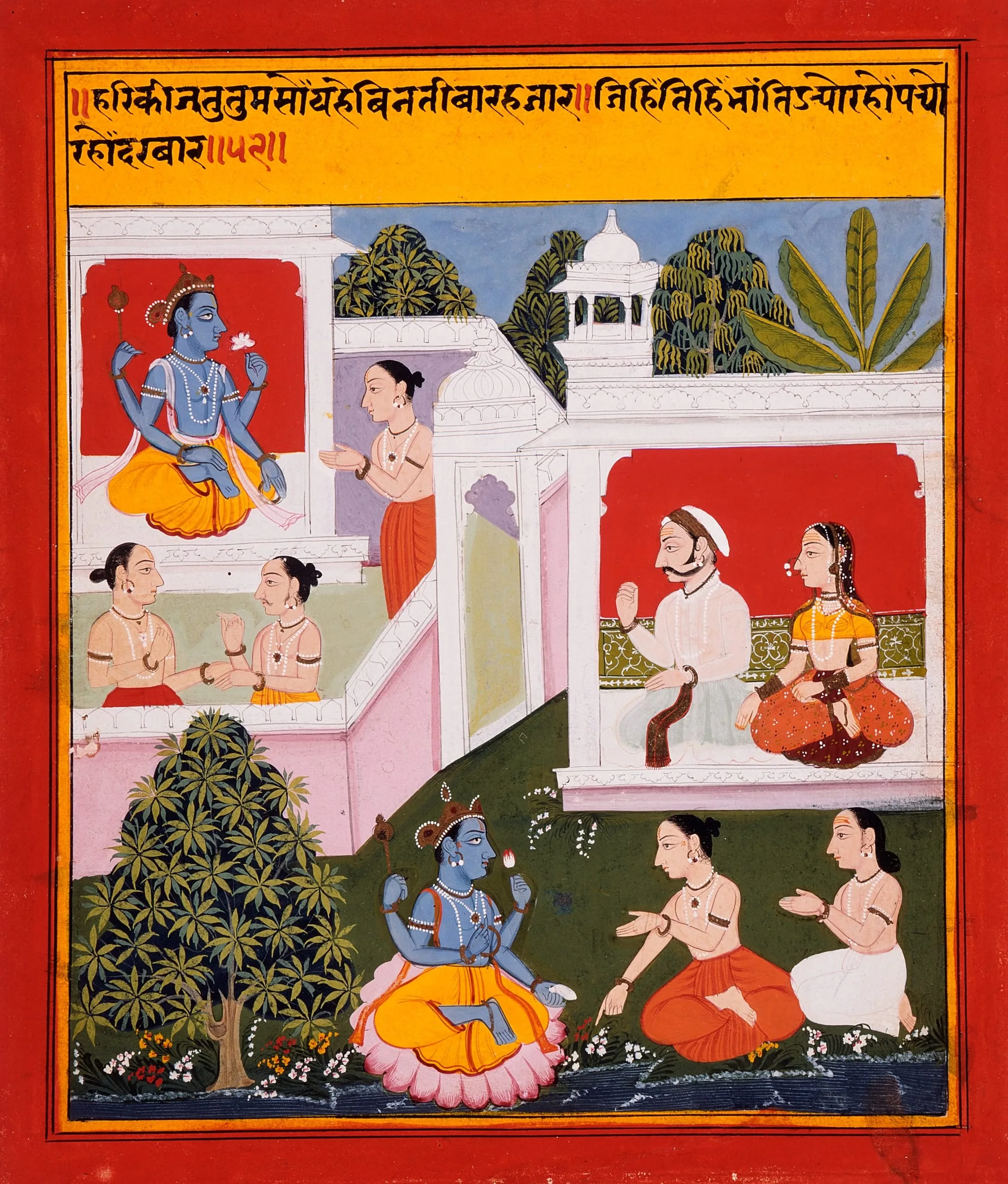
This painting and its series mate AC1999.127.23 illustrate passages from the Satsai (Seven Hundred [Verses]), one of the four great jewels of Hindi literature. The standard Satsai is an anthology of 713 poetic verses, but numerous manuscripts vary in verse number and content. The poem primarily celebrates of the romance of Radha and Krishna describes male lovers (nayakas) and female lovers (nayikas), and identifies the romantic sentiments associated with the six seasons of the Indian climate. It was written in "Braj-Bhasha," a dialect of Hindi, by Bihari Lal Chaube (1595–1664), who was born in Govindpur, near Gwalior in Madhya Pradesh, and later lived in Mathura, the home of Krishna. Bihari Lal subsequently worked at the court of Amber under Jai Singh I (r. 1625–67), for whom the Satsai was reportedly composed in 1662.
This folio visualizes the opening invocation (mangalacharan) of the manuscript, in which the poet Bihari Lal surrenders himself to the divine court of Radha and Krishna and requests to remain forever at their door. The poet is shown twice in continuous narration as he presents himself to Krishna.
The header is inscribed with a scribal variant of Couplet (Doha) 1 of the Satsai that reads,
Oh Mother [Radha], my desire is focused on Lord Hari [Krishna]; I make a thousand prayers. In whatever way possible, I have fallen and remain steadfast... ...let me remain at the door of your royal court. [Verse] 59. (Translation by Google. subject to verification.)
Additional series mates of this dispersed manuscript are in the San Diego Museum of Art (1990.617), and Yale University Art Gallery, New Haven (1973.153–.155, 2001.138.29 and 2026.49.4). See also Stuart Cary Welch and Milo Cleveland Beach, Gods, Thrones, and Peacocks: Northern Indian Painting from Two Traditions: Fifteenth to Nineteenth Centuries New York: The Asia Society, 1965), p. 81, no. 37b. See also AC1999.127.5.