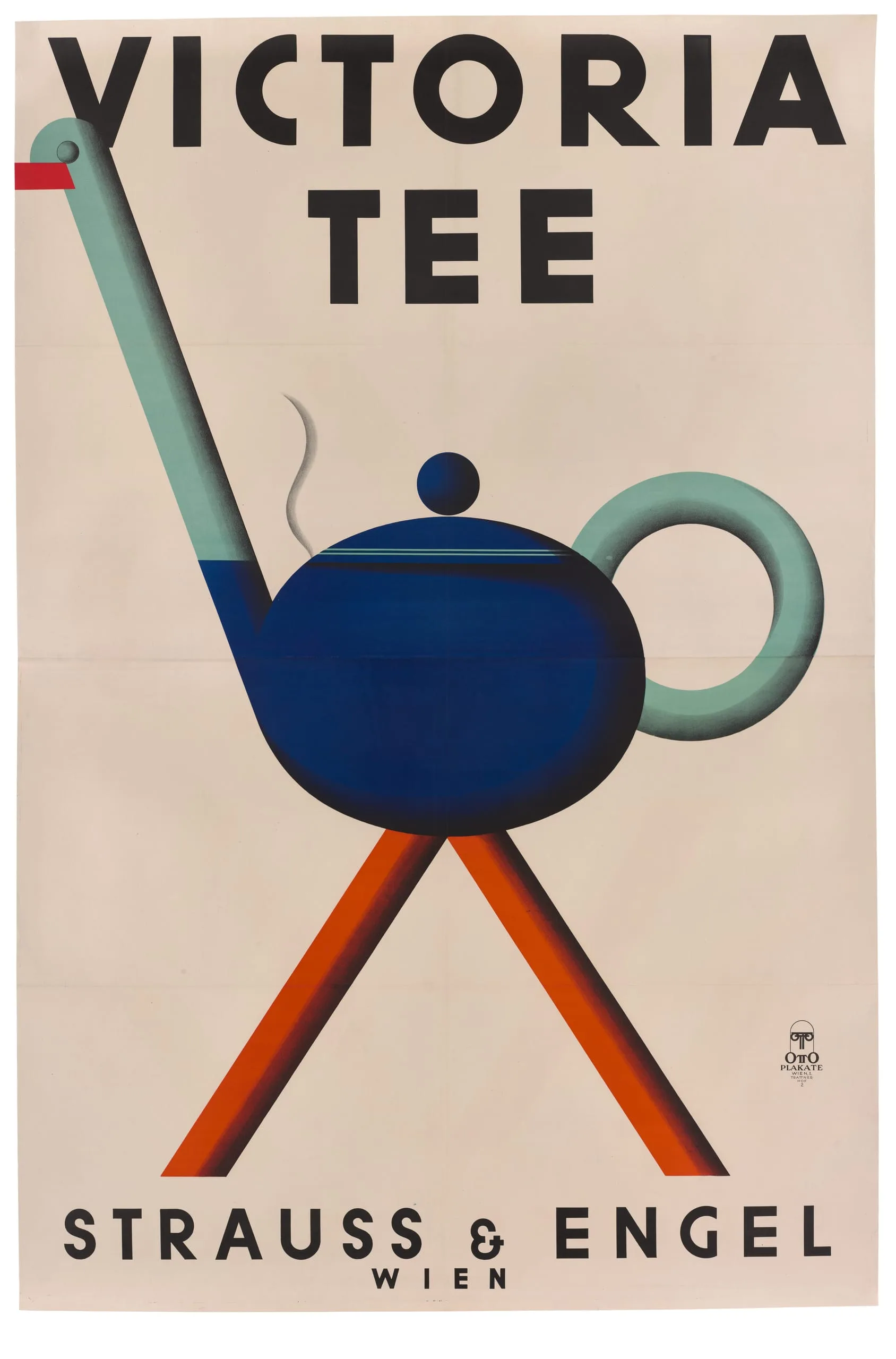
This poster for Strauss & Engel’s Victoria Tee is a clever example of the early twentieth-century German advertising style known as Sachplakat (object poster). Sachplakat presented items in isolation, often with little more than the firm’s name for context. The technique established a link between the name and product, a crucial leap as modern consumers adjusted to buying sealed, branded products rather than bulk goods that they could see and touch. Illustrators often rendered the objects in a flat, reductivist aesthetic or with photorealistic precision, using these seemingly objective depictions to convey the manufacturer’s honesty and reliability.
Victoria Tee integrates a teapot into an abstracted image of an ostrich—Strauß in German—making a clever reference to the company name. Reklameatelier Otto’s geometric rendering modernizes a 1911 poster by Atelier Hans Neumann, which had featured a comic baby ostrich delighting in the tea’s aroma. The Viennese commercial art studio Reklameatelier Otto was founded in 1925 by Otto Löbl, who had worked for Neumann prior to opening his own firm. Employing around ten designers, the studio produced posters and publicity for clients ranging from cinemas and theaters to fashion houses and food manufacturers. After the 1938 Nazi annexation of Austria, Löbl, who was Jewish, was forced to shutter his business. He and his family escaped to the United States.
This poster comes from the collection of Julius Paul. Between 1895 and 1937, the Hungarian-born Jewish Viennese businessman amassed a collection of more than 6,300 posters, which he left to his nephew Gaston upon his death in 1938. The following year, Gaston was forced to abandon the collection when he fled Austria in the face of Nazi persecution. In 1939, book dealer V. A. Heck, a known Nazi collaborator, sold the collection to the Albertina Museum. It remained there until it was restituted to Paul’s heirs in 2008.
Staci Steinberger
2022