LACMA

ShopMembershipMyLACMATickets
LACMA
Los Angeles County Museum of Art
5905 Wilshire Blvd.
Los Angeles, CA 90036
info@lacma.org
(323) 857-6000
Sign up to receive emails
Subscribe
© Museum Associates 2025

Museum Hours

Monday

11 am–6 pm

Tuesday

11 am–6 pm

Wednesday

Closed

Thursday

11 am–6 pm

Friday

11 am–8 pm

Saturday

10 am–7 pm

Sunday

10 am–7 pm


  • About LACMA
  • Jobs
  • Building LACMA
  • Host An Event
  • Unframed
  • Press
  • FAQs
  • Log in to MyLACMA
  • Privacy Policy
© Museum Associates 2025
Collections

Unknown
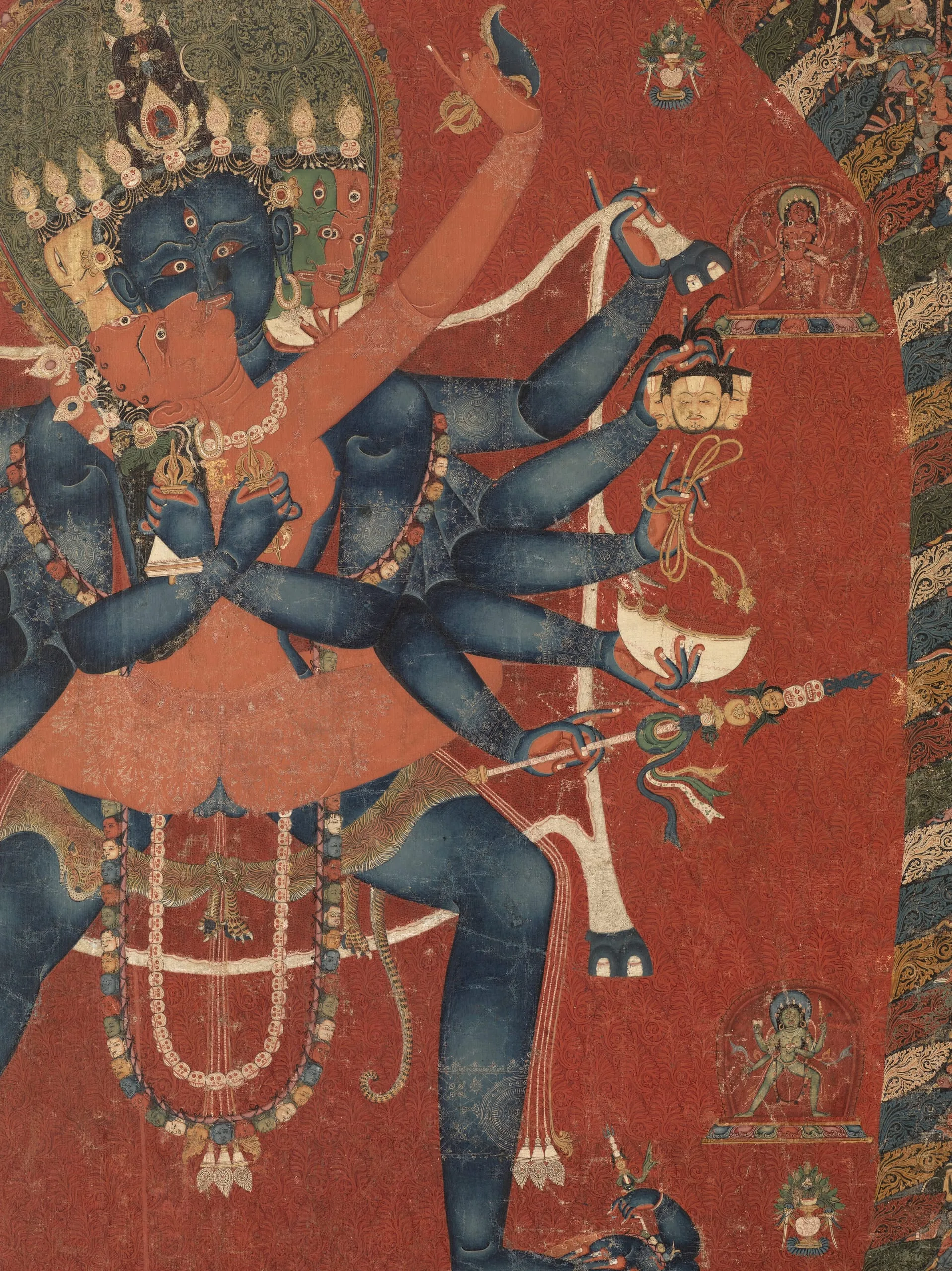
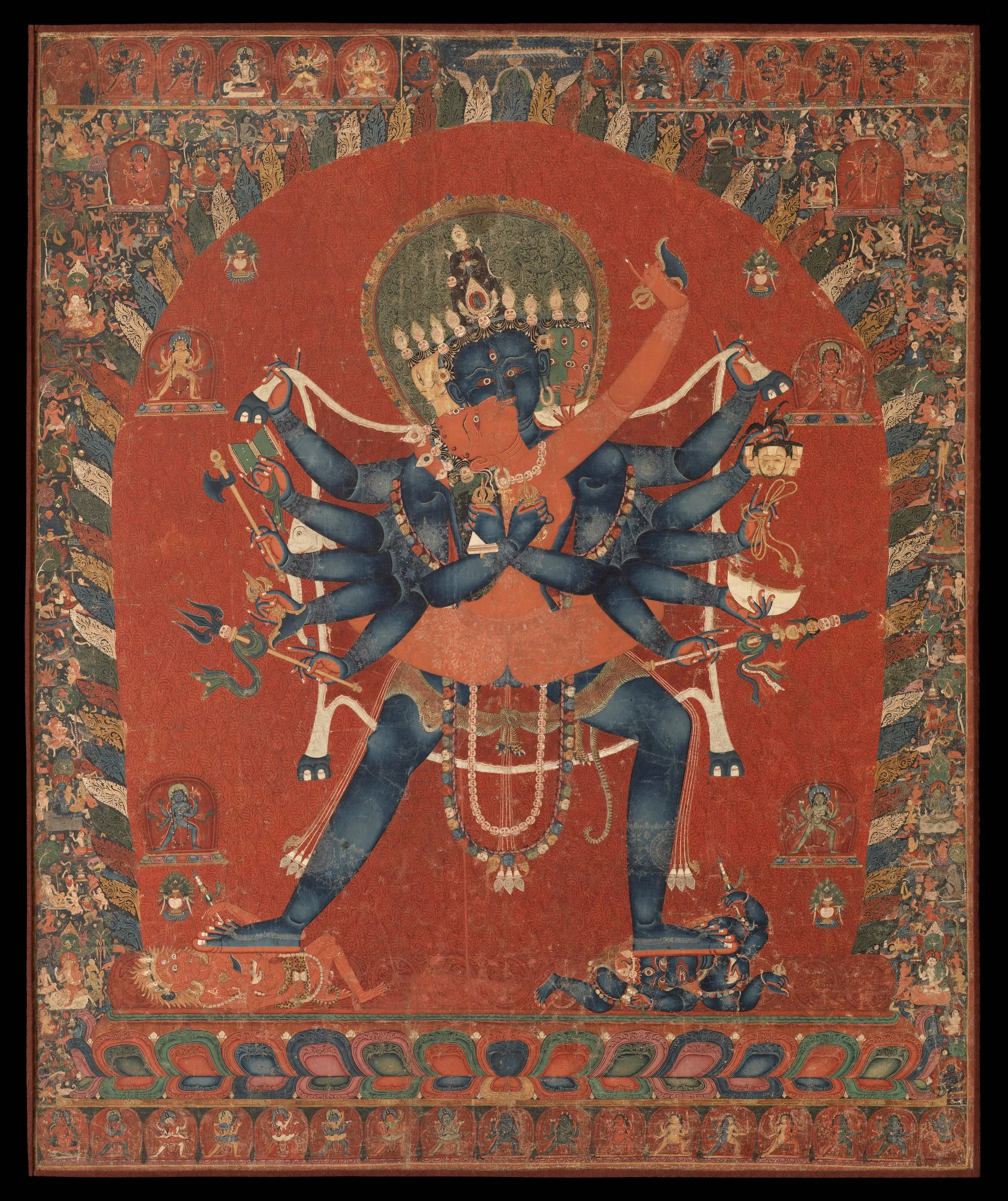
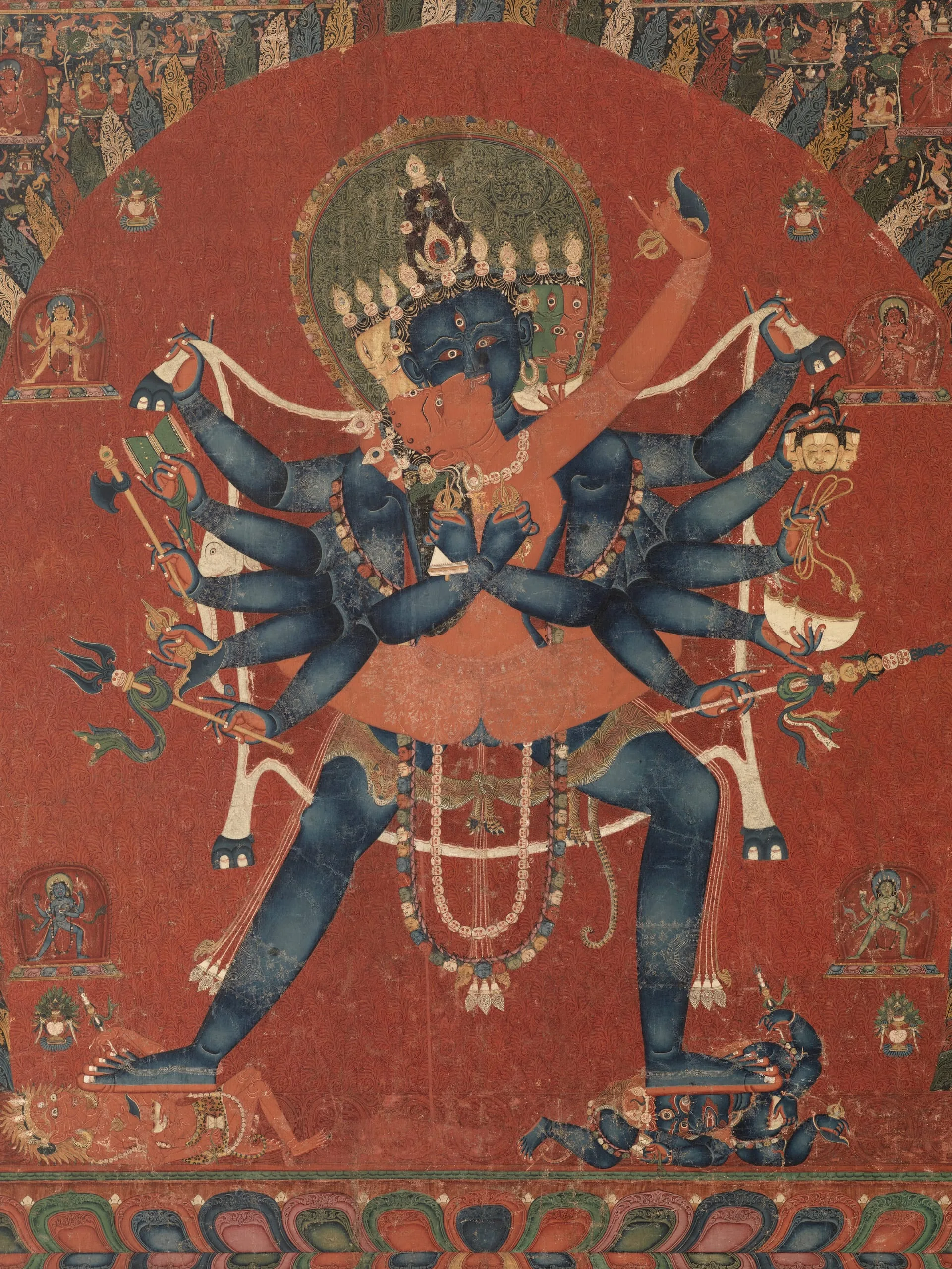
The Buddhist Deities Chakrasamvara and Vajravarahicirca 15th century

On view:
Resnick Pavilion, floor 1
Tibetan thangka painting of a multi-armed, multi-headed blue deity standing in a wide stance against a vermillion arch, holding ritual objects, surrounded by rows of smaller figures in a dense decorative border
Tibetan thangka depicting a multi-armed, blue-skinned deity in dynamic dancing posture against a red background, with a golden halo, crown of skulls, jeweled ornaments, and multiple attributes held in outstretched arms; smaller deity figures line the borders.
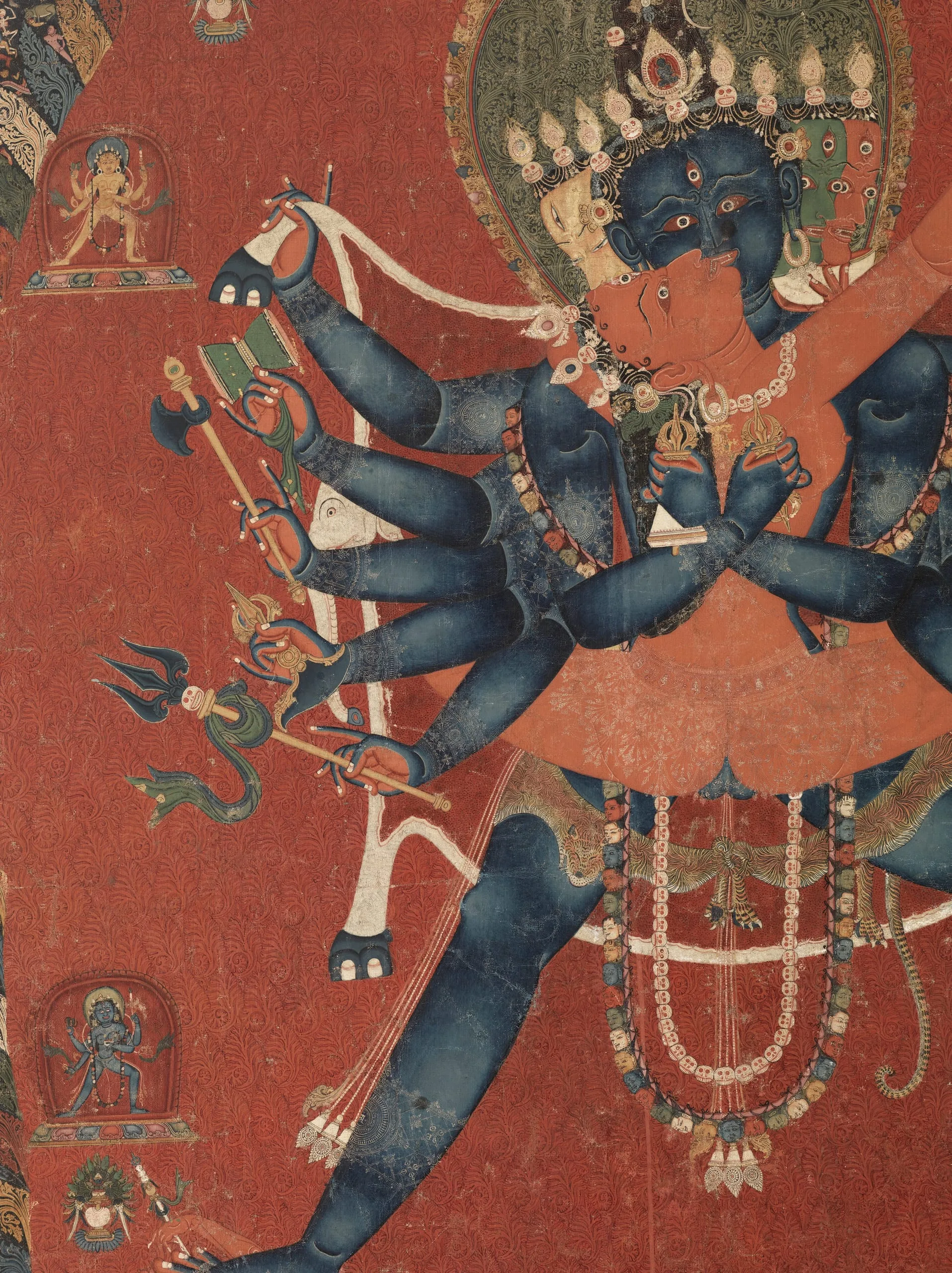
Tibetan thangka detail, multi-armed blue deity in dynamic dancing posture against deep red background, holding ritual implements including a curved blade and severed head, adorned with bone and bead ornaments; smaller deity figures appear in upper and lower right corners
Himalayan thangka painting on red ground depicting a multi-armed, multi-headed blue deity in yab-yum embrace, adorned with jeweled crown, bone ornaments, and garlands, holding ritual implements; smaller deity figures in the margins.
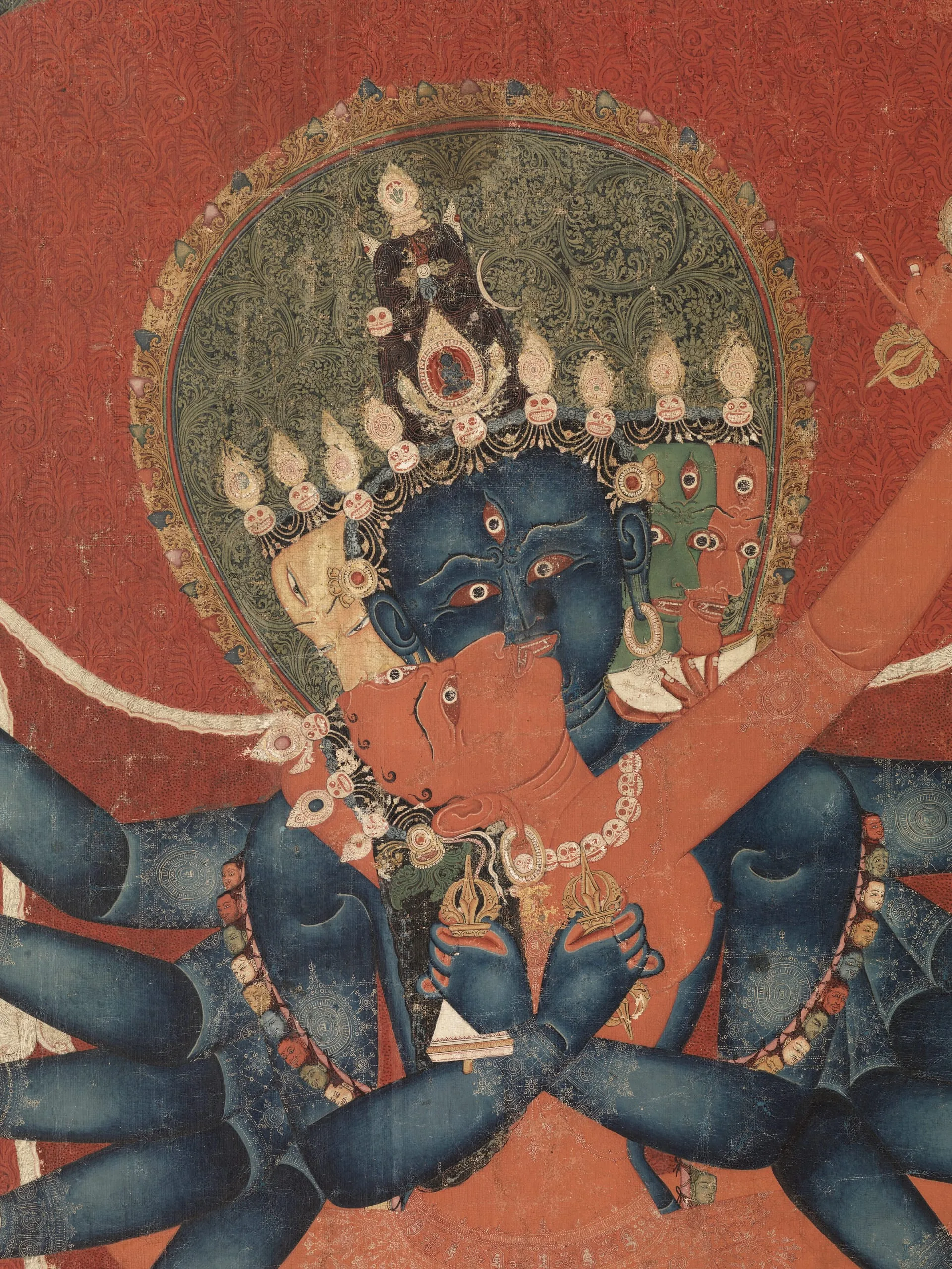
Himalayan thangka painting, multi-headed and multi-armed deity with deep blue skin against a red ground, wearing a crown of skull ornaments and jeweled necklaces, with a green foliate halo edged in gold; multiple faces in yellow, green, and blue tones, hands holding ritual objects including a vajra and flame
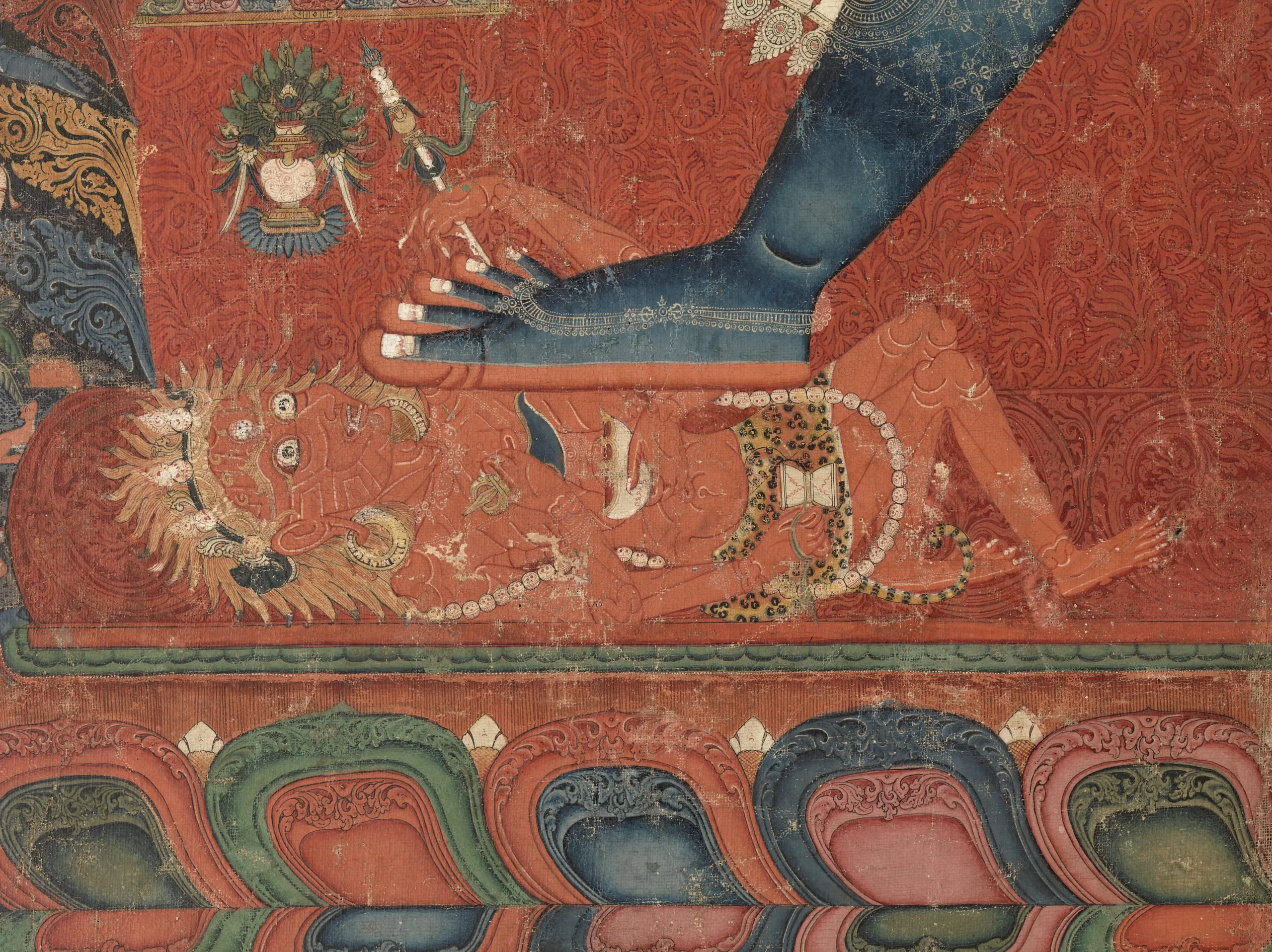
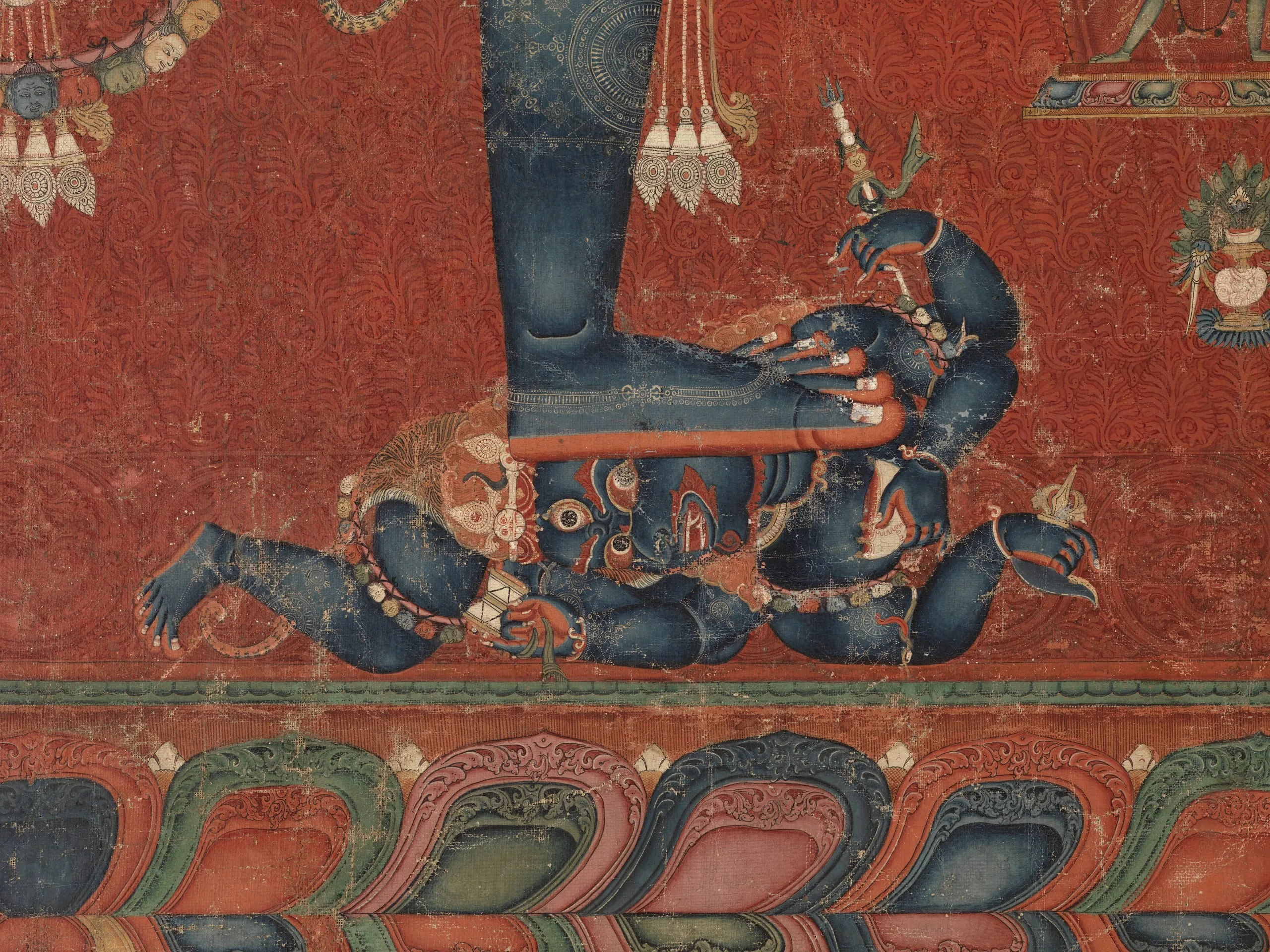
Detail of a Tibetan thangka painting, deep red ground with dense scrolling floral patterns. A dark blue figure's foot and lower leg press down on a prostrate orange-red figure wearing a spotted animal skin, with a lion-headed form at left. A decorative vessel with foliage appears at upper left. Lower border features a row of stylized lotus petals in red, green, and blue.
Detail of a Tibetan thangka painting; a dark blue wrathful deity with multiple limbs reclines beneath the legs of a standing figure on a deep red ground with scrolling floral patterns; lotus petal border in red, green, and blue at bottom; fine mineral pigments with crisp outlines.
Artist or Maker
Unknown
Title
The Buddhist Deities Chakrasamvara and Vajravarahi
Place Made
Tibet (by a Newar artist)
Date Made
circa 15th century
Medium
Mineral pigments and traces of gold on cotton cloth
Dimensions
54 x 45 in. (137.16 x 114.3 cm)
Credit Line
From the Nasli and Alice Heeramaneck Collection, Museum Associates Purchase
Accession Number
M.70.1.3
Classification
Paintings
Collecting Area
South and Southeast Asian Art
Curatorial Notes

In this finely preserved and exquisitely rendered paubha (Nepalese painting), the central blue figure of Chakrasamvara (The Union of the Wheel of the Elements) symbolizing the blissful state of perfect wisdom) stands in passionate embrace with his red-bodied consort Vajravarahi (The Diamond Sow). They are surrounded by a fiery red aureole, with numerous cremation grounds and the deities who preside over them depicted in the background. The upper and lower registers represent other forms of Chakrasamvara and Vajravarahi, along with numerous other deities.

Vajrayana (adamantine or diamond) Buddhism differs from the two earlier forms of Buddhism, Theravada (The Doctrine of the Elders) and Mahayana (The Great Vehicle), through its use of incantation and ritual as the primary tools to achieve enlightenment. In addition, through their use, the practitioner can gain power over beings in other spheres of existence, either by dominating them, so that they will do ones will, or by identifying oneself with them, so that one may enjoy their higher states of existence. Paintings such as this are meant to be the objects of intense introspective meditation on oneself and the nature of the universe as one identifies oneself with Chakrasamvara.

Tantric or esoteric Buddhist art is symbolic, with each symbol taking on new meaning when it is interpreted to the practitioner. On a conceptual level this dramatic image of Chakrasamvara and his spouse, Vajravarahi symbolizes the union of Wisdom and Means. The four faces of Chakrasamvara and their four colors symbolize the four elements (earth, water, fire and air). The three eyes on each face indicate that he sees each of the three worlds (earth, heaven and hell) and that he is aware of the three times (past, present and future). To symbolize the great compassion which has caused him to remain in this world and assist living beings, with his right foot he tramples the red figure of the Night of Time symbolizing the extremes of nirvana (final extinction) and with his right foot he tramples on the figure of Bhairava who represents samsara (the illusion of this world). The garland of 50 severed heads represents the purity of the 50 consonants and vowels of the Sanskrit alphabet. As the Chakrasamvara Tantra states: "Thus he is flamboyant, heroic, unlovely, wild, fearful, terrible, compassionate, dignified and serene. Such are the nine modes of his dance."
Selected Bibliography
  • Little, Stephen, and Tushara Bindu Gude. Realms of the Dharma: Buddhist Art across Asia. Los Angeles: Los Angeles County Museum of Art, 2025.