- Title
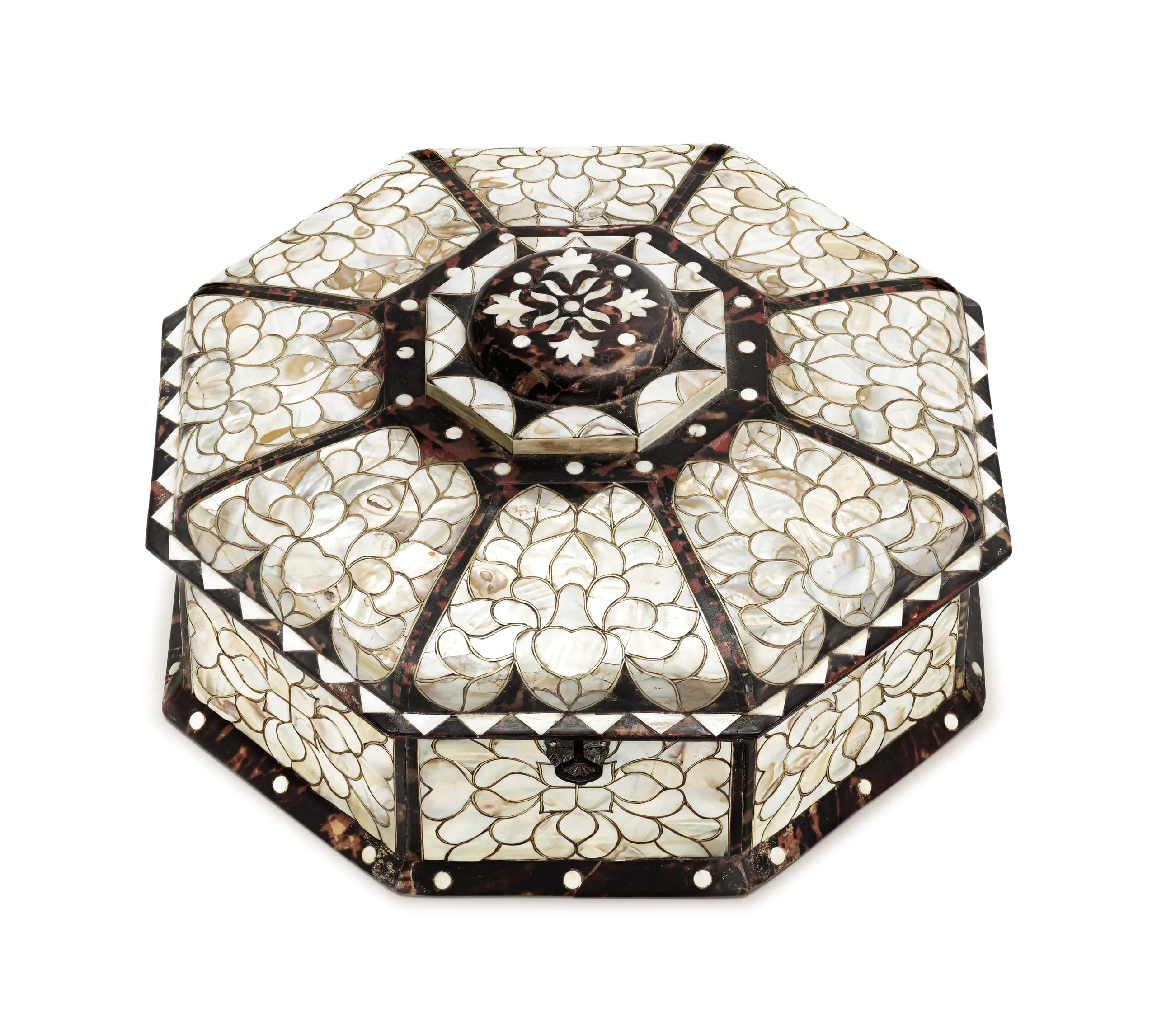
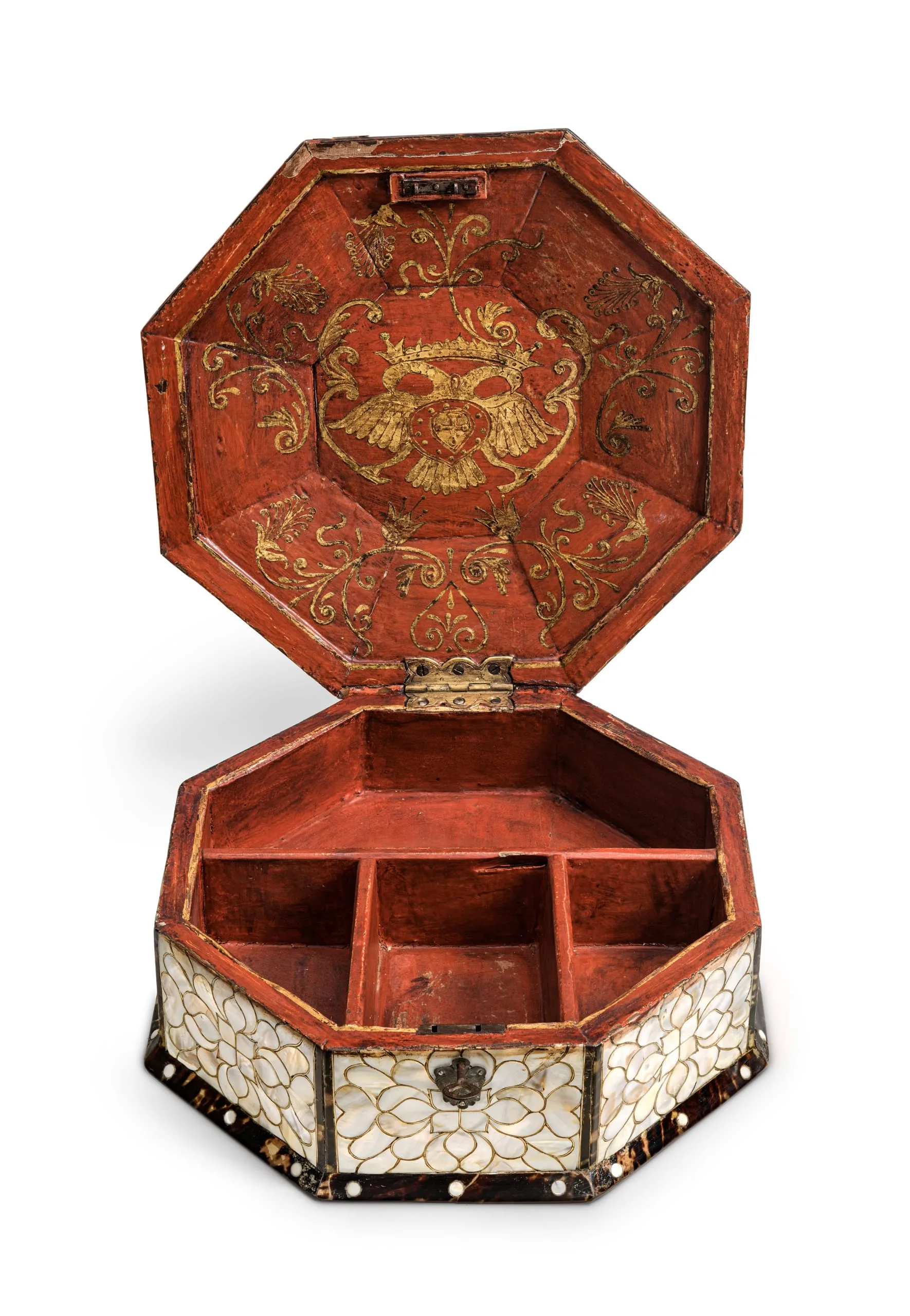
- Sewing or Jewelry Box (Costurero o joyero)
- Date Made
- last third of the 18th century
- Medium
- Wood, inlaid with mother-of pearl and tortoiseshell, brass, silver, and paint
- Dimensions
- Diameter: 15 3/4 in. (40 cm)
- Accession Number
- M.2022.5
- Curatorial Notes
A mesmerizing pattern of hearts and leaves in shimmering, opalescent shell fragments covers all surfaces of this octagonal sewing box. The interior, which is decorated with imitation lacquer evocative of Chinese aesthetics, is dominated by a gilded, crowned, double-headed eagle, a symbol of the Spanish monarchy, and also of the Augustinian order. The surrounding floral motifs include tulips, which originated in the Turkish mountainsides and were collected in courtly gardens of sultans. These flowers became an object of enduring fascination (and a source of big business) in Europe from the mid-sixteenth century onward. Employed as an ornamental element across a range of media, the prized bloom was also a marker of fashion and a symbol of wealth.
Because of their materials and their designs that vaguely resemble Asian decorative arts, these works have been difficult to categorize. Scholars have suggested that they were imported aboard the famous Spanish trading ships—known as the Manila Galleons—that traveled annually between the Philippines and Mexico. But archival and material documentation suggests that such works originated in Guatemala, where mother-of-pearl and tortoiseshell were harvested locally and considered prized commodities. Many items made of these materials were exported to Mexico and Peru. The designs draw on a range of European and Asian sources, which local artists creatively reinterpreted.
Ilona Katzew
2024
- Provenance
Collection of Jean-Pierre Carrière, Paris; by inheritance to his sister Denise Carrière, Paris, 2019; Galerie Terrades, Paris, 2021; LACMA, 2022.
- Selected Bibliography
- Katzew, Ilona, ed. Archive of the World: Art and Imagination in Spanish America, 1500–1800: Highlights from LACMA’s Collection. Exh. Cat. Los Angeles: Los Angeles County Museum of Art; New York: DelMonico Books/D.A.P., 2022.
Ilona Katzew, “Special Things: Boxes in Spanish America,” Unframed, July 20, 2022, https://unframed.lacma.org/2022/07/20/special-things-boxes-spanish-america.
- Selected Exhibition History
- Archive of the World: Art and Imagination in Spanish America, 1500–1800. October 20, 2023 - January 28, 2024
- Archive of the World: Art and Imagination in Spanish America, 1500–1800. June 12, 2022 - October 30, 2022
- Archive of the World: Art and Imagination in Spanish America, 1500–1800. June 22, 2024 - September 08, 2024