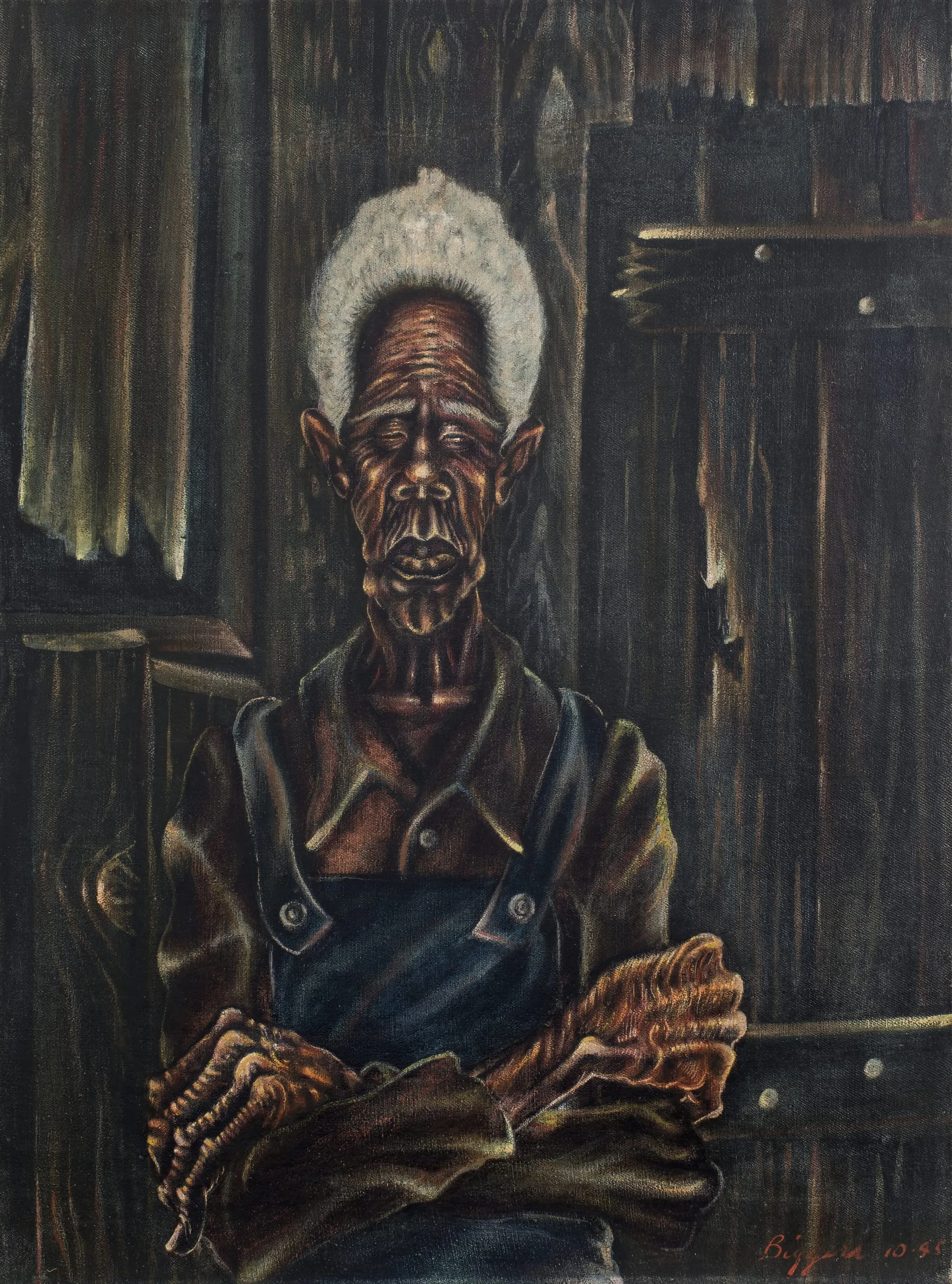
Sharecropper epitomizes John Biggers’ expressive social realist paintings depicting Black life in the American South. Painted during Biggers’ sophomore year at Hampton Institute (now Hampton University), where he was studying and working alongside Elizabeth Catlett, Charles White, and Hale Woodruff, the work reveals Biggers’ knowledge of European modernism, enhanced by his Viennese emigré professor Victor Lowenfeld’s instruction.
Here Biggers focuses on sharecropping, a farming system that emerged in the South after the Civil War and lasted until the 1940s,. Under the system formerly enslaved African Americans and their descendants worked fields belonging to primarily white landowners, preventing them from acquiring capital and and land of their own. The solitary sharecropper conveys both exhaustion and strength: although his faced is lined and his hands gnarled, his posture is erect and he appears almost saint-like, with closed eyes and white hair framing his head like a halo. The somber palette and contrast between wood, hair, skin, and clothing all contribute to the subdued mood of the painting. The splintered wood backdrop represents a shotgun house, a recurring motif that Biggers used in his work.
Sharecropper is closely related to his panoramic mural Sharecroppers (1946-7), which depicts a large family of eight, recalling the artist’s own family growing up in segregated Gastonia, North Carolina. By contrast, Sharecropper focuses on a solitary figure, the central figure in the mural. Together with the mural, they mark the beginning of Biggers’ resolve to use art for a greater social cause, highlighting conditions of racial and economic injustice, and demonstrate Biggers’ attention to the populations affected and neglected by the economic conditions of the war-stricken United States. He would create twenty-six murals and numerous paintings and works on paper; many drew inspiration from African art and culture, his own family, the injustices of a segregated United States, and the dignity of everyday survival.