LACMA

ShopMembershipMyLACMATickets
LACMA
Los Angeles County Museum of Art
5905 Wilshire Blvd.
Los Angeles, CA 90036
info@lacma.org
(323) 857-6000
Sign up to receive emails
Subscribe
© Museum Associates 2025

Museum Hours

Monday

11 am–6 pm

Tuesday

11 am–6 pm

Wednesday

Closed

Thursday

11 am–6 pm

Friday

11 am–8 pm

Saturday

10 am–7 pm

Sunday

10 am–7 pm


  • About LACMA
  • Jobs
  • Building LACMA
  • Host An Event
  • Unframed
  • Press
  • FAQs
  • Log in to MyLACMA
  • Privacy Policy
© Museum Associates 2025
Collections

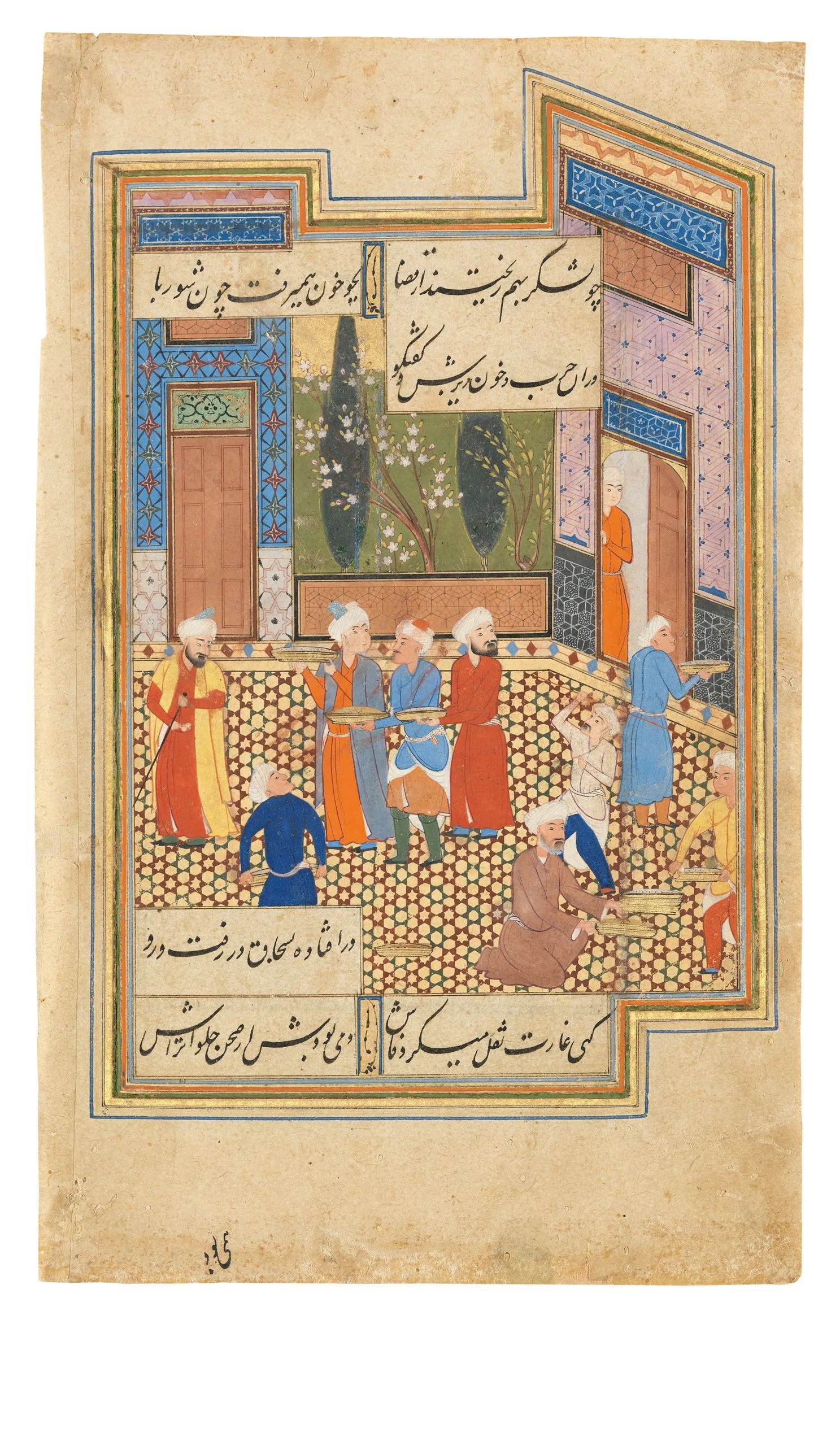
Preparations for a Feast: Folio from a Manuscript of the Kulliyat of Bushaq At‘imacirca 1570

Not on view
Illustrated Persian manuscript page with miniature painting of robed and turbaned male figures gathered in a tiled courtyard before decorated architecture, surrounded by Persian script in black ink
Title
Preparations for a Feast: Folio from a Manuscript of the Kulliyat of Bushaq At‘ima
Date Made
circa 1570
Medium
Ink, opaque watercolor, and gold on paper
Dimensions
9 3/4 × 6 in. (24.8 × 15.24 cm) Image: 8 1/4 × 5 1/2 in. (20.96 × 13.97 cm)
Credit Line
Purchased with funds provided by Mehrdad and Sholeh Amanat and Catherine Benkaim and Barbara Timmer
Accession Number
M.2021.94
Classification
Manuscripts
Collecting Area
Art of the Middle East: Islamic
Curatorial Notes

Abu Ishaq Shirazi, called Bushaq At‘ima (d. 1423 or 1427), is best known for his poetic work Diwan-i at‘ima (Book of Edibles), also surviving as the Kulliyat-i bushaq, which is entirely dedicated to food. More than a collection of food poetry, the Persian text gives the names of dishes, their ingredients, and even the festive occasions for serving them. Bushaq’s work includes parodies of classic poets such as Sa‘di, Hafiz, and Firdawsi in which he substitutes culinary terminology while preserving the original meter and rhyme.


Attesting to the widespread popularity and longevity of Bushaq’s food poetry, this late 16th-century painting is a detached folio from an otherwise unknown illustrated version of his collected works. It does not reflect the accompanying text but rather suggests the outcome of putting the verse into practice by preparing a meal. The figure in white, wearing an apron and wielding a red stick to hurry along the servers, is probably the bavarchi (chef), while the figure in the yellow robe is likely the sufrachi, or table steward.

Selected Bibliography
  • Komaroff, Linda, editor. Dining with the Sultan: The Fine Art of Feasting. Los Angeles: Los Angeles County Museum of Art; New York: DelMonico Books, 2023.