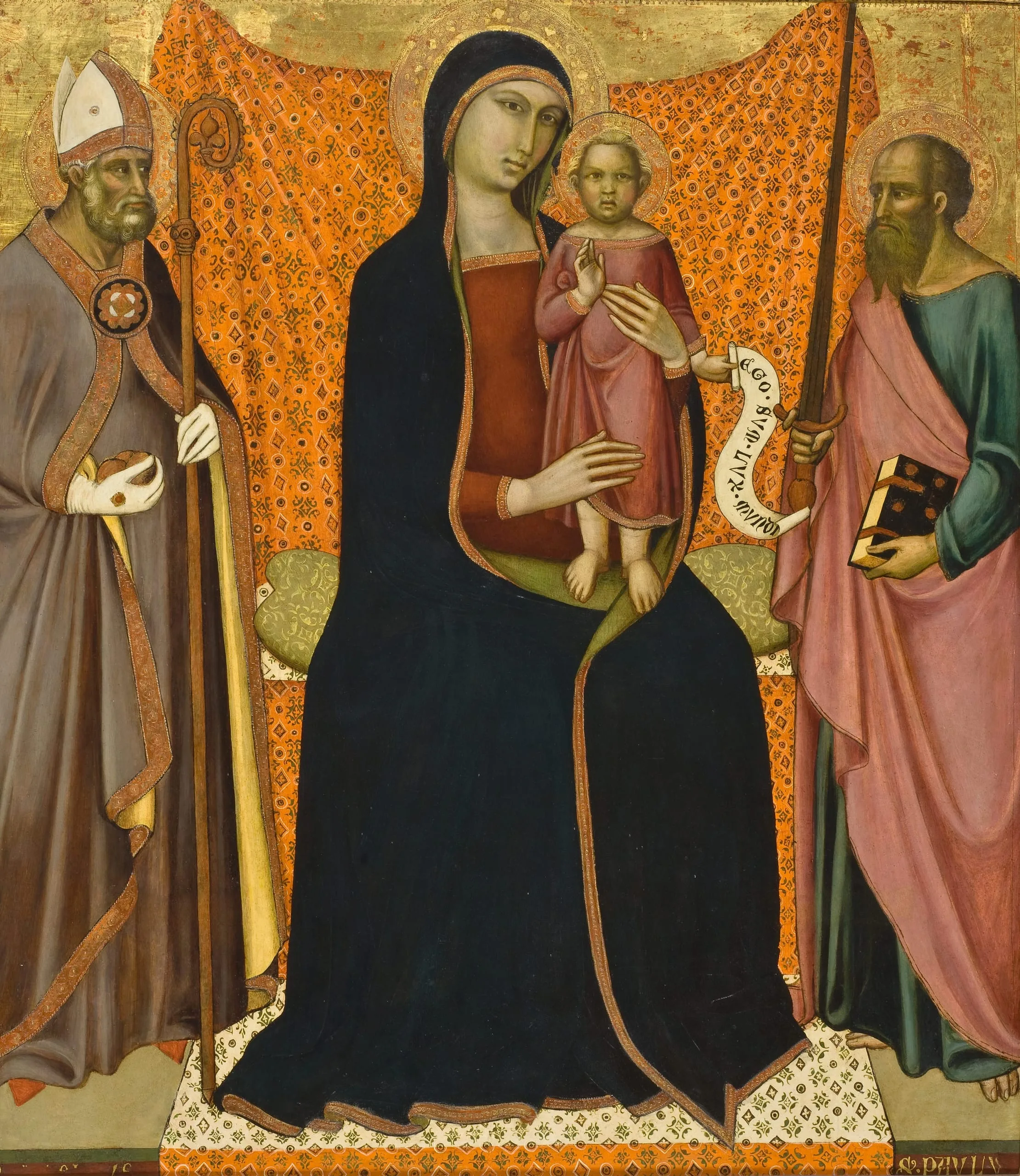
Copious amounts of gold leaf adorn Luca di Tommè’s impressive altarpiece. At the center are the Madonna and Christ Child, the latter holding an unfurled scroll inscribed with the Latin words for “I am the Light of the World.” Saint Nicholas stands at left, identifiable by his bishop’s miter and cope, and Saint Paul at right, carrying a sword and his epistles. The four figures are surrounded by intricate patterns of meticulously worked or punched gold to enhance the altarpiece’s opulence. An orange-hued brocade composed of elaborate floral and geometric motifs drapes the Virgin’s throne and cascades to the floor. It was likely modeled after silk twill produced in the territories of the Mongol Empire that found its way to Europe through nautical and land trade routes from Central Asia.
Beneath the grandeur of the altarpiece, however, lies a history of complex economic, social, and political turmoil that significantly shaped Sienese society during the artist’s lifetime. In the late fourteenth century, wars between the Italian city-states caused a severe economic depression, during which numerous Sienese banking houses and workshops collapsed. The city was further devastated by bubonic plague in 1348, reducing the population by two-thirds. Subsequent epidemics ravaged the region, instilling fear among the populace. These catastrophic events led people to attribute their suffering to divine displeasure, prompting collective prayers and public displays of repentance in an attempt to appease God. The city venerated the Virgin as its special protector. It is within this context that Luca executed the Madonna and Child—with the great reverence, piety, and contrition shared among Sienese citizens.
2024