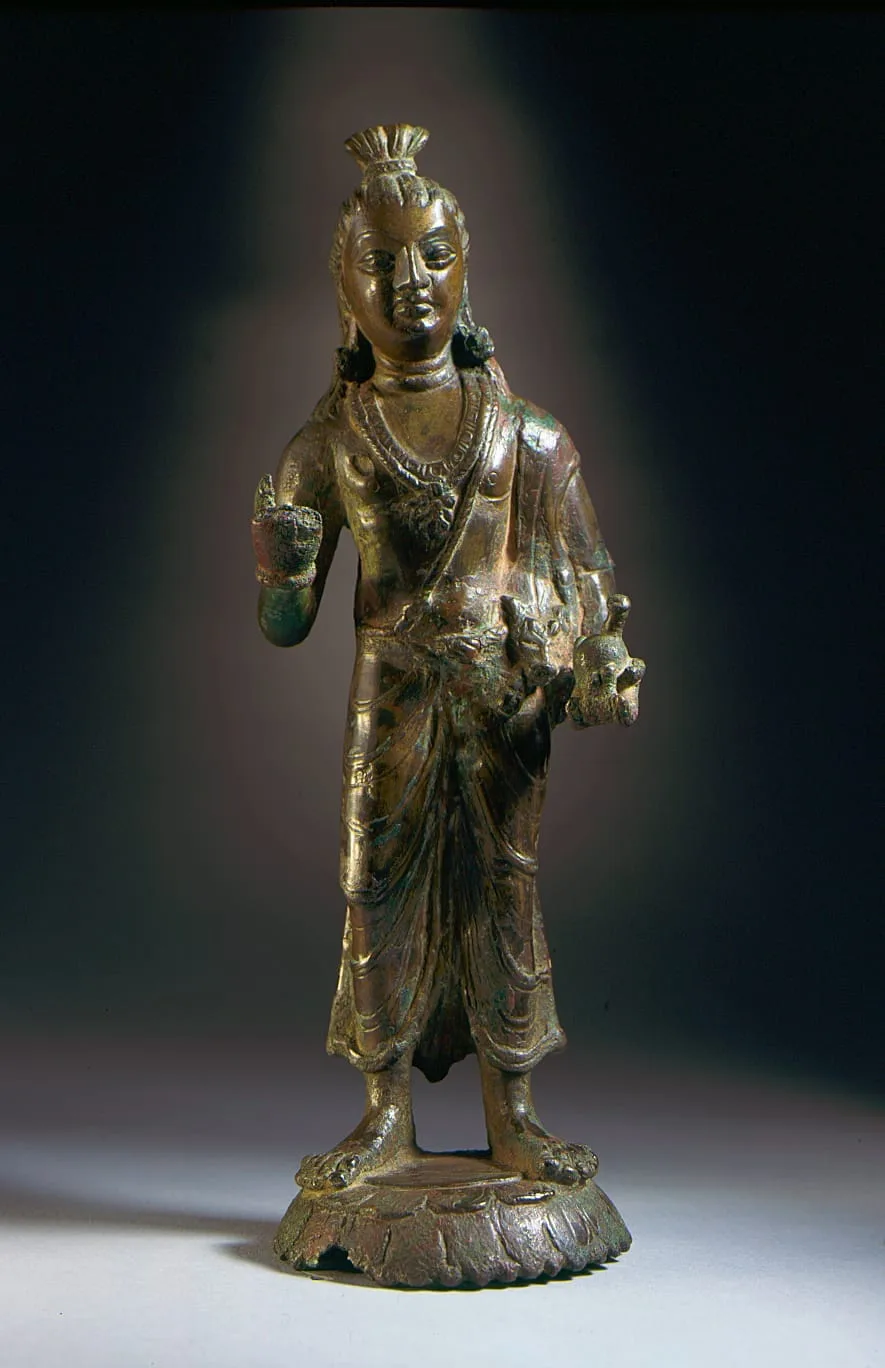
- Title
- The Bodhisattva Avalokiteshvara (Lokanatha)
- Date Made
- circa 4th-5th century
- Medium
- Copper alloy
- Dimensions
- 10 1/2 x 3 1/2 x 3 1/4 in. (26.67 x 8.89 x 7.62 cm)
- Accession Number
- M.69.15.2
- Curatorial Notes
Avalokiteshvara (Lord who gazes down [with compassion]), also known as Lokanatha (Lord of the World), is one of the earliest and most important Bodhisattvas (one whose essence is perfect knowledge) who postpone their own Enlightenment to assist all sentient beings in their own spiritual quest. Avalokiteshvara was first introduced in the Lotus Sutra, or Saddharma Pundarika Sutram (Sutra on the White Lotus of the True Dharma). Probably compiled in India during the 1st century CE, it is the principal Mahayana scripture and was particularly significant in China and Japan.
Avalokiteshvara is depicted here in the guise of an Indian ascetic. He has a topknot and is clad in only a dhoti. He wears sparse jewelry, including the Brahmanical sacred thread (yajnopavita) worn over his left shoulder and across his chest. He also has an antelope skin, symbolic of his ascetic nature, draped over his left shoulder with its head visible near his waist. Avalokiteshvara carries an ascetic’s waterpot in his left hand. His right hand (now damaged) is held in the gesture of reassurance (abhaya mudra). He stands on a lotus base.
This is the earliest known example of Avalokiteshvara represented as the Brahminic archetype associated with princely asceticism, spiritual purity, and the selfless renunciation of the Bodhisattva ideal.
- Selected Bibliography
- Dohanian, D.K. The Art of India. Rochester, NY: Memorial Art Gallery of the University of Rochester, University Publications, 1961.
- Rosenfield, John. The Arts of India and Nepal: The Nasli and Alice Heeramaneck Collection. Boston: Museum of Fine Arts, Boston, 1966.
- Reedy, Chandra L. Himalayan Bronzes: Technology, Style and Choices. Newark: University of Delaware Press, 1997.
- Huntington, John C. and Dina Bangdel. The Circle of Bliss: Buddhist Meditational Art. Columbus: The Columbus Museum of Art; Chicago: Serindia Publications, 2003.
- Pal, Pratapaditya. Indian Sculpture, vol.1. Los Angeles: Los Angeles County Museum of Art; University of California Press, 1986.
- Little, Stephen, and Tushara Bindu Gude. Realms of the Dharma: Buddhist Art across Asia. Los Angeles: Los Angeles County Museum of Art, 2025.